Sunday, 1 May 2016

Seoul's Lotus Lantern Parade: Where To Pick A Spot?


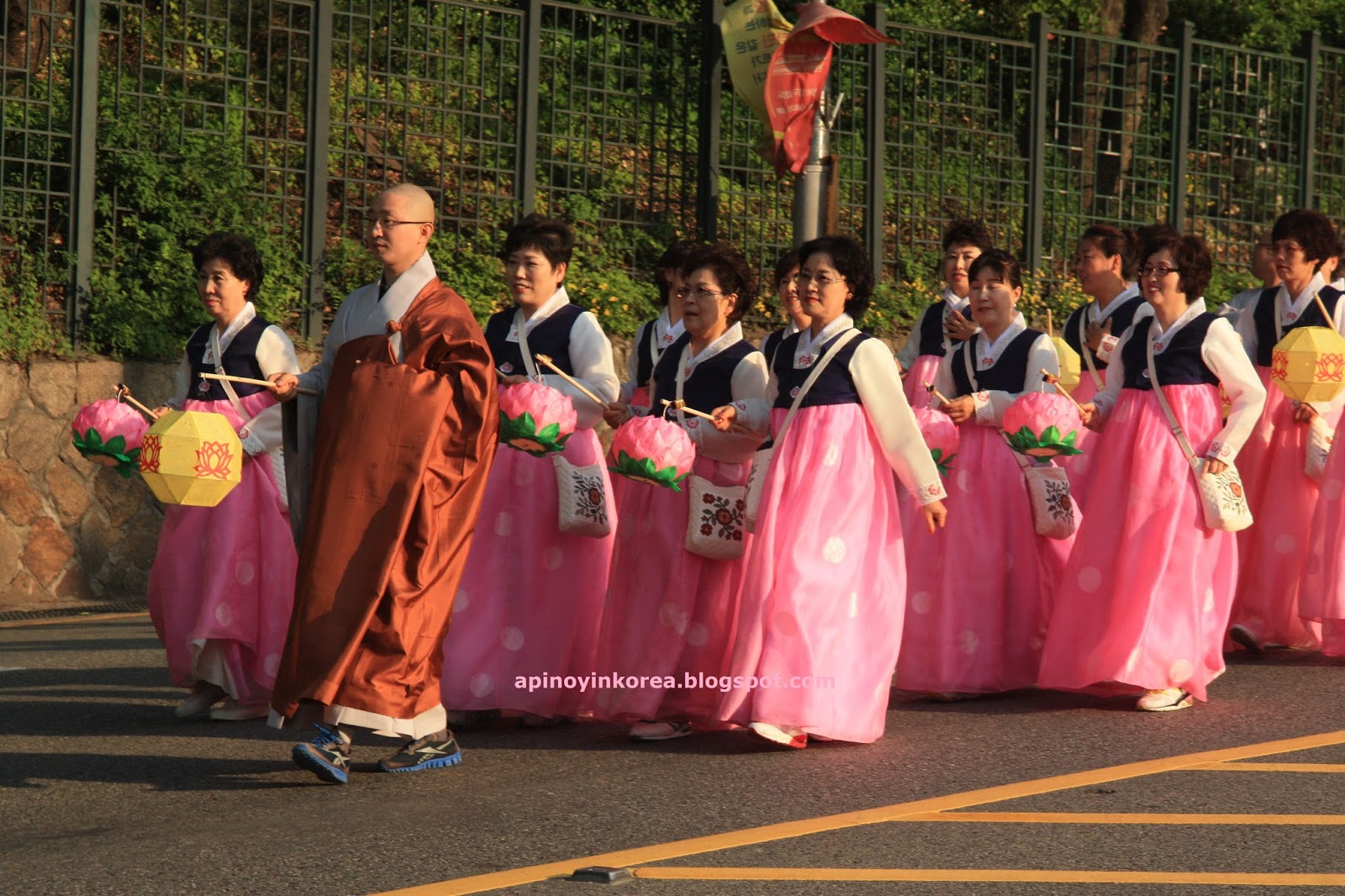
It's Buddha's birthday soon, and thousands are expected to line up along the main Jongno street again to watch the most colorful and most popular parade in Seoul! The lotus lantern parade!

On a few occasions, I was able to watch the parade along the main Jongno street, joining the thousands who stood there for hours as the participants in their colorful costumes and lanterns paraded and fascinated everyone on one cool spring evening.


A couple of years ago, I excused myself from the tennis session that Saturday afternoon and headed down to Dongkuk University where the participants danced and cheered before the actual parade.

It was a sight to behold at the Dongkuk University grounds. It was a sea of colors. The cheerfulness of everyone and those neon and pastel colors of their intricately looking and diaphanous costumes made the atmosphere and experience special. Everyone really put an effort to impress and regale that day. 


Maybe this time, I will try and claim a spot along the main Jongno street and watch the parade from there.
But I should be early as I am sure thousands of other spectators have the same idea as mine.


The parade will start from the Dongkuk University grounds and follow the route down the Jangchung-dong area, going towards the Dongdaemun Design Plaza and will turn left at the main Jongno Street. By the time it reaches the main Jongno Street, the darkness will have fallen and the brightness and colors of the lanterns will have captured and enamoured everyone. The parade ends up at the Jogyesa Temple after it turns right at the Jonggak Tower.

But if you want to watch the Eoulim Madang, or the cheering and dance performances, at the Dongkuk University grounds before the parade, you can just take the subway and head to Dongkuk University Station (Line 3) and follow the crowds as you get out of Exit 6. You should be there at 4PM.


I remember last year, I treated myself to a bowl of yummy patpingsu at Taekgukdang bakery right next to Exit 2 of the Dongkuk University Station after the parade. Taegukdang is a very old bakery dating back to 1946, and it has been a favorite of mine. 

But since I plan to be at the crowded Jongno street this time, I wonder if I could find a patpingsu place after. If not, then maybe something from the Gwangjang Market will do.

So, if you're watching the parade next weekend, too, have fun! And make sure you have your powerbank for your smartphone! Because you will be taking a lot of photos!

These photos were from taken as the parade was just taking off from Dongkuk University.

Enjoy the lotus lantern festival and parade, everyone!


Here's the link to the official lotus lantern parade schedule. In the link, you'll find the route of the parade and you can decide which spot to watch it from.

http://www.llf.or.kr/eng/


           (My patpingsu at Taegukdang bakery 
                         after the parade.)

Wednesday, 27 April 2016

Election 2016: Bakit ko Binoto si MAR ROXAS at LENI ROBREDO

Kagagaling ko lang kanina sa Philippine embassy dito sa Seoul, South Korea, para bumuto sa Overseas Absentee Voting para sa 2016 national elections.

Para sa akin, madali lang ang pagpili kung sino ang iboboto ko. Alam na natin ang mga katiwalian at naglabasan na rin ang mga totoong kulay at pagkatao ng mga tumatakbong presidente at bise-presidente ng Pilipinas. 

Alam na natin ang history ng katiwalian ni Binay. Ang buong pamilya niya yata ay ginawang negosyo ang kaban ng bayan. 
Wala rin akong tiwala kay Grace Poe. Kung ipinagpalit niya ang pagiging Pilipino para maging American citizen, puede niyang ipagpalit ang Pilipinas uli.  

Si Duterte naman ay isang loose cannon. Sa kanyang 'rape comments' at sa gusto niyang pagputol ng diplomatic relations sa US at Australia, tila yatang hindi niya alam na kailangan ng Pilipinas ang mga allies at alliances. At nahihirapan akong paniwalaan ang kanyang mga pangako. Tila yata lahat nang sinasabi niya ay kung ano ang gustong marinig ng mga tao. Hindi ako kumbinsido.

Si Miriam naman ay may sakit. Kaya 'get well soon' na lang sa kanya.

At sa lahat sa kanila, inilalagay ko ang tiwala ko kay Mar Roxas at Leni Robredo. Kung ikaw ay OFW or nakatira sa ibang bansa, ipagtitiwala mo ba ang bayan mo sa isang kawatan, isang sira-ulo, o sa isang americanang walang eksperiyensiya?

      (Philippine Embassy in Seoul, South Korea)

May tiwala ako kay Mar at Leni na maipagpatuloy nila ang pag-unlad ng Pilipinas. Alam ko na marami pang dapat gawin para lumago ang ekonomiya ng bansa at masupil ang korapsyon sa gobyerno. 

May tiwala ako na sa presidency ni Mar Roxas, mananatiling mataas ang confidence ng mga international investors sa Pilipinas, at lalong maipagpatibay ang 'peace and order' sa bansa.

Kaya habang nasa malayong lugar ako, ipinagtitiwala ko ang bayan kay Mar Roxas at Leni Robredo.

Sana kayo rin.

Sunday, 17 April 2016

Jean's Korea Stopover: Touring Seoul Like A Local!

Three years ago, when my my kumare Maria had a stopover at Incheon International Airport for a few hours before her flight to London, I was able to tour her around Seoul in record time! 
      (Seoul Station is the premiere train 
                   station in Korea)

This time, Jean, another friend who lives in California, was flying back to the US and had a few hours of stopover at Incheon International Airport. So, it's another day to tour Seoul again! In record time!

Over the years, people have asked me if they would be able to sneak out of the Incheon International Airport and roam Seoul during their layover. My suggestion has always been to join the free transit tours offered at the Airport because these transit tours have a bus and a strict timetable to stick to, allowing passengers to make it back to the airport for their connecting flight.

But the disadvantage of these tours is that they only visit a few tourist spots and stay close to one area. 

I, however, always have other ideas for my tourist friends passing through Incheon Airport. And that is to run around Seoul on a marathon tour, while riding the local transport system like a local! Those transit tours can't beat that!

And so, when Jean flew in at Incheon Airport and had a few hours to spare, he simply took the Airport Railroad Express (AREX) train from the airport to Seoul Station! And from there, we ran around Seoul during that cool, spring April day just in time when the cherry blossoms were proudly blooming. 

I took notes of our tour route and timetable so I could share it here for everyone to try out in case they also have a few hours' layover at Incheon International Airport.

Here it is:

STOP 1 @ 9AM: Seoul Station - arrival, quick coffee and breakfast

Taking the Airport Railroad Express (AREX) train to Seoul, Jean arrived at Seoul Station for a quick breakfast! There are cafes and donuts shops inside the Seoul Station, and we just grabbed a quick breakfast.

Transport: Leave the main Seoul Station building and head down to Subway Line 1 to go to City Hall Station, the next stop. 
Or you can take either of these Blue Bus Numbers: 506, 150, 501 at the Seoul Station Bus Transfer Hub going to the Seoul Plaza. Make sure when you take the bus, the direction is towards the left if you're facing out of the Seoul Station.
             (By the Cheonggye Stream)

STOPS 2,3: 9:40am @ Seoul Plaza and Cheonggye Stream

From Exit 5 of City Hall Station, we roamed around Seoul Plaza and headed down to the Cheonggye Stream for more photos.

              (Greeting Admiral Yi)

STOPS 4,5: 10:10am @ Gwanghwamun Square and Gyeongbuk Palace

Seoul Plaza, the Cheonggye Stream, Gwanghwamun Square and Gyeongbuk Palace are a few hundred meters to each other. For this stop, we were able to see these tourist spots within walking distance.

At Gwanghwamun Square, the statues of   Admiral Yi Sun-Sin and and King Sejong are the most popular photo stops.
         (Courtesy call to King Sejong)

And by walking the entire length of Gwanghwamun Square, we ended up at the front entrance of Gyeongbuk Palace. We just crossed the street after!

We didn't buy any entrance tickets as we didn't need to enter the main palace. Jean just posed in front of the palace! And that was it! He already stepped into South Korea's premiere royal palace within an hour of his first breakfast in Korea! Ha-ha-ha! 
      (A royal visitor at the royal palace)

And from Gyeongbuk Palace, we walked towards the bus stop in front of the Sejong Arts Center and waited for the Blue Bus 402 which would take us to Nam-san (Mt. Nam) for the cherry blossom road!


STOP 6: 11:10am @ Namsan's cherry blossom road near Namsan Park

The cherry blossom lane was just across the bus stop, and we didn't need to trek up Nam-san towards the Seoul Tower; we could see it from where we were. We just roamed around the park and joined other international and local tourists admiring the blossoms that cool spring morning!
                (Cherry blossom lane)

From the Yongsan Library Bus Stop, we simply took Blue Bus 402 (or 405) going down to our next stop, Namdaemun Market. 

STOP 7: 12noon @ Namdaemun Market 


                     (Market day!)

Since it was lunch time, we stopped by the small binddaeteok restaurant near Gate 2 of Namdaemun Market and went for some hotteok dessert at the most popular sweet hotteok stall in the market!
                    (Korean snacks!)

From Namdaemun Market, we just strolled towards Myeongdong shopping area since it was just about 400 meters away.

STOP 8: 12:40pm @ Myeongdong shopping area and Myeongdong Cathedral
             (Myeongdong Cathedral)

We walked around the busy Myeongdong shopping center and ended up at the other end where the Myeongdong Cathedral is located. 

From there, we walked towards the highway nearest the Cathedral (turning right if you're descending from the Cathedral steps), and waited for Blue Bus 470 (or 471). The direction of the buses should be towards Namsan tunnel. 

The blue bus ran through the tunnel, passed through Yongsan's Hannam-dong (my neighborhood, actually!), crossed the Han River via Hannam Bridge, and brought us to Gangnam Station! We were right in the middle of the priciest commercial real estates in Seoul! 

Yes, Jean crossed the Han River on a Seoul bus through one of the busiest bridges connecting northern and the southern Seoul!

STOP 9: 1:20pm @ Gangnam Station and Psy's Gangnam Style

We headed to Exit 11 of Gangnam Station where, next to it, was Psy's silhouette declaring it's the Gangnam Style spot. There's actually a big button behind this small stage, which plays the pop song when pushed.
             (Psy also welcomed Jean!)

From there, we took the train from Gangnam Station (Green Line 2) towards Sadang Station. At Sadang Station, we transferred to the Line 4 (Blue Line) for a train that would take us back to Seoul Station.

STOP 10: 2:10pm @ Seoul Station

Jean made it back to Seoul Station past 2PM in time for the next express train trip back to Incheon Airport. The express train took less than 45 minutes to reach Incheon Airport, where Jean would wait for his boarding time around 4PM.

By the way, at the Airport Express train terminal, there is a shop where you can leave your handcarry bag for a fee. 

                     *  *  *  *  *

So, there! With free hours during his stopover at Incheon International Airport, Jean was able to run around Seoul, rode the efficient transport system of buses and subways, tried Korean dishes and visited the most popular tourist spots like a local! And even got a Gangnam Style welcome!

And in case you also want to do this transit tour, here are some important reminders:

1. For the Immigration officer to allow you to leave the Incheon Airport, you will need to present the boarding pass for your connecting flight as well as your travel documents like your passport.

2. Get a Seoul map from the tour desk at Incheon Airport and familiarize yourself with the places you want to visit.

3. Take note of your connecting flight's boarding time and the AREX train schedule going back to Incheon Airport.

4. Decide on what time you should be heading back to Seoul Station's AREX terminal and rush back immediately if you think you'll be pressed for time, even if you're not finished with your DIY tour. Always remember, you have a plane to catch!

5. Buy a T-Money transport card and make sure you have enough load for the bus, subway or taxi rides.

6. You will need cash in Korean won when you're buying from small stalls and shops.

7. Have fun on your adventure! We did!

                    *  *  *  *  *

IMPORTANT: Make sure you incorporate in your travel time going back to the airport the following:  train schedule, train ride, x-ray security check at Incheon, Immigration check and walking time towards your boarding gate.

I HIGHLY suggest you should be on the airport express train on the way back to Incheon Airport at least TWO (2) HOURS before your BOARDING TIME to allow an hour for the train ride, and another to get through the long queue at the airport security and Immigration. 


MAKE SURE your watch, or smartphone clock, is synchronized with Korea Time!

Saturday, 9 April 2016

April 9: Remembering Bataan Day

On April 9, 1942, more than 80,000 prisoners of war made up of Filipino and American soldiers of the United States Army Forces in the Far East, or USAFFE, surrendered to the Japanese forces in the province of Bataan, Philippines.

Of that number, there were about 70,000 Filipino and about 12,000 Americans. One of those Filipino soldiers was the brother of my aunt from Iloilo Province. He was just 19 when he was conscripted. My aunt once told me that when she was about 15 when World War II was over, her father sent her to the USAFFE offices to claim benefits entitled to their family. Since she was the one who could speak English in the family, her father sent her. 

Those who surrendered that day in Bataan were made to walk for more than 100 kilometers to San Fernando, Pampanga, in the next province, where they would be loaded to freight trains up to Capas, Tarlac, in another province, and walk further up to Camp O'Donnell, where the so-called Death March ended on April 17, 1942.

It was called the Death March because these prisoners of war walked with no food and water, sick, malnourished and starving. And in the tropical Philippines, April is a very hot month, and walking with torn shoes under the hot sun along mosquito-infested countryside would beat any able-bodied man physically. With no food and water, anyone who could no longer carry on to walk was just killed (perhaps bayoneted) along the way; others were simply left to die by the roadside, including those who probably contracted malaria. 

And today, along with all of you celebrating the spirit and courage of those who served to defend the Philippines during World War II, I pay tribute to their memory and nationalism, and their gift of the ultimate sacrifice.😭

                                *  *  *  *  *

At the National Museum of the Philippines in Manila, I chanced upon these painting by Filipino artists depicted the horrors of World War II:

            'Rape and Massacre' in Ermita by Diosdado M.           Lorenzo shows Japanese soldiers raping and                slaughtering women in a family home 


          An untitled painting by Manuel Rodriguez 
  showing a Japanese soldier about to behead a father, while the mother and child beg for his life

    'Death March' by Dominador Castaneda showing dead Filipino soldiers lying on the road, while other soldiers help each other get through the March


    'A Tragic Lesson (The Fall of Bataan)
   by Gene Cabrera