Thursday, 4 May 2017

Night Boating @ Seoul's Banpo-Hangang Park


Yes, it's probably cool and relaxing to ride those boats near the Floating Island at Banpo Park in Seoul.

Firstly, the changing colors of the man-made Floating Island make it an enchanting background while your boat is making its way around the calm waters of the Han River.


Secondly, whether you're with your family, your friends, or with your current girlfriend or boyfriend, riding a smaller boat and just floating around the vicinity with plans of having dinner or coffee on the Floating Island are a more convenient alternative to riding the bigger boat of the Han River cruise, whose main attraction at night is mainly the Banpo Fountain Bridge.


I once road at the Han River cruise. The ride is actually interesting if you do it during daytime when you can see the apartments on both sides of the Han River, the bridges over the river, and the Floating Island. Though you won't be able to see the colors of the Banpo Fountain Bridge during the day, at least you'll get your money's worth of seeing Seoul's riverscape under the spring sun.

At night, it's just the lights of apartments and the Banpo Fountain Bridge, which I think has lost most of its colors. It used to be really colorful - with fascinating rainbow colors. But over the years, it seemed to have lost most its colors.


That's why it's probably more fun, especially for kids, to get on these small boats and just laze around the calm, quiet waters of the Han River near the Banpo Park. The kids won't get bored as the ride isn't that long. I think they'd probably even want to stay on the boat longer.

So, one of these cool nights, you know where to boat, float and relax! 

Wednesday, 3 May 2017

A Pinoy @ The Movies: LION


Artsy films always have limited viewership and are not that widely marketed. I must have missed watching this film while I was in Seoul during its pre-Oscar season run. Thankfully, I was able to catch it weeks after the Oscars at a local cinema in Bacolod City. 

Lion reminds me of Philomena, a story of a mother's search for her lost son. Dame Judi Dench, playing Philomena, was nominated for an Academy Award in her portrayal of a real-life mother who crossed an ocean in order to find her lost son. In Lion, Dev Patel, also portraying a real-life adoptee, crossed an ocean in order to find his family in India.

Nicole Kidman was also nominated for her role as Patel's adoptive mother. Here, Kidman and her husband are an Australians couple who adopts two Indian boys instead of having their own because "there are already too many people on Earth".

As to why the movie was titled Lion, you have to watch the film.

As the film was based on a true story, Patel's journey from a lost boy in India, to his adoption in Australia, and finally his search of his family back in India was an emotional 118 minutes of superb acting.

His desire to find his lost family ended up in a discovery of who he really was as a person and as a son. Don't worry, the film has a very happy ending that is different from that of Philomena's.

And you'll also find out how important Google Earth's role figured in Patel's search for his Indian family.

Go watch the film, and download Google Earth. You'd probably want to find out where Ganesh Talai is. 

Friday, 14 April 2017

Palm Sunday: Artsy Leaves And Religion

When I was a kid, on Palm Sunday, I always looked forward to getting my 'palaspas' or those coconut leaves woven and turned into artful forms, such as crosses, bird figures, triangular shapes, and cubes. 

It was only during my early grade school years at a local Catholic school when I understood the religious significance of bringing and waving this artsy lukay (as we call it in our Hiligaynon language), although I always saw them ending up at my mom's altar. 

But for me, as a kid, I was just fascinated by how a simple coconut leaf could be transformed into artsy figures after some folding and creativity. And the artists who created those creative fronds I received lived in the haciendas. Their mastery of this art was just learned from their family members and neighbors.

Luckily, I always got mine from my grandmother, who always asked my relatives living at the farms to spare me some artful lukay. I remember, one time, she seized one for me. She spoiled me - with a leaf.😃

These palaspas were brought to the church or to a religious ceremony to be blessed by the priest, and after the Mass, some people placed this at their altar at home, or at their door to keep away evil, and ward off gossipy neighbors and loan collectors. 😂


This year, the palaspas carried by the Catholic faithful to the city plaza were mostly bought from the church grounds sold by enterprising 'artists' from the haciendas, who now knew how to monetize their art. For 20 or 30 pesos each, you can have your palaspas without having to climb a coconut tree. 😆


At school, we were taught that the tradition of waving these palaspas came from the Bible when Jesus entered Jerusalem and was welcomed by people waving palm leaves. And since palm trees are scarce in the Philippines, we turned to what we have a lot: coconut trees!


Well, had Jesus been welcomed into one of the rural villages in the Philippines, He would have been greeted, not only with the waving of artsy coconut leaves, but also with fresh coconut water (or buko juice!) and freshly baked buko pie! And Jesus probably would have never left!


And that morning at our city plaza, where Father Rafa Baja led his parishioners at the blessing of their coconut palaspas, I was just glad that the tradition continues. Although I no longer felt like having my own palaspas to wave, I was just happy I was there to watch a lot of people do.


So, did you have your artsy palaspas blessed, too?

Thursday, 13 April 2017

Oración: The Painting and The Prayer

I remember when I was a kid, when the church bells rang three times before dusk and after the afternoon Mass, everyone who was a Catholic would stand still when caught on the sidewalk and faced towards the direction of the parish church. If you were home, you'd stand up, turn towards the church, and murmur the prayer.

The bells called on the Catholics to pray the Angelus, or the oración, the reciting of three versicles from Bible verses. This practice, originated by monks in the 13th century, is recited three times during the day: morning, noon, and evening.

I remember when we recited the Angelus at school properly and loudly, and without haste and any bell ringing, it would probably take about three minutes to recite.

But I wondered. Why was it that when the bells of the parish church rang three times, the interval between the first ring, which signified the start of the prayer, and the last ring, was probably only 60 seconds?  Surely, with 237 words (yes, I used Microsoft Word to count the words) in the English version of the Angelus, one would have to really spill the prayer out quick, so as to finish the whole thing within a minute.

Was the person ringing the bell in a hurry to go home? Or, he probably thought those caught in the sidewalk were hurrying home. At least he was thoughtful.

And after the Angelus at home, we would make 'mano' (Spanish word for hand), or hold the hand of our matriarch, Tita Luz, and bring it to touch our forehead as a sign of reverence and respect to our elders.

These days, the Angelus is now broadcast from the church steeple in a recording by a male voice at around six in the evening. But wouldn't it be more inviting if it were a female voice which would lead the prayer? Perhaps, some lady with an angelic voice because, as the first versicle proclaims, "the angel of the Lord declared unto Mary", I would expect an angel's voice to be calm, relaxing, and, well, female. But I was taught that angels actually don't have any gender, but based on the paintings I saw of angels, they all look feminine.  

Oh, well. 
            (A family faces towards the direction 
              of the church to pray the oración)

But in this painting by the legendary Fernando Amorsolo, the family stays still, is facing the setting sun, and praying the oracíon. This rural setting amidst the rural and natural landscape is Amorsolo's signature, and here, in his play of light, his other signature, he shows us a Filipino family's moment of prayer and gratitude at the end of a day's work, bathing the scenery in greens, shadows, and calmness. Even the carabao seems to join in prayer as well. 

I grew up in the countryside with some days spent in the hacienda amidst fruit orchards and sugarcane fields. And this painting, when I saw it during my visit at the National Museum of the Philippines, brought back childhood memories of those days in Hacienda Dapdap when my grandmother brought me with her. Yes, there were a lot of carabaos, too.

And while the painting would probably even lead you to join the family in prayer, it's Amorsolo's interpretation and mastery of the art that enable you to connect with his portrayal of life and faith.

                            *   *   *   *   *


        (This painting by Philippine National Artist 
                for Painting, Fernando Amorsolo,  
                  done in 1959, was on display at 
          the National Museum of the Philippines)

Thursday, 6 April 2017

A Philippine Heritage Home: Iloilo City's Camiña Balay Nga Bato

Visiting a heritage house always gives you a peek, not only into the former residents' way of life, but also into a culture's rich past.

I'm lucky there are heritage houses that are a short ride from where I live. In Silay City in the Philippines, I have visited two heritage homes, the Balay Negrense and the Jalandoni Mansion, and there's The Ruins in the neighboring Talisay City. But The Ruins is actually a hollow remnant of a mansion, bereft of furnishings and soul.

Luckily, I was able to visit the most famous heritage home in the Negros Island: the Gaston Family's mansion in Manapla. Together with my family, I dropped by one morning to visit Monsignor Guillermo 'Gigi' Gaston, who lives in the mansion. Compared to other heritage houses that are now museums, the Gaston Mansion in Manapla is still a residence.

It has been featured in several period movies, the most famous of which is the classic Oro, Plata, Mata.


But across the Iloilo Strait, in Panay Island, specifically in Iloilo City, Iloilo Province, there are many well-preserved heritage homes, too. And during our trip to Iloilo City to watch the Dinagyang Festival, we dropped by Camiña Balay nga Bato in the Arevalo District of the city.

This heritage home of the Melecoton-Avanceña family was completed in 1865 (after a five-year construction), and stands along Osmena Street in the Arevalo District of Iloilo City.


             (Batirol for making tablea tsokolate)


Thanks to my friend Wendy, who's from the Jaro district of Iloilo City, for suggesting this tourist spot as one of our stops during the Dinagyang Festival. We were able to tour this home and enjoy a cup of tablea tsokolate.

And thanks to Manong Junior for driving us around Iloilo that day.


(During the Spanish times, most Filipino homes were made of wood or nipa. Houses made of stones could only be afforded by illustrados, or the illustrious rich families.)


(This ancestral home is open to the public, and visitors are advised to call in advance to reserve if  they're coming in large groups. I just called an hour before our arrival to make sure they were open that day; and since there were only the three of us, we were immediately welcomed when we got there.)


(The bust on the corner is that of Ramon Avanceña, the Chief Justice of the Supreme Court of the Philippines from 1925 to 1941 during the American Occupation. He was appointed to the Supreme Court by the US President, Calvin Coolidge. Justice Avanceña resigned at the start of the Japanese Occupation.)


(Even before the Spaniards came, local Philippine tribes already knew how to weave colored fabrics using banana, abaca and other indigenous materials, which they dyed into various colors. The more colors your woven fabric had, the more difficult it was to make. That's why only the rich tribe members could afford to wear such multi-colored costumes and had draperies in their homes. The Avanceña family made their fortune from weaving, and you can actually buy these woven fabrics, which you can wear as 'patadyong' or wrap-around dress.)


Mrs. Luth Saludes Camiña, the 4th generation member of the Melecoton-Avanceña clan and the lady in charge, welcomed us into her ancestral home. After I told her I was from Victorias City, she told me that she bought a lot of railroad ties from Victorias to make wooden floors because the molave wood from those ties were very strong and sturdy.


(The family's collection of bowls and plates include from the 12th- and 13th-century bowls, Mings, celadon, Vietnamese ceramics, and other priceless potteries. This proves that trade between the Philippine tribes and neighboring Chinese and other Southeast Asian settlements was active and flourishing centuries before colonial powers arrived in the Philippines.)

Looking at these centuries-old earthenwares (photo above), I think the makers didn't expect the user of their products to eat much. Perhaps, they underestimated some people's huge appetite.😀 


(This piano, according to Mrs. Camiña, has been providing entertainment and musical lessons to the family since 1895. During the American Occupation, this musical instrument was probably busy every night entertaining American generals and soldiers, whose night life might have been limited to singing and dining at an illustrado's house, as well as spending time with local lasses and mosquitoes in the dark.😀)

So if you're visiting Iloilo City in the Philippines, I highly recommend you drop by Camiña Balay nga Bato (Camiña House of Stone). You'll be able to get a glimpse of Iloilo's rich cultural past as well as the taste of homemade tablea tsokolate and pancit molo.

Here's the heritage home's Facebook page:

https://www.facebook.com/BalayNgaBatoIloilo/

Tuesday, 4 April 2017

Professor Butch Dalisay And Writing in Hiligaynon

I met Professor Butch Dalisay in Seoul last year. Professor Butch is a literary giant with a truckload of award-winning works to his name. He's a professor at the University of the Philippines and is a Carlos Palanca award hall-of-famer, having won it 16 times. The Carlos Palanca Awards for Literature are the Philippine version of the Pulitzer Prize.
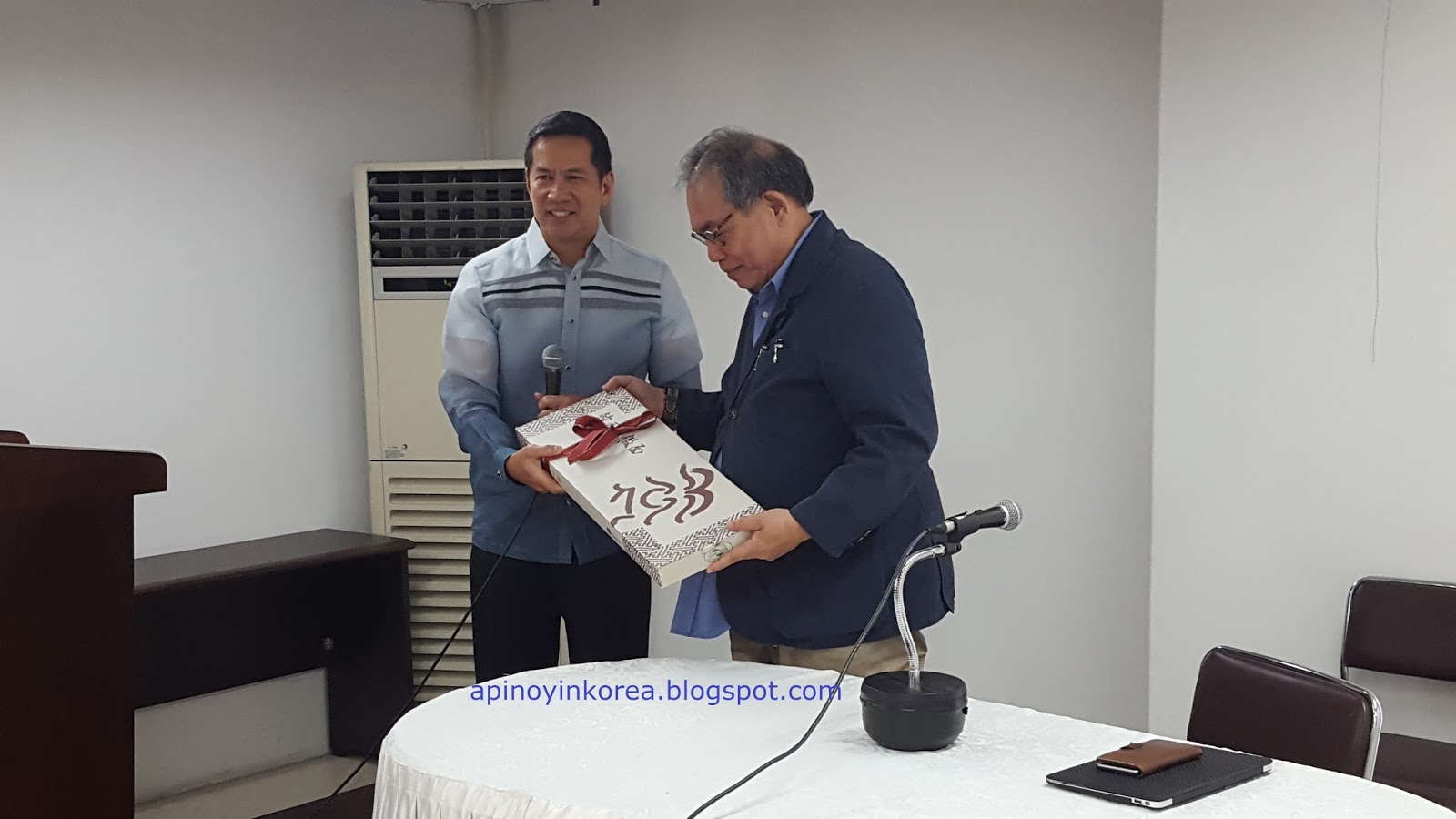
                  (Ambassador Raul Hernandez 
                   welcomes Professor Dalisay)

I'm a big fan of award-winning writers. Such creativity! And their solid grasp of the English language and writing styles! Perhaps, if only I were an English major, I would have felt more confident with my writing. But I majored in Economics and Accounting. So, instead, throw me your billions, and I will count them for you with my eyes closed. Ha-ha-ha!

I also remember my English teacher in college at La Salle, Dr. Elsie Coscolluela, who also has several Palancas to her name.

               (Professor Butch being presented 
              with a gift by Ambassador Hernandez)

But during Professor Dalisay's talk with us Pinoys in Seoul, he told us that the best Filipino novel won't be written in English, but in Pilipino. 

The Professor's right. The great novels of the world were originally written in the native tongue of the writer. So, perhaps, the Filipino writer who will eventually write this great Filipino novel is not an English major, but a Filipino major? Hmm. Does this give me a chance? Ha-ha-ha!

                    (Ambassador Hernandez with 
                     Professor and Mrs. Dalisay)


And as Professor Butch told us that Hiligaynon, or commonly known as Ilonggo, the dialect spoken in our region, is actually classified as a language, this gave me an idea. 

Maybe I should write one short story in Hiligaynon. Who knows? This could win me a Palanca some day. Naks! It doesn't hurt to dream, does it?

That day, I asked Professor Butch to autograph my copy of his short story Heartland, that won first prize in the 1982 Carlos Palanca Awards. 

I hope with his autograph, Professor Butch brushed his good luck on my future Hiligaynon attempt at a Palanca. 

Suguran tá karon magsulat.:-)

Sunday, 2 April 2017

Bot-ong Kag Tablea Tsokolate!


"Ay abaw! Kanamit guid sinâ!"

That would be a normal reaction of someone coming face-to-face with a plateful of bot-ong and a warm cup of tablea tsokolate.

Bot-ong is a Philippine delicacy made of glutinous rice that was cooked by steaming it with coconut milk while wrapped in coconut leaves. Some would sprinkle it with brown sugar, others would use latik, a sweet sauce made of grated coconut meat caramelized in brown sugar and coconut milk.

But for me, dipping a slice of bot-ong in a warm tablea tsokolate would be a yummier option: the chocolate flavor of the drink mixed with the bland, yet creamy bite of the soft, sticky rice in your mouth brings out a harmonious taste of home and culture.


"Ti, maka-on 'ta!"