Thursday, 9 April 2015

Persons of the Week: The Florists and Horticulturists of the Yeouido Cherry Blossom Festival


If you're heading to see the blooms of the cherry blossoms at Yeouido in Seoul this weekend, these are the hardworking people who are making the welcome arch the most photogenic man-made structure at the festival.


Since I am avoiding the chaos at the Yeouido Cherry Blossom Festival this weekend, I ran to the site late last night after work to take a hike, literally!  My legs needed stretching and my mind needed relaxing. So, a kilometer or two of strolling along the cherry blossom lane was what I did. 

Once I got at the start of the Festival's cherry blossom lane, I noticed these group of people working overtime placing the colorful flower patches around and on the welcome arch. And even though they're not finished yet, people were already posing next to it.


And with the use of a crane, which levitated them to the top corners of the arch, they plugged in more flowers to complete the whole design. 

I wonder what time they finished last night, or whether they were able to complete the task. But for this work alone that will bring more enjoyment, and probably millions of memorable photographs, these florists and horticulturists are my persons of the week!

PS. I was told by the Korea Tourism Organization hotline operator that the colored lights on the cherry blossom trees will be turned off at 11PM each night during the festival. I hope the organizers can extend it as people will probably stroll around the cherry blossom lane even until midnight.

Wednesday, 8 April 2015

Cheese Ramyeon and Tuna Kimbap: Not A Yaya Meal!


Yes, my favorite duo, the cheese ramyeon and tuna kimbap are not only for the yayas.  It's also for the amo, the driver, the kusinera, the hardinero, the kapit-bahay, and the guard! 

In short, it's for everyone! And everyone will crave for these two whenever they see this picture. Just like I craved it when I passed by the kimbap restaurant in downtown Seoul as I headed to, well, I forgot where I was heading to that time. Must be the craving. Ha-ha-ha!  

So, let's forget about the whole brouhaha about 'yaya meals', and just concentrate on this meal that's perfect for everyone just wanting to enjoy the cheesy spiciness of the hot broth drowning the ramyeon on the bowl, and the bite-size slices of tuna kimbap, where the kim (edible seaweed) envelopes each roll of rice, Korean radish, spam, tuna mixed with mayonnaise and a few more ingredients that will want you to order more!

Burp!

Monday, 6 April 2015

Seoul's Hammering Man

When I first arrived in Seoul, I immediately noticed that in front of every big building, there always is a sculpture or a piece of art calling the attention of everyone passing by. I guess it's the tradition here in Korea, to upstage your neighbor with a bigger sculpture.

Some works of art don't impress, while others are just too huge to be ignored. And while some huge sculptures seem like an expensive waste of real estate, a few are worth it.

And one piece that actually impresses is the Hammering Man  in front of the Heungkuk Life Insurance Building in the Gwanghwamun area.
The first time I saw it was when I wandered around the area on my way to the Seoul Museum of History years ago. With the height of 22 meters, the sculpture of a giant with a very big hammer can't be missed. It's silhouette was like from a Tim Burton movie.

I wonder how much steel was needed for this 50-ton installation. The artist Jonathan Borofsky created the Seoul version of the Hammering Man in 2002, and in 2008, it was "moved closer to the main street in order to interact fully with the urban landscape". Of course, it was meant to interact with the landscape, and not with pedestrians. Ha-ha-ha!
I think the move was a good decision; it caught my attention from afar. It wouldn't have been obvious if it stood on the side of the building, hiding it from view.

And tonight, as I leave the Cinecube Cinema inside the Heungkuk Insurance Building, I took some photos of the giant. And next time, when you're in the Gwanghwamun area and happen to see a giant with a hammer next to a tall building, it's the Hammering Man.

Friday, 3 April 2015

Good Friday In Seoul...


Unlike the observance of Lent in the Philippines, the Lenten season in South Korea is hardly felt.  I don't see any religious procession on the streets; only traffic. And nobody gets nailed on the cross somewhere on the hills; only tourists looking for colorful spring flowers and cherry blossoms.

So, what to do? 

Well, I just headed to the Myeongdong Cathedral, and prayed for world peace, and repented for all the sinful, sweet delicacies I selfishly indulged in for the past year.   

At the Cathedral, I noticed a number of Filipino tourists, which made me think that perhaps, it's their own version of international visita iglesia. I even noticed some of them were doing a via crucis

As I quietly left the Cathedral, this somber atmosphere inside the church will turn into a more joyous one in two days. I will be back there for Easter Sunday.

In the meantime, have a quiet Good Friday, everyone...

         (Myeongdong Cathedral's light and shadow at night)

Thursday, 2 April 2015

Seoul National Cemetery: A Less Crowded Cherry Blossom Spot In Seoul!


I just found a new spot to see the cherry blossoms in Seoul!

If I go to Yeouido, I will be elbowing against a million other people while walking the five-kilometer cherry blossom lane behind the National Assembly grounds. So, there's no Yeouido for me this year. I have visited Yeouido on a few occasions during the cherry blossom festival, when the roads leading to the area are usually blocked off to vehicular traffic. The crowds have to walk from the Yeouinaru Station, and the buses going there are usually full.

A good time though to visit Yeouido would be at night when there are less crowds. But the problem at night is the organizers turn off the colored lights at midnight, just when everyone else is still enjoying the night stroll. I wonder if they will turn off the lights at midnight again this year.

                                   (Time for spring!)
                    (A kid running to join the soldiers' parade)

Other than the cherry blossoms, you can always visit the flowery areas along the mountain trails in Seoul. There's actually one near my neighborhood. Maybe I should visit Eungbong-san (Mt. Eungbong) this time. It's famous for its yellow forsythias this time of the year.


      (Crisp in their uniforms and precise in their cadence)

           (The exhibit includes facts about the Korean War)

There's another option: Nam-san, right in my neighborhood. This area is actually closer to home, and I can even ride a bus going up. To see the cherry blossoms, I can just walk down from the Seoul Tower area and follow the cherry blossom trail down to the Yongsan Library. This way, it's less tiring, but I think there will be a lot of people, too. Not only on the trail going down, but also on the ride going up!

If you want to take the Yellow Namsan Bus, I suggest you wait for it at the bus stop at Hangangjin Station, or maybe at the Chungmuro Station. Why? Because if you wait at the bus stops near Nam-san, it would already be full.


                        (Showing off their combat skills and 
                          their colorful traditional costumes)

But not too many people in Seoul know that there's another spot to catch the cherry blossoms. This place is not only near, it's also less crowded, airy, and they have a spring festival with a military parade and exhibits!

Where is it?

          (Crowds watching the parade and performances)
(Turn the beat around, love to hear percussion!)


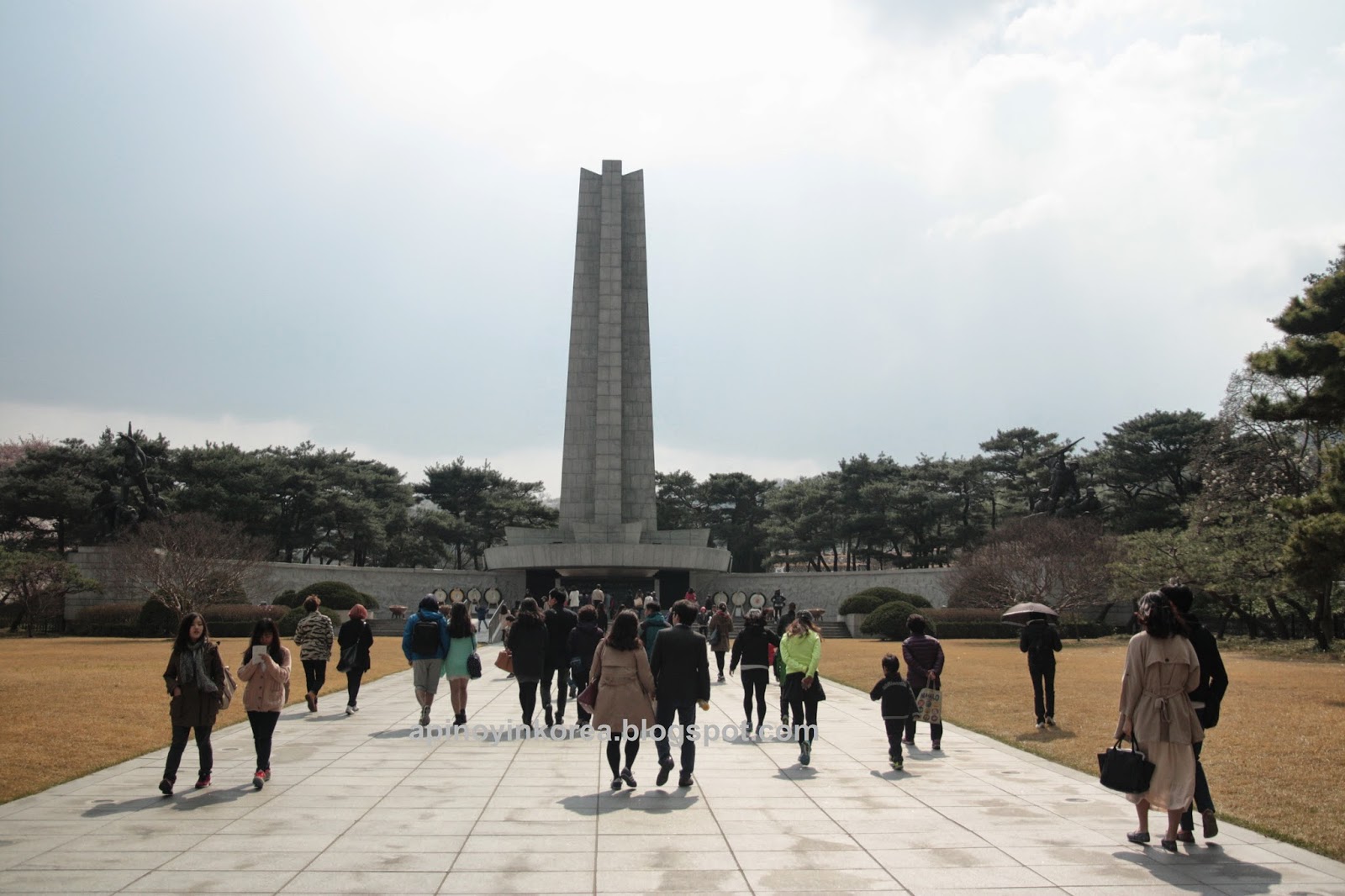
It's the Seoul National Cemetery in the Dongjak District!

I visited the Seoul National Cemetery in the fall when the colors of the leaves were changing. The place was serene and quiet. Unlike other open spaces and parks in Seoul, putting up a kiosk to sell drinks and snacks is prohibited. This place was worth another visit; I will return in spring.

             (Cherry blossoms and a less crowded street)
              (Cherry blossoms and dramatic landmarks)
          (Thousands of tombstones for the fallen heroes)

I guess in spring, the Seoul National Cemetery will have more visitors as it celebrates a festival in time when the cherry blossoms bloom. The festival is complete with a military parade where soldiers show off their precision march while they wear their pristine uniforms and accompanied by a drum and bugle corps. If you're there, for a moment, you'd forget that this area is a cemetery, where heroes and martyrs are laid in honor, respect, and memory, and where solemnity is observed all the time. But as part of their calendar, the cemetery's administration celebrates the heroism of the fallen by having this festival of parades, performances and reenactments of ancient wars by soldiers in colorful traditional costumes.  Around the grounds, there are also displays of the Korean War relics to show the present generation actual artifacts from the Korean War.


If you decide to catch the cherry blossoms at the Seoul National Cemetery, just take the Subway Line 4 or Line 9, and get off at Dongjak Station. From Exit 8, the entrance is a few meters out. But unlike Yeouido, you can bring your car!


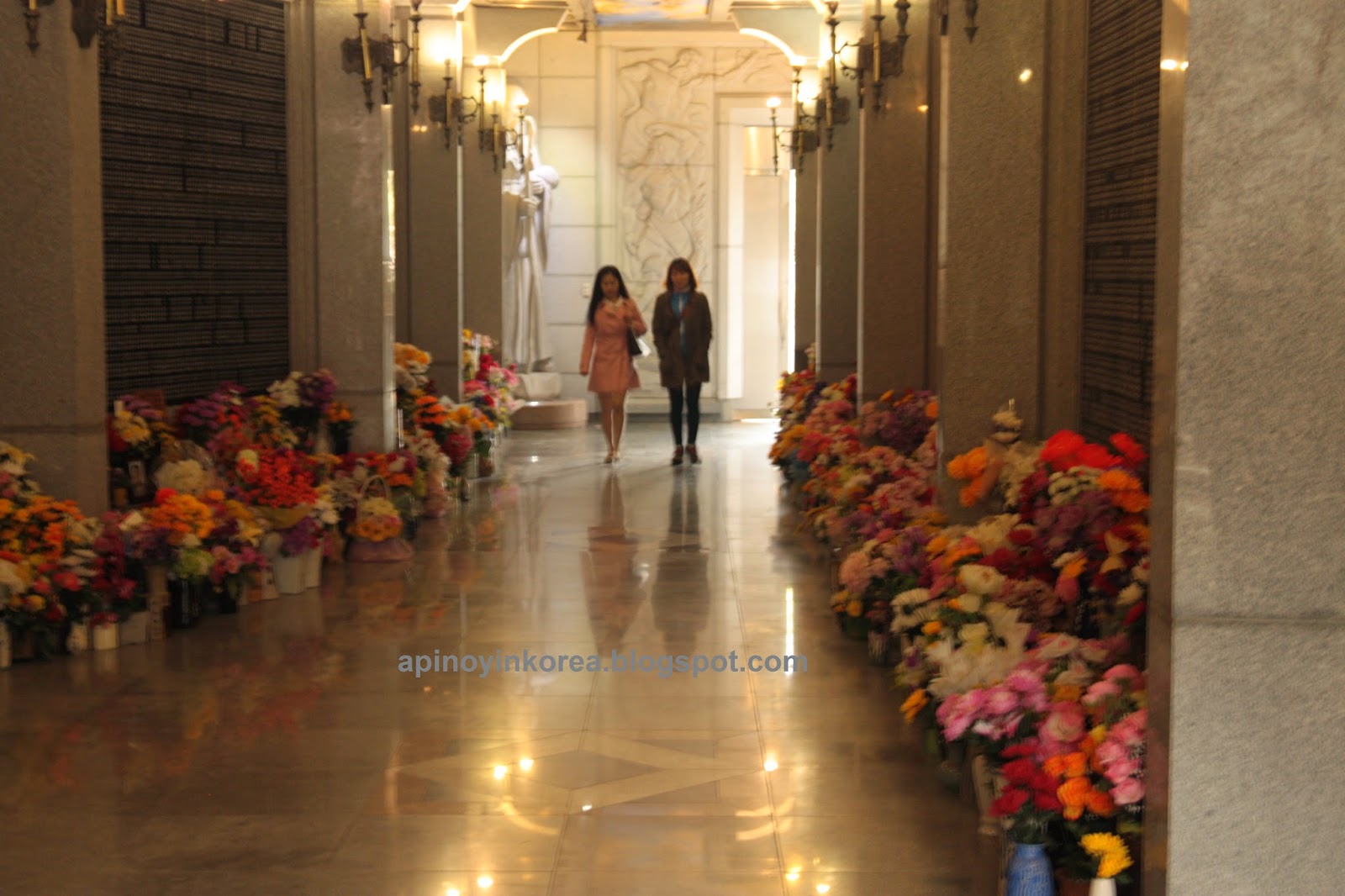
And since you're there, after going around to see the cherry blossoms, why don't you also visit the Memorial Tower where names and portraits of the fallen heroes and martyrs are placed. And behind it are sectioned areas that contain thousands of tombs of these heroes, where you would always see family members offering flowers and messages as a sign that these heroes are never forgotten.    

So, there. I just shared with you a new spot to catch the cherry blossoms in Seoul this spring. 

Have fun!

                                     *   *   *   *   *

Seoul National Cemetery's website:

http://www.snmb.mil.kr/mbshome/mbs/snmb_eng/index.jsp

Wednesday, 1 April 2015

April 1 is the Last Day of Cherry Blossoms in Seoul!

Last night's heavy rain in Seoul washed away most of the blooms from the cherry blossom trees, and today, April 1, we might see the last of the cherry blossoms this season because of the surprisingly windy weather since this morning. 


A few days ago, these lucky office workers in the Yeouido area were fortunate to have been able to take photographs of the blooms before they fell off. They were lucky, indeed. But I wonder if I would also be lucky enough to run to the Yeouido area after work to catch the last falling petals.

Oh well, if I wouldn't be able to today, there's always next year. 

Sigh. :-(


Monday, 30 March 2015

Chicken Feed: Andong Jjimdak!


When I looked it up on the Internet, they said this dish originated in the city of Andong in the North Gyeongsang Province in Korea. What a coincidence! Andong is actually the sister city of Bacolod, my hometown and the birthplace of the Masskara Festival. And just like Bacolod, Andong also has its own mask festival!

And every time I get face-to-face with this dish, it always reminds me of a Filipino favorite, adobo!

Andong jjimdak is a dish made of slices of steamed chicken marinated and almost submerged in spicy soy sauce, swimming alongside potatoes, carrots and other sliced vegetables, and choking in lengthy cellophane noodles. 'Jjimdak' means steamed chicken.

The spiciness is actually brought by the small cuts of red pepper, which I totally avoid. Once the Korean ajumma brings over the big plate of Andong jjimdak to our table (you can't eat alone with this dish!), you will also need a clean table scissor to cut the noodles short so you can fish them out and carry them over to your plate. 

Each bite of the steamed chicken reveals its soft meat coated with a bit of saltiness from the soy sauce and a little spiciness from the pepper. I usually top my bowl of rice with the chicken and the noodles, which I then bathe with a few spoonfuls of the spicy soy sauce. 

Eating Andong jjimdak, unlike other Korean dishes, is like a ceremony because of the scissors. I always feel like I am opening an event with all this ribbon-cutting, except that these aren't ribbons. These are cooked cellophane noodles that are chewy and slippery.


A big plate of Andong jjimdak is actually pricier than most Korean dishes. A plate for two is about KRW24,000. That includes two bowls of rice and the use of the scissors. Ha-ha-ha!  These Andong jjimdak restaurants actually have aprons for costumers to use. And borrowing one is advisable if you don't want to splash some soy sauce on your white shirt or blouse.

So, if you want to be fed with spicy, steamed today, try some Andong jjimdak and cut some ribbons for me!