Showing posts with label Insa-dong. Show all posts

Sunday, 3 August 2014

'A' For Amigos, 'B' For Blue House, 'C' For Cafe Jass


After enjoying our unique lunch experience at the Tong-in Market's Dosirak CafeJunhoHyunsung and I walked off our lunch to have coffee near the Insa-dong area. Hyunsung's cousin, Woong-cheol has a cafe around that area.

From Tongin-dong in the Jongno District, we headed to the Insa-dong area by walking behind the Gyeongbuk Palace. At the back of the Palace is actually the Blue House, the official residence of the president of South Korea, and as expected, this area is tightly guarded. I remember passing through this Cheonghwadae area a couple of autumns ago after coming from Michael and Sara's home near the Jahamun area, where I had lunch. And today, coincidentally, after another lunch, I was passing through this area again.

              (Tourists taking pictures of the Blue House)

As we entered the guarded area, we were stopped by the policemen on duty, who asked to check our bags and the reason why we were walking towards the Blue House. Sadly, they forgot to ask how our lunch was. Or what we ate. Ha-ha-ha!

When we got to the 'photo spot' in front of the Blue House, there were a lot of tourists already busy posing and clicking away. We joined them for a few minutes and noticed that the three of us were the only Seoulites in the pack. The rest were tourists! Junho said that locals don't usually venture into this tightly guarded area in Cheonghwadae to take pictures. But today, three strayed from the main road. Ha-ha-ha!
               (Pink flowers and a house colored blue)


We wandered through the alleys of Samcheong-dong before ending up across the northern end of Insa-dong on our quest to find Hyunsung's cousin's coffee shop. To find it, we simply crossed the street and walked towards that street behind Jogyesa Temple. And when we got there, the coffee shop looked familiar. I have been here before!


Cafe Jass is right behind Somerset Palace Seoul, a hotel where friends JK and Ruth used to live. Our friends used to have parties there and one occasion when I visited Ruth, she took me to Cafe Jass

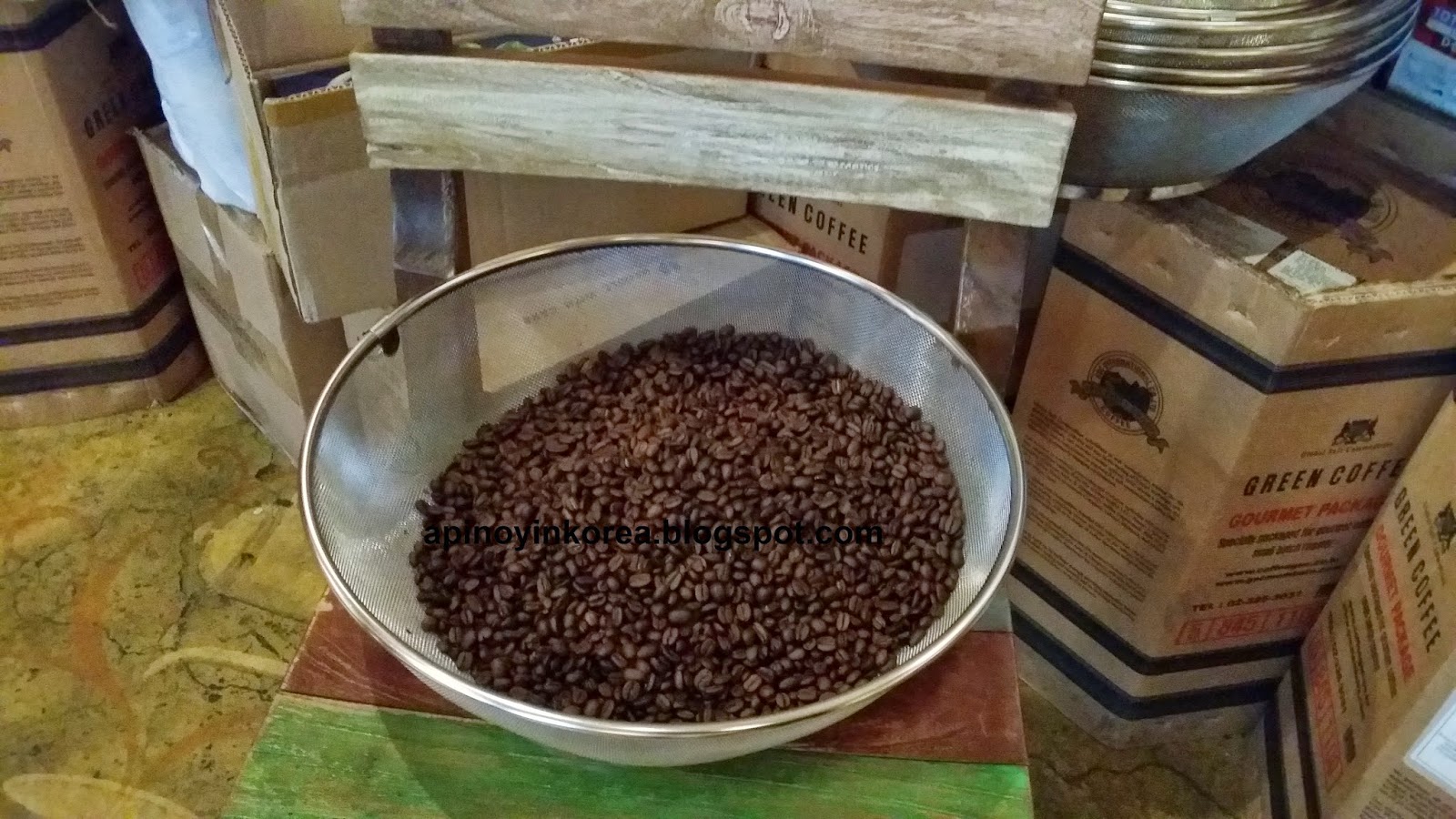
And as we were enjoying our coffee (and the cheese cake on the house!)Woong-cheol, the owner of Cafe Jass,  started roasting his coffee beans and the delightful aroma of the beans filled the coffee shop, which then seemed to have awakened the senses of everyone in the room. It was already mid-afternoon by the time we were able to rest our legs from walking off our Dosirak Cafe lunch at Tong-In Market, passing behind Gyeongbukgung and in front of the Blue House, and ending at a coffee shop next to Jogyesa Temple.


What started off just as a hungry quest to experience the Dosirak Cafe ended up as a day-tour around the Jongno District and, well,...a blog! And thanks to my good amigosJunho and Hyunsung, the Blue House and Cafe Jass were indeed worth the stroll. 

Tuesday, 18 February 2014

Insadong's Ssamziegil: Shopping All The Way Up!


Yes, that is Insa-dong in the picture with a few rooftops covered with thin snow from the night before. Looking at Insa-dong from the B&B where I stayed over the weekend was weird. From the ground, Insadong would look culturally interesting if one strolls its cobblestone alleys and just ignore the garish and tacky cosmetic shops that have invaded this artsy area recently.

         (Ready for your close-up? The portraiture corner)
But there's one street in Insadong where you can still avoid the inescapable posters of Korean celebrities selling cosmetics and facial cleansers. (Sometimes, seeing this overload of celebrity posters is sickening and ruins one's day! Ha-ha-ha!).

That street is Ssamzie-gil'Gil' in hangeul means 'street'. So, it's Ssamzie Street. But if you're in Insadong and have to ask where it is, just ask for Ssamziegil.


This street is actually a complex, where one walks up from the ground up to the higher floors by just tracing the labyrinth path that elevates continuously floor by floor. One doesn't need stairs or an elevator, actually. Although there's a stairwell at a corner for those in a hurry going up, or going down.


                   (Bags made from recycled wet suits)

And last weekend which I spent around the Jongno District, I visited Ssamziegil and saw for myself the interesting shops that filled up all the floors and attracted tourists, both local and international.

                 (I bought one of those red Korean fans)
     (Korean fans, small bags, scarves, trinkets and souvenirs)

Since it was a weekend, the whole 'street' was full, and even in this very cold weather, couples, kids and their parents, and group of friends seemed to enjoy the complex and all the interesting trinkets, bags, clothes and other unique souvenirs that filled the display windows from ground floor up to the top. There was even a corner where you can have your portrait drawn.

                     (Big roses are red, stairs are multi-colored)
I entered one shop which sells interesting-looking Korean fans. From their display, one caught my eye. I thought this would a good Korean souvenir and a gift; I bought it. Although I could speak survival Korean, I deliberately abandoned the idea of speaking hangeul to continue my pretense that I was a tourist that day. Ha-ha-ha!  Although the husband and wife (I think) who were manning the shop could speak a little English, they were ready with a big calculator (like most vendors in Korea) to make sure there was no misunderstanding when it came to the price. After a few seconds of haggling, I got the Korean fan for KRW15,000.


I walked the whole stretch of the 'street' to see for myself all the shops. I also entered a bag shop and queried the Korean lady about her colorful bags. We conversed in English and she told me that some of her bags are made of recycled wet suits. Yes, those worn by scuba divers. No wonder they were pricey! Those suits must have reached far into the ocean depths and must have logged hundreds of diving hours.  


At the top floor is a small covered restaurant and an outdoor cafe, which looks enjoyable if the weather isn't as freezing as these days. But I think it would be a good idea to just sit there during day time and chat with friends, away from the noisy chaos of the life below and away from the in-your-face posters of Korean celebrities displayed at the cosmetic shops on Insadong's main alley. Ha-ha-ha!

So, if you're in this neighborhood, you now know where to escape. On the uppermost photo, that's Ssamziegil that I encircled in red, where you can go shopping all the way up, and relax when you get to the top.

Tuesday, 11 February 2014

A Jongno Weekend: Hanoks, Mandu and Snow!

As part of my mission as a Global Seoul Mate, I checked in at  a B&B in the Jongno District, just next to Insa-dong, to experience a different kind of a weekend. I live in Seoul, and actually, Jongno is just seven minutes by bus from my neighborhood in Hannam-dong in the Yongsan District. Although it felt weird, I simply had to pretend like a tourist during the weekend!

I got to my preferred B&B place at the SK Hub Building right next to Exit 6 of Anguk Station on a cold Friday night at around 8PM. I was a starving by that time and I had to find a place to quiet my rumbling stomach. After dropping off my bag, I hurried down and follow where my hungry tummy led me.

Insadong's Koong Mandu
Luckily, Koong Mandu, my favorite restaurant in Insadong that serves the best mandu (Korean dumpling) in the whole of Seoul, was still open! Although, there were just a few customers inside finishing their dinner, I decided to join them. And from the menu, I then ordered a meal of six mandus swimming in a bowl of hot savory broth that could serve two hungry tourists! Ha-ha-ha! Their mandus are big, but for a starving person, the flavor of the minced meat filling and the softness of the mandu wrapper made it easy to gobble them down effortlessly. It has been a long time since my last visit here. I was happy to have made it before they closed for the day. 
(My hot bowl full of mandu. The lady in the background was filling the mandu wrappers with flavored minced meat.)

The Cheonggye Stream and Coffeesmith cafe
After a heavy dinner, I decided to walk it off by strolling towards the Cheonggye Stream, where I stopped by at the Tourism Information booth to ask for a map of Bukchon. It was very cold outside, but since the crowd that night filling the streets of Jongno didn't look bothered by the weather, I tried to share their spirit.

At the Tourism Information booth, I told Miss Ryu, the information officer, that I planned to visit Bukchon village the next morning; she then pulled out a map of the village from the shelf and explained the most interesting spots of the place to me.  Every night, the booth closes at 10PM and again, I was just in time! Afterwards, I continued my stroll along the Cheonggye Stream and stopped by the Coffeesmith cafe to study the map and update my blog while having a hot cafe mocha. It felt good sitting indoors with a hot cup of coffee!
                       (At the Tourist Information booth; 
                       Miss Ryu gladly took my photo)
                  (Frozen, not the movie, but the stream)
(Blogging away at the Coffeesmith with my hot cafe mocha)

Bukchon Village
This is perhaps the most famous place in Seoul where one can find a lot of clustered hanok, or Korean traditional homes. When I got there the next morning, a lot of international tourists were already there strolling the village. This place, by the way, is still a residential area. So, everyone is required to be quiet while walking around, but groups of tourists from Asia were noisy as they scampered around taking photos of each other. If only I could speak their language...
                                    (Hanok rooftops)

I followed the map that I got from the Tourist Information booth and had a great time revisiting the place. I was here a few times in 2006 when I was invited inside the house of Mr. David Kilburn, a British gentleman, who was an advocate of the preserving hanoks in this area. His house was a location of the movie, Empty House or 빈집.

My visit to Bukchon deserves a separate blog as I had a lot of photographs taken during Saturday morning when it was a bit cloudy, and the next day, when all the hanoks were covered with a thin layer of snow that fell the night before. I got there early in the morning to make sure I photographed the snow before it melted.


(A couple posing at a famous Bukchon alley full of hanoks)


Snowy Seoul
In the afternoon, I passed by Daehangno where I intended to catch a Korean musicale that night, even though I don't understand the songs. Ha-ha-ha!  This was where my friend Cielo and I caught Hwarang, a Korean musicale, when she came to Seoul last time.
                  (A sculpture next to the Hyewha Station)
                              (Snow started to fall!)

It turned out, while I was around Hyewha Station, I had to call it a day when heavy snow and strong winds came blowing through the city by mid-afternoon. I would have wanted to squeeze in a visit to a palace while there was still daylight. I guess the snowy weather didn't want me to.

Insadong's Ssamziegil
Although it was still snowing, but not as heavily as during the afternoon, I headed out again to Insadong, and stopped by Ssamziegil. 'Gil' in Korean means street, and this building is populary described as street as the structure is a continuous walk from the ground up to the highest floor. One can reach the top without using the stairs as the floor continuously elevates.

On my stroll at Ssamziegil and along Insa-dong, a few interesting souvenirs caught my eye. As a tourist, I gladly bought them to remind me of my fun weekend at this place. 

Insadong's Andamiro Restaurant
It was already below freezing when I finished my walk around Insa-dong, and dinner was just the missing slot in my schedule that night. So, I wandered around and found a familiar restaurant. Andamiro! Who doesn't like Italian food?

This restaurant's customers are mostly locals, who prefer a quiet place for their dinner of wine and Italian cuisine. A few friends of mine prefer this place when they're in Insa-dong, and there was no reason for me to go somewhere else to seek refuge and dinner in this weather. After all, I love Italian food, too!
                         (My bolognese pasta in cream)

'Dragon's beard' candy and Korean chestnuts!
And just along the main Insa-dong alley, there are a couple fo stores where tourists are attracted to. The guys making the 'dragon's beard' candy are always busy calling everyone into their stall to show how this unique candy is made. As I passed by, I got curious, too. I think I have tasted this candy years ago, and I forgot how good they actually were. This was the time I got me a box or two again!


And who doesn't enjoy a pack of warm, cooked chestnuts? As I walked toward my B&B right along the Exit 6 of Anguk Station, I spotted a chestnut vendor. I just couldn't resist buying a pack. I was supposed to be a tourist, who couldn't speak Korean, but I had to tell him I love chestnuts in Korean. He gladly gave me an extra to enjoy. A pack cost KRW5,000. Reasonable enough for these big chestnuts, freshly peeled and ready to eat!


Tourist Information Guides in Red Jacket
Since Insa-dong is also one of the most popular places for tourists in Seoul, a few teams of tour guides in red jackets walk around to provide information for everyone. They can speak in three languages: English, Japanese and Chinese. I will have to feature them in another blog as these guides are helpful and dedicated. I talked to a team while I was in Insa-dong, and they were there even during the snowy and cold morning, willing to help out anyone.

     (The Seoul Tourism Organization guides in red jackets)

Well, my weekend as a tourist in the Jongno area is over. But it was fun pretending to be one, especially there was a lot to see and discover again. 

So, thanks to the artisans, the vendors, the waiters, the hanok owners and everyone else who made my weekend in the Jongno District a good one!
                                  (Let's drink to Jongno!)

Saturday, 8 June 2013

The Seoul Walking Tour App Brings Me To....Insa-dong!

Following a visit to the Tapgol Park nearby, I just walked for a few meters and voila! I was at the Jong-ro entrance of Insa-dong

I think the last time I walked the whole stretch of Insa-dong was during the flash mob of K-Performance Supporters last year. That was a fun experience in surprising the crowds and tourists in the area with a flash mob. If you were part of the flash mob, perhaps I was able to capture your dance moves in these photographs.

This time, there won't be any flash mob, only a wandering tourist with a smartphone and an uploaded Seoul Walking Tour app.


As I strolled down the main alley, listening to the audio file about Insa-dong on the Seoul Walking Tour app, I agreed when the narrator (who I think is Mr. Choi from Arirang News) described Insa-dong as 'one of the most popular attractions for international tourists visiting Seoul.'


This place is hugely famous for traditional Korean art work and handicrafts, and small shops offering Korean tea and the experience of enjoying a quiet afternoon in this part of Seoul, which has its own unique character.

Aside from tea and coffee shops, they are restaurants on both sides of the alley. Aside from a pasta restaurant, my favorite restaurant in Insa-dong is Koong Mandu, which has the best mandu (korean dumplings) dishes in Seoul!


Years ago, when I visited Insa-dong for the first time, I remember the main alley was full of artsy galleries and artisan shops. Lately, cosmetic shops are invading the place. I hope the Jongno district government puts an end to this invasion, as we don't want to wake up one day to find out that Insa-dong has turned into another Myeong-dong.

Although I'm a Seoulite now, I always look at Seoul through the eyes of a tourist every time I roam the city. And as a tourist, I certainly would want Insa-dong to remain true to its character as one of the places in Seoul, where a visitor can still experience a purely Korean atmosphere, surrounded by unique traditional architecture and full of uniquely Korean artistry and tradition.


According to its history (provided by the Seoul Walking Tour app), Insa-dong started out as a market where the descendants of Dohwaseo, a government body tasked to organize royal processions and events during the Joseon Dynasty, sold artworks and artisan tools for these crafts. The workers and their descendants must have been forced to find a livelihood when Dohwaseo was closed down when the dynasty declined.

The Joseon Dynasty lasted for five centuries, ending just about hundred years ago. And today, although I could still see a hint of that character of a traditional market that was started by those descendants more than a century ago, I am worried that commercialism will eat its way into Insa-dong and erase such character soon.


But in the meantime, armed by a smartphone with the Seoul Walking Tour app and a camera, I felt the cobblestones beneath my feet, thinking that, these steps must have the same place where, a hundred years ago, those descendants walked and set up shop as they made, sold and let everyone else appreciate their artistry just like the present-day artisans do.

So, if you're walking through Insa-dong, make sure you have the Seoul Walking Tour app in your smartphone as well, and you will also feel the character of the place like I did today.

My next stop....Jogyesa Temple!