(Note: This post is NOT to be used as a reference for Korean Immigration policies. This is just to share my experience in applying for a permanent resident visa in Korea.)
After I finished my sixth year in South Korea, I was told I could already apply for a permanent visa since I held an E-7 visa continuously for six straight years. But at that time, I was required to present a TOPIK Level 2 certification, which I didn't have. TOPIK stands for Test of Proficiency in Korean, and I needed to pass at least Level 2.
But after my tenth year, that TOPIK Level 2 requirement was waived; I no longer needed it in my application for a permanent visa since I was told I completed a ten-year continuous stay in Korea under the same visa type.
So, I went to the Seoul Global Center in Jongno, Seoul, and with the help of the Filipino staff Robely, I was able to get the list of documents I needed. Robely helped me call the Immigration hotline 1345, who then enumerated to her the required documents and faxed to her the forms (other than the application form) I needed to accomplish.
These are the standard requirements I submitted:
1. Application form with photo
(Download application form here.)
2. Passport and alien registration card
3. Current employment contract
4. Your employer's business registration
5. Apartment rental contract (if the contract is not in your name, there's a document in Korean to be signed by the person who is the signatory to the lease contract of the apartment you live in).
6. Any postmarked letter addressed to you at the current address where you live. (The address should be the same as the one in the apartment rental contract.)
7. Letter of guarantee from a Korean citizen. (There's also a prescribed form for this letter written in the Korean language).
8. Latest income tax return (You can request this from any National Tax Service office. Your previous annual income in Korea should be 100% more than the per capita income in Korea.)
9. Transcript of records from my university with apostille. (In my case, I requested my transcript from my university and I had it apostilled with the Commission of Higher Education of the Philippines, which then sent it the Department of Foreign Affairs of the Philippines (DFA) for authentication. After claiming it from the DFA, I asked a friend in Manila to bring it to the South Korean Embassy in Manila for authentication. I gave an authorization letter to that friend so she could request authentication on my behalf.)
10. Clearance from the National Bureau of Investigation of the Philippines (I applied for the clearance at the Philippine Embassy in Seoul and had the application sent to the Philippines. And when I flew home for a vacation that year, I visited the nearest NBI office to facilitate the process. The clearance was released days after and was claimed by someone whom I authorized.)
11. Processing fee of KRW230,000
Other than the standard documents required above, I also submitted these documents which I thought could help in the approval of my application:
12. Photocopy of my Korean bankbook (I photocopied the last page and the information page that included my name, signature and bank account number).
13. The latest statement of pension plan balance from the National Pension Service. (This statement is sent to any pension plan holder in South Korea, or you can visit their office and request for your latest statement).
14. The latest statement of investments from the securities firm to which my annual severance payments were deposited.
15. Certificate of Award from the Seoul City Mayor when I won in the Seoul International Essay Writing Competition
16. Certificate of Appointment as a World Korea Blogger from the Director of Korean Culture and Information Service (KOCIS)
17. Letters of blood donation result from my numerous blood donation at the Korean Red Cross over the years. (Since I didn't have any certification from the Korean Red Cross, I submitted these letters as proof that I was a regular blood donor. These letters are sent to the blood donor days after the actual bloodletting; it contains the blood tests done on your donated blood.)
Note: You can add more documents, e.g., scholastic diplomas from Korean schools/universities, certificates of awards in Korea, certifications from your volunteer work in Korea, certificates from competitions you won, and other achievements in Korea. I wasn't married, so I wasn't required to submit any marriage contract.
I submitted all those documents in mid-November and I received an SMS on my phone late December (about 36 days after) advising me that I could already get my new alien card. So in my case, it took about 36 days for the processing and approval of my application.
* * * * *
As I mentioned above, this post is only to share my experience in applying for a permanent residency visa in Korea. Do visit the Korean Immigration website for official policies:
http://www.immigration.go.kr/HP/IMM80/index.do
Showing posts with label immigration. Show all posts
Wednesday, 18 October 2017
Thursday, 27 August 2015
Living in Korea 101: Visiting the Korea Immigration Office in Seoul
For those of us living in South Korea, we may have to, at one time, extend our visas, or apply for an alien registration card (ARC) if we're staying in the country for a long period.
I got my ARC early on when I started working in South Korea, and it helped me open a bank account and got me mileage cards for cafes, movie houses, supermarkets and department stores. It's even required if you want to register as a blood donor for the Korean Red Cross.
Having lived here for a number of years already, I must have gone to the Seoul Immigration Office in Yangcheon District at least once every two years to renew my visa, and considering that there are a lot of foreigners who may need to visit the same place, I decided to post a how-to-get-there blog.
By the way, there are two immigration offices which foreigners living in Seoul can visit. One is at the Seoul Global Center building in Jongno District, and the other is at Yangcheon District, depending on which district you live. I live in the Yongsan District and my assigned immigration office is at Yangcheon District.
And this is how to get to the Immigration Office at Yangcheon-gu if you're assigned to renew your visa in this office:
1. Take the subway train and get off at Omokgyo Station (Line 5).

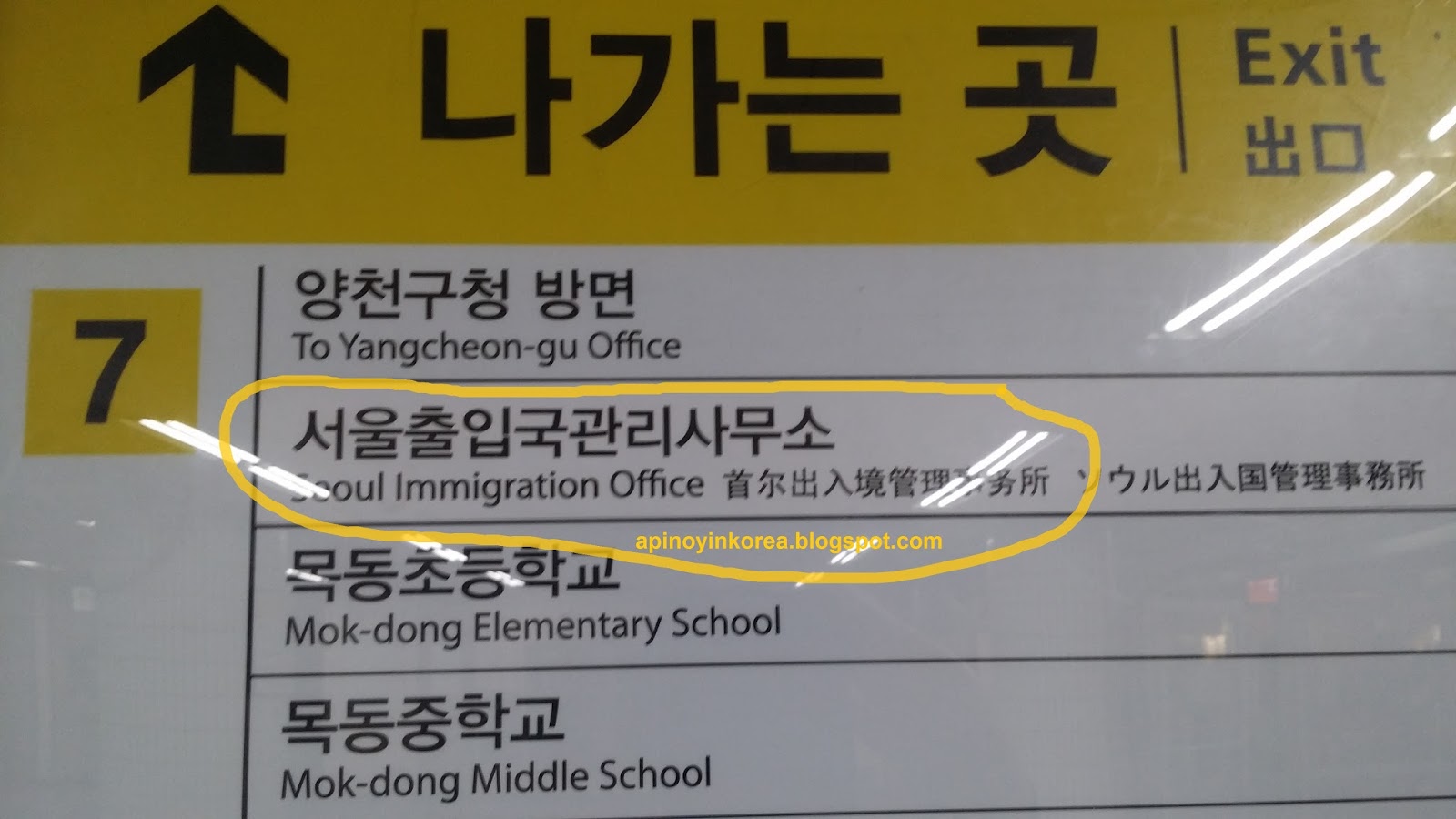
2. Get to Exit 7. That's the exit nearest the Immigration Office.
3. If you want convenience, take a cab from Exit 7 and just say 'immigration' to the driver. At this exit, there is a line of taxi cabs waiting for anyone heading to the immigration office. I always take the cab as it's a long walk and I want to save time.
(Taxis lining up at Exit 7)
4. The cab will stop at the intersection near the immigration office and the taxi driver will just point you to its direction. The immigration building is at the left of the intersection, but since there's no left-turn, you will have to alight and cross the street from there.
6. The immigration services are on the ground floor to your right when you enter. Make sure you get your 'waiting number' from the machine by selecting the service you need.
(The Immigration Building's directory)
Wait at the seating area till your assigned number comes up on the digital display. There is also a staff in the area who gives assistance.
By the way, the service fees are paid in the form of stamps, which you can buy at the lobby from a lady, or from a stamp-dispensing machine for nominal amounts.
Note: Before you head to the Immigration Office, make sure all your required documents are complete and signed, so that you don't have to go back. If you are being issued a new ARC, this would take a few days. But if you have an existing ARC and you are extending your stay, you can just wait for about 15 minutes while they stamp the 'extension date' in your ARC.
I hope these directions help.
Korean Immigration Services website:
http://www.immigration.go.kr/HP/IMM80/index.do
To make a reservation for your visit:
http://www.hikorea.go.kr/pt/ResvMain_en.pt?locale=en
For Korean Immigration hotline: Call #1345
I got my ARC early on when I started working in South Korea, and it helped me open a bank account and got me mileage cards for cafes, movie houses, supermarkets and department stores. It's even required if you want to register as a blood donor for the Korean Red Cross.
Having lived here for a number of years already, I must have gone to the Seoul Immigration Office in Yangcheon District at least once every two years to renew my visa, and considering that there are a lot of foreigners who may need to visit the same place, I decided to post a how-to-get-there blog.
By the way, there are two immigration offices which foreigners living in Seoul can visit. One is at the Seoul Global Center building in Jongno District, and the other is at Yangcheon District, depending on which district you live. I live in the Yongsan District and my assigned immigration office is at Yangcheon District.
And this is how to get to the Immigration Office at Yangcheon-gu if you're assigned to renew your visa in this office:
1. Take the subway train and get off at Omokgyo Station (Line 5).
2. Get to Exit 7. That's the exit nearest the Immigration Office.
3. If you want convenience, take a cab from Exit 7 and just say 'immigration' to the driver. At this exit, there is a line of taxi cabs waiting for anyone heading to the immigration office. I always take the cab as it's a long walk and I want to save time.
(Taxis lining up at Exit 7)
4. The cab will stop at the intersection near the immigration office and the taxi driver will just point you to its direction. The immigration building is at the left of the intersection, but since there's no left-turn, you will have to alight and cross the street from there.
(The intersection near the Immigration Office)
5. Cross the street and follow the signs. Make sure you get into the right building. The immigration office is the second building, not the first one.
(Immigration building as seen from the intersection)6. The immigration services are on the ground floor to your right when you enter. Make sure you get your 'waiting number' from the machine by selecting the service you need.
(The Immigration Building's directory)
Wait at the seating area till your assigned number comes up on the digital display. There is also a staff in the area who gives assistance.
By the way, the service fees are paid in the form of stamps, which you can buy at the lobby from a lady, or from a stamp-dispensing machine for nominal amounts.
Note: Before you head to the Immigration Office, make sure all your required documents are complete and signed, so that you don't have to go back. If you are being issued a new ARC, this would take a few days. But if you have an existing ARC and you are extending your stay, you can just wait for about 15 minutes while they stamp the 'extension date' in your ARC.
I hope these directions help.
Korean Immigration Services website:
http://www.immigration.go.kr/HP/IMM80/index.do
To make a reservation for your visit:
http://www.hikorea.go.kr/pt/ResvMain_en.pt?locale=en
For Korean Immigration hotline: Call #1345
Subscribe to:
Posts (Atom)