Monday, 24 December 2018

Seoul's Seongsu-dong: Shoes And The City


(A shoe museum at Seongsu Station)

Red shoe diary 
I think Carrie Bradshaw (Sarah Jessica Parker's shoe-addict character in 'Sex and the City') would have loved shopping around this neighborhood.

From all shoe styles, for adults and kids, she would have spent all day walking around, visiting one shoe shop after another.
(Gail pointing out the must-visit corner 
of Seongsu-dong)

This is Seongsu-dong in the Seongdong District of Seoul, South Korea. If you're familiar with Seoul's geography, it's a short distance to the right of the city's geographical center, just above the Han River along the trail of the  Seoul subway's Green Line.

(Seongsu-dong is a star 
neighborhood for shoe lovers)

I was only able to walk around this place recently, recent being the past three years. From my seat on the bus, the main street always looked like any other Seoul neighborhood, and from the subway above (yes, the Line 2 trains are on elevated tracks while passing this part of Seoul), I'd only see rooftops of residential and commercial buildings. That's why I never really bothered to visit...until I ran out of places to visit! Ha-ha-ha!

(A black stiletto inside the Seongsu Station)

(A tourist sits on the giant red stiletto)

What I didn't know was that the interesting corners are on the alleys next to the main street, hidden from view, and that's where I finally brought my friends who, I was sure, were more interested in shoes than I was.

Yes, the best tourists to bring along to Seongsu-dong are the ones who love shopping for shoes. Luckily, I have friends who do! 
(Seongsu Station converts itself into a tourist attraction with artsy tiles and exhibits)

Follow the shoes
When you get off at Seongsu Station, you'd immediately realize you are in the shoe neighborhood because this station has a museum for shoes! From displays of different shoe styles to old shoe-sewing machines, and even a directory of all the shoe shops and stores in the neighborhood, the station gives its visitor a glimpse of what the neighborhood is all about!

According to the Visit Seoul website, in the 1960s, the shoe stores specializing in handcrafted footwear were mostly concentrated around Seoul Station but they moved to the Myeongdong area during the 1970s and 80s. And then in the 1990s, one by one, they moved to the Seongsu-dong area in the Seongdong District because the rentals were comparably cheaper.

(Tita Rena, Wendy, Gail, and Kristine are 
welcomed at the shoe center of Seoul)
(The ladies are dwarfed by giant shoe art)

Today, there are about 500 different shoe-related businesses in this neighborhood. These businesses include actual shoe-making, shops that sell shoes, businesses that supply raw materials required for shoe-making, shops that sell certain shoe parts, and stores of shoe resellers and distributors.

Most shoe shops are on the alleys next to Exit 3 or Exit 4 of Seongsu Station. But before heading there, we walked about 300 meters out of Exit 1 to catch the biggest red stiletto shoe you'd find in Seoul! 

Other than the giant red stiletto, walking from Exit 1 up to the intersection, you'd also see small shoe shops and a symbolic sculpture of two giant hands sewing a giant shoe! 
(These tourists invite you to visit Seongsu-dong!)
  (Wendy, Gail, Kristine, and Tita Rena with the biggest right foot shoe in Seoul. Behind them 
are small shoe shops lining up the sidewalk.)


Lunch @ Daelim Changgo Gallery Co:lumn
After walking through the artsy path of Seongsu-dong, we decided to grab lunch before hitting the shoe stores. We crossed to the other side of the main street - to the side of Seongsu Station's Exit 3 and 4.

(The spacious interiors with art installations 
make the restaurant unique and interesting)


The Daelim Changgo Gallery Co:lumn was an old factory and warehouse converted into a gallery and restaurant. But it was the latter character that was more interesting to me and my tummy. I figured, since I wasn't into shoes and wouldn't get any high from shoe-shopping, I might as well have fun eating. 

Our dishes were all yummy and even made more enjoyable in the company of friends. 
(Inside the gallery that also serves as a restaurant)

If the shoe fits
In order to walk off the calories from our lunch, we jumped from one store to another, admiring and trying on (at least Gail, Veronica, and Wendy did!) the shoes made by the shops.
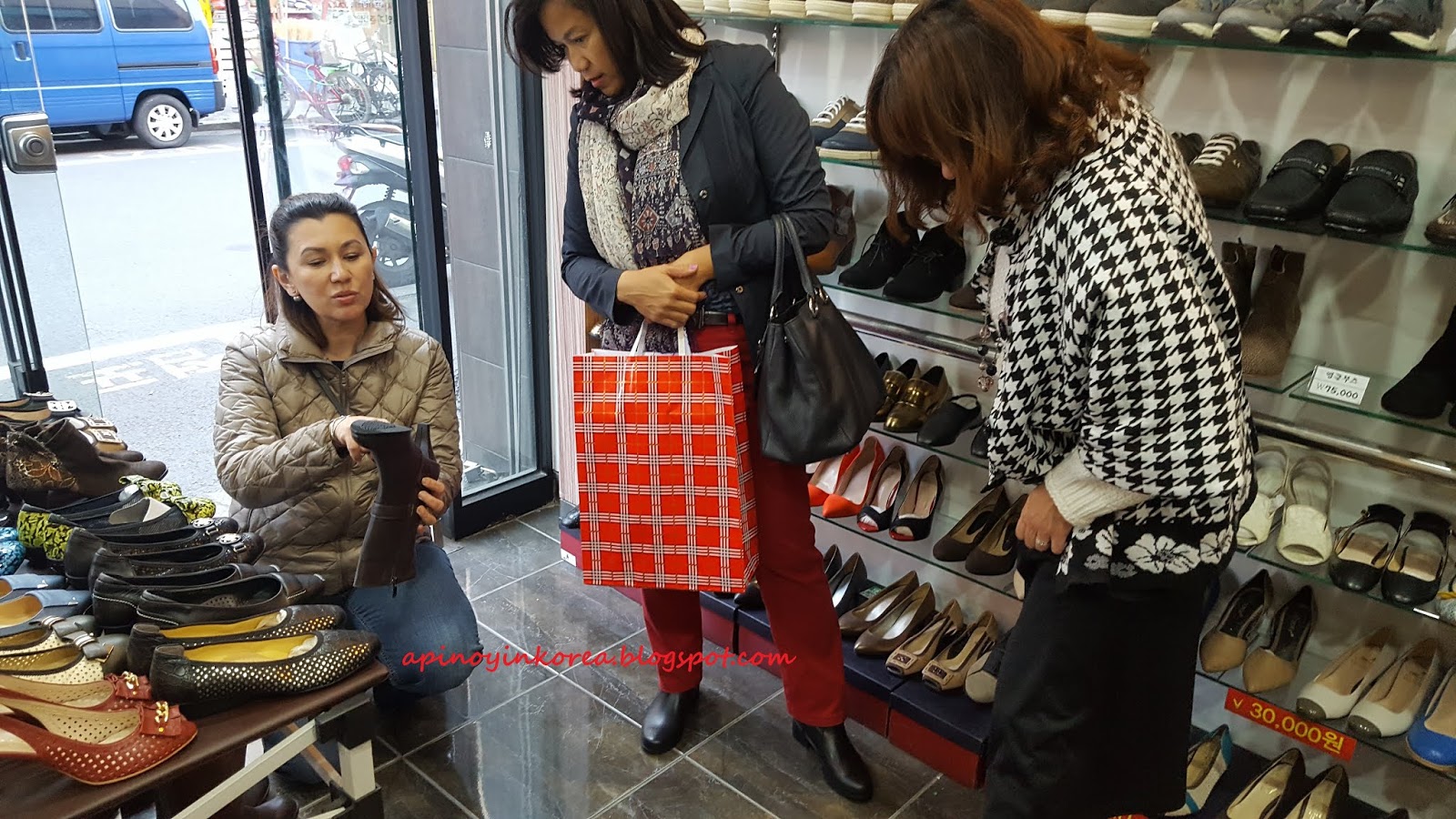
(Veronica, Gail, and Wendy shopping for shoes)

The owners of the stores we visited told us that they could even tailor-make shoes for us. We could just choose a design, pick the leather, and get our foot measurements. And after a week, he could just text us if the shoes are ready for pick up! 

Since you're buying from the shoemaker himself, the prices are so reasonably low! So much lower than the ones sold at the department stores! 

(Happy shoppers!)

Common Ground shops and cafes
The other interesting corner near Seongsu-dong is Common Ground, an open area full of blue container vans that were turned into shops, restaurants, and cafés.
(A red shoe)
                            (A gold shoe)

Common Ground is already part of the neighboring district, Gwangjin-gu, and it's about 700 meters from Exit 3 of Seongsu Station. But it's worth visiting if you're in the area. From there, just walk eastward towards the direction of Konkuk University Station until you see piles of blue-colored container vans. That's Common Ground.

These multi-layered commercial spaces, made from container vans, even have a 'rooftop', where you'd find open-air restaurants, food stalls, and an ice cream counter. On the ground, a small entertainment corner and food trucks occupy the open area.
                (Everyone's favorite at Doré Doré)

If there's one thing that would bring me back to Common Ground, it's the cafe that serves rainbow cake. The multi-colored layers are separated by white cream and it's heavy to the tummy. Heavy because I had a slice all to myself!

If you want to visit Common Ground on another day, it's closer to Konkuk University Station. It's about 200 meters from Exit 6.
      (Inside the container vans are 
pop-up shops and cafés)
      (Common Ground's open space with 
a stage and food trucks)

I know the shoes sold at Seoul's department stores are a bit pricey. So, here at Seongsu-dong, just like the bags at Dongdemun's NPH bag market (read blog here), you have cheaper options. And you can have a pair tailor-made, too!

So, gather your shoe-loving friends and drag them to Seoul's shoe center. Who knows? You might bump into Carrie Bradshaw herself.😀
(Let him eat cake!)


#seoul #Korea #shoes #seongsudong #konkuk #konkukuniversity #tourist #kdrama #carriebradshaw #kpop #shopping

Monday, 10 December 2018

Sightseeing in Seoul: The Insta-Popular #Insadong

Yes, Insadong is one of the most popular spots in Seoul for local and international tourists. 

Just like other famous Seoul attractions such as #Hongdae, #Gangnam, #Myeongdong, and #SeoulTower#Insadong is also a popular hashtag mention, and I don't wonder why.

The first time I walked around Insadong more than a decade ago, it felt like a throwback to an old Seoul with its cobblestone walks and traditional artisan shops. Although this place is slowly turning modern with galleries and cosmetic shops, Insadong, in the olden times, was a place for artists and craftsmen given its proximity to Gyeongbukgung Palace.


(A flash mob at Insadong)


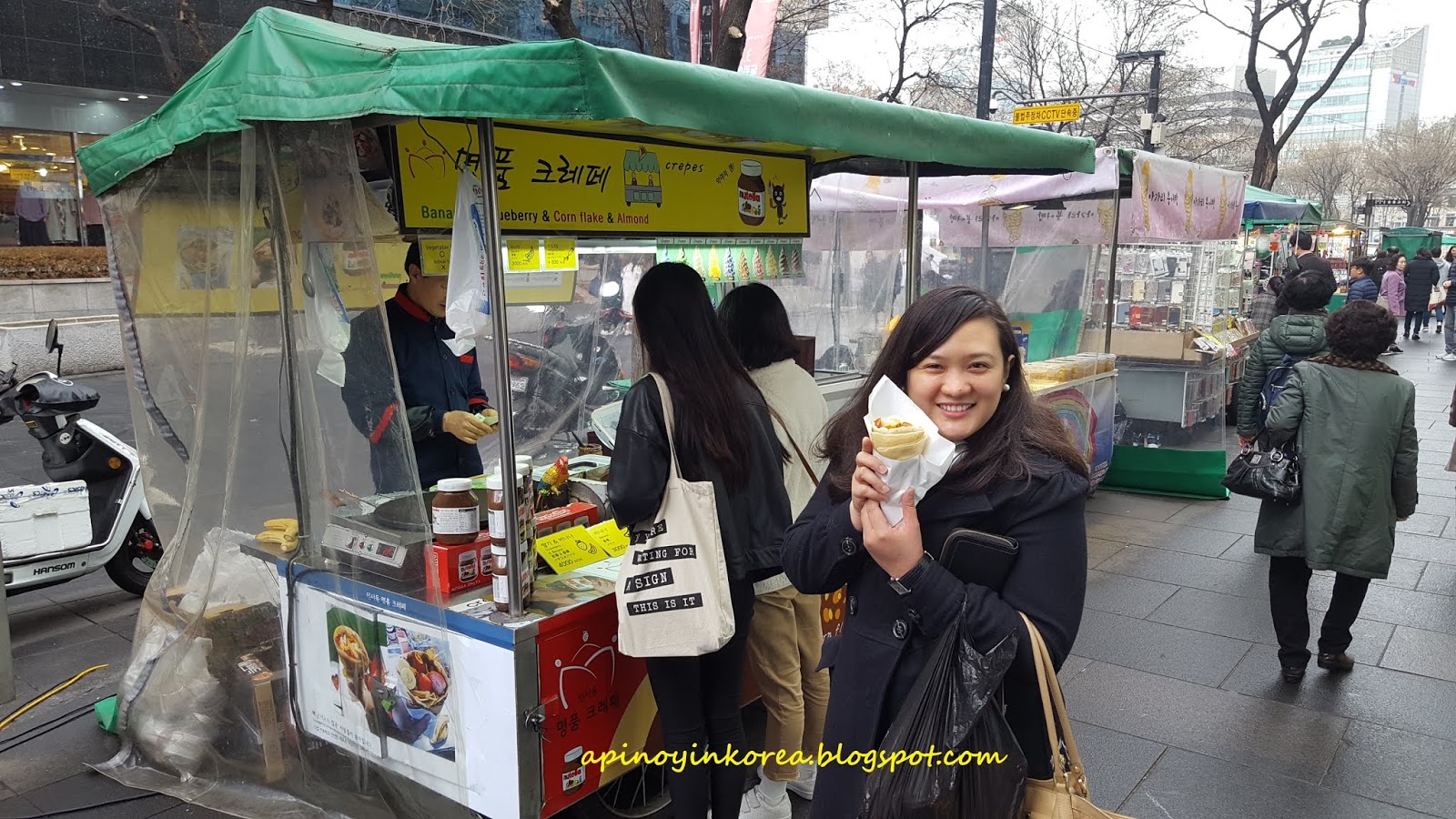
Insadong is a must-visit place when you're in Seoul because it's not only a place of traditional artisans and galleries, it's also full of interesting cafés and restaurants. On the main street, you'd find enterprising vendors selling Korean sweets, magicians, and food carts like the one selling my favorite strawberry-banana-Nutella crêpe.

Straight from my photo albums, here are my fun memories of #Insadong.


(Giant inflatables invade Insadong)


Insadong flashmob
This was the most fun day I had at Insadong. Why? I wasn't just a tourist; I was taking part in an 'instant' tourist attraction!

A few years back, during the launch of the Korea In Motion campaign, I got to participate in a flash mob activity by documenting its 'behind-the-scenes' story as a member of the K-Performance Supporters, a group of bloggers whose job was to help promote Korean tourism.

Of course, I didn't even think of volunteering to dance with the pack, lest I wanted to ruin the whole campaign.😄 Insadong was the best place to hold the flash mob as it was always full, although I was thinking, if it were held in Myeongdong, that place would have been too crowded for all the dancers, giant inflatable mascots, and camera crew.


(B-boys join the flash mob)


From their rehearsal in the morning until the flash mob in the afternoon, the day spent in Insadong was worth the excitement and the fulfillment that I was able to help promote Korea In Motion.

(B-boys join the flash mob)

A Jongno weekend
Insadong's location is perfect for tourists with limited time in Seoul. Since it's located in the Jongno District, which has a lot of tourist spots, one can just walk around its neighboring attractions like the Gyeongbuk Palace, Changdeok Palace, Tong-in Market, Bukchon Village, Samcheong-dong, and Jogyesa Temple.

That's why when, as a member of the Global Seoul Mate program, I spent a weekend pretending as a tourist in Seoul as a paid challenge (yes, the Seoul City government paid for my tourist expenses!), I chose to book at an Airbnb next to Insadong. It was not just very convenient and easy, it was also fun! I got to visit a lot of places around the area and savor Korean dishes and snacks like a tourist and got paid for it!

Insadong's mandu restaurant
And if there's one place in Insadong that I would go back to every now and then, it's Koong Mandu, Seoul's best mandu restaurant. Over the years, I brought friends here for lunch or dinner, including my former colleague, Agnes, and her pals when they were in Seoul. The grandma's yummy mandu recipe has been a reason why people keep coming back over the years.

And because Insadong was just five minutes away from Jongno's beer alleys, we simply walked towards the direction of Cheonggyecheon and continued the night with beer, chips, and stories.


               (My friends Fay and Joy about to 
                 enjoy mandu at Koong Mandu)

Although Insadong has restaurants that serve western cuisine, it should be interesting for tourists to enjoy the popular Korean dishes like my favorite mandu!


       (Joy, Loren and Fay at their 'Expressions' exhibit at an Insadong gallery)

Art galleries
Showcasing local painters and artists, Insadong has galleries as well as shops where you can purchase materials for your painting handicraft hobbies.


         (Fay, Loren and Joy at their 'Expressions' exhibit at an Insadong gallery)


When my friends Fay, Loren and Joy had a painting exhibition, they held it at Kyung-In Museum, one of the galleries in Insadong. That gallery, coincidentally, was located just across Koong Mandu, where we had lunch to celebrate their exhibition.


               (My mom and sister at Ssamziegil)


(My mom window shopping at Insadong)

Sightsee-Insadong
When I toured my mom and sister around Seoul, I made sure they got to see Insadong's interesting galleries, artisan shops, and cafés by walking its cobblestone main alley.


Ssamziegil, right in the middle of Insadong, is the most popular place to visit. This square is actually a 'street' because it's called 'gil', the hangeul name for 'street'. The building's design enables one to ascend to higher floors without taking the stairs.


Insadong welcomes Patricia 
And the latest guest Insadong welcomed?  Patricia

My niece, Patricia, recently came to Korea to work and I just had to introduce her to Insadong just as I did my family and friends. Patricia got to know Insadong by strolling around its corners and alleys after our lunch at the Philippine market in Hyehwa-dong  along Daehangno in the Jongno District.


                 (Patricia on top of Ssamziegil)

From our heavy lunch of Filipino dishes, we just had to walk off the few calories we gained that day, and climbing all the way up to the rooftop of Ssamziegil helped. 


(Patricia ordering her crêpe)

But since we didn't have our dessert yet, I brought Patricia to my favorite crepe stall at the end of Insadong. 

For KRW3,000, the ajussi prepared the yummiest strawberry-banana-Nutella crêpe right in front of Patricia. To pay, Patricia simply dropped the KRW3,000 at a small box on the table. For sanitary reasons, the ajussi doesn't touch the cash; he simply lets his customers drop their payment and get their change, if any, from the box.


(Patricia enjoying her 
strawberry-banana-Nutella crepe!)


Since she now knows the interesting shops, cafés, and galleries of Insadong, Patricia can also bring her family and friends visiting her to this place as well.

Just like other tourist attractions in Seoul, Insadong has its special vibe and character not found in any other place in the city. It is unique on its own and you have to visit it to feel it.

So, have you also visited the Insta-popular Insadong lately?  

By the way, here's the video of our #Insadong flash mob:


Wednesday, 28 November 2018

Victorias City, Negros Occidental, Philippines: School Zone or Ukay-Ukay Zone?

The Mission of the Department of Interior and Local Government of the Philippines:

The Department shall promote peace and order, ENSURE PUBLIC SAFETY, strengthen capability of local government units through active people participation and a professionalized corps of civil servants.

                           *   *   *   *   *

I first posted this photo on November 23, 2018, on the 'Victoriahanon Kami' Facebook page taken from the southern end of a crowded Yap Quiña St. in Victorias City, Negros Occidental, Philippines. 


School Zone or Ukay-Ukay Zone?
The photo I posted shows Yap Quiña St. where the entrance gates of the Victorias Elementary School 1 (or VES1 as parents and teachers call it) are located. (Years ago, the Victorias Elementary School was divided into VES 1 and VES 2 because the student population was so large that it couldn't be managed by one school principal alone. This street is used by VES 1).


'Ukay-ukay' is a Filipino term for a flea market selling used clothes and other items. The term came from the word 'halukay' that means to rummage.


                     (Not Instagram-worthy
                  but worth raising the issue for)

The only thing wrong about the photograph was that, on the right side of the photo, UKAY-UKAY stalls that stretched from one end of the street (at Victorias Commercial Center side) up to the end other (bordering Montinola Street) have eaten up the sidewalk and part of the street on that side where the schools' gates are!


(A part of the map of Victorias City showing 
Yap Quiña St. littered with red spots representing ukay-ukay stalls in front of VES1)


The scene caught my attention because the school children and their parents were being squeezed between the stalls and the passing tricycles and other vehicles. Anyone of them could be sideswiped! 😓And this happens in the morning when the kids go to school, at noon when they are fetched and brought back to school again, and in the afternoon when they leave for home.

Here is an actual video of the scene taken on November 26, 2018, at 7AM when kids and parents (and a few lolas!) arrive at school. The entrance gate to the school is hidden behind the ORANGE tarpaulin tents of the ukay-ukay stalls.


After I posted, a lot of commenters agreed about the risk faced by the children, their parents, and teachers as they go to school, and other pedestrians that also pass through this street.

Of course, a few commenters bashed me for complaining on behalf of the kids and their parents. I simply shrugged off narrow-minded creatures. They're not worth my keystrokes. Ha-ha-ha!😆

But I wondered, like the rest of the Victorias citizens, WHY the Barangay 4 officials and the Victorias City government gave business permits to these ukay-ukay stalls. In my post, I asked for them for any reaction or response, but there was none.😞


                                (Tarpaulin ukay-ukay tents being 
                 set up on November 20, 2018)

The stalls were set up on November 20, 2018, a Tuesday, when there were no classes due to Typhoon Samuel's Signal No. 1.

          (The ukay-ukay tents eat up the SIDEWALK 
      and part of the street adjacent to the school)


Since the suspension of classes for two days was announced the day before, the ukay-ukay vendors probably decided that it was the best time to put their stalls up and surprise everyone - the students, their parents, the principal and teachers - on Thursday, the next school day.

       (The ukay-ukay tents eat up the SIDEWALK 
        and part of the street adjacent to the school)

On a sad note, however, a few mothers messaged me that they worry every day as their own kids face this risk of having an accident. One mother told me that she works away in Manila and that she's worried that she's not around to watch her kid go to school every day.


    That's the school's name hidden by the stalls. 
                 The new name should be: 
Mababang Paaralan (at Presyo) ng Ukay-Ukay


One grandmother, Lola Belen, told me personally that she and her apo (grandkid) have to be careful about the danger on that street and that the authorities even closed the gate where they usually enter.

Another grandma, Lola Lydia, also told me personally that whenever she brings her grandkid who goes to VES2, they avoid this street. She also told me that they should relocate those stalls for the simple reason that people who want to buy from the ukay-ukay stalls will go wherever they are located. See? You don't need a grandma to disprove the local government's logic of putting them there. 


 (Ukay-ukay stalls compete for space vs 
 students, tricycles and other vehicles)

      (Is it a SCHOOL zone or an UKAY-UKAY zone?)


According to the Mission of the Philippine Department of Interior and Local Government, they should ENSURE PUBLIC SAFETY.

But in this case, it seems in Victorias City, the mission is impossible.😢

Have a walk with the students through the ukay-ukay, er, school zone and decide for yourself:


PS. This blog is dedicated to the mothers who messaged me about their concern for the safety of their children every day. 😭

Tuesday, 20 November 2018

The Gaston Mansion: A Heritage Treasure Hidden in A Philippine Hacienda

I would have designated this mansion a national treasure a long time ago; this very rare gem of a home is so beautiful you wouldn't believe you're not in a movie set. But ironically, it's been turned into a movie set! A lot of times!

On this side of the Negros island, particularly in Silay City in the north, 19th and early 20th-century ancestral homes have been diligently preserved by landed families, turning their homes into a showcase of the city's history and heritage.

While the neighboring Talisay City boasts of its most famous historical landmark, The Ruins (read blog here), a 1920s mansion that was deliberately torched during WWII and whose silhouette and history were turned into a tourist attraction, Silay City, on the other hand, has Balay Negrense (read here), also well-preserved Gaston family mansion completed in 1901 that, other than being an attraction itself, hosts a celebration of the city's culinary heritage 'Kaon Ta!', my mom's favorite. 

But closer to my hometown is another beautiful mansion. This one's even more special. Why? It's a real home!
(This dirt road belies what treasure lies ahead)

The Gaston Mansion in the middle of Hacienda Santa Rosalia in Manapla on the northern part of the Negros island in the Philippines was built in 1935, and it's very well-preserved and still postcard-perfect that it has been featured in many period movies like Oro, Plata, Mata; Sonata; and Everyday I Love you. 

And since the mansion is just close by, on one pre-Covid weekend, we visited Monsignor Guillermo 'GG' Gaston, whom we personally know, in his mansion. Yes, that's why I called this mansion a real home because he still lives there. It has five rooms on the second floor and four rooms on the ground floor.

Monsignor GG is a Catholic priest and one of the eight children of Don Jose Gaston and his wife, Doña Consuelo Azcona-Gaston. Don Jose, coincidentally, has appeared in two of my previous blogs: the first was about a 1940 photograph at Don Felix Montinola's home in Victorias (read blog here), and another was about a 1961 photograph while having lunch with President Diosdado Macapagal (read blog here).

According to Monsignor GG, the land on which the Gaston Mansion now stands was originally owned by his grandmother's family (Doña Rosalia Policar who later married an Azcona) as his father's family's (the Gastons) hacienda was situated in Victorias, the next town to the south. Monsignor GG's mother was Doña Consuelo Azcona-Gaston, a daughter of Doña Rosalia Policar-Azcona. In those days, the tradition of naming the hacienda was by using the name of a saint who was a namesake of the hacendádo, or haciéndero.

(Workers in Hacienda Santa Rosalia 
on their way to work)

During our visit, I had to ask Monsignor GG about their family name, Gaston. I studied French and the name Gaston was a given name (and not a family name) that was always used in our French textbooks as an example, and my hunch was right! 

Their family name was actually Germain, a French surname. Why did it become Gaston? During the Spanish period, when the Spaniards were registering Yves Leopold (Monsignor Gigi's great-grandfather), the Spaniards mistook Gaston as his family name, instead of Germain. His full name was Yves Leopold Gaston Germain, and the Spanish registrars thought Gaston was the apellido paterno (father's surname) and Germain the apellido materno (mother's surname) because that was the way they wrote their names in Spain (given name, father's surname, and mother's surname).

And so Gaston became his and his descendants' last name. Yves Leopold, by the way, was from Lisieux in the Normandy Region of France and is credited for bringing to the Negros island, in the 19th century, the sugar technology that changed the province's landscape (literally!) and fortunes forever.


(The Germain, er, Gaston family genealogy 
starting with Yves Leopold and wife Prudencia is 
divided into three main branches, representing 
their three children, using France's 
colors: white, blue and red. 
Monsignor Gigi belongs to the blue branch.)


When the mansion was being built, the construction was slow as it was meticulously supervised by Don Jose himself. The furniture in the mansion was all made within the grounds and everything is still kept in the mansion until today as the family has decided to keep everything as it was since the early 20th century.

The mansion's architecture is Victorian and is surrounded by beautiful gardens, fruit-bearing trees, and sugarcane fields all over. It's less than 800 meters from the main national highway from where you wouldn't be able to tell that there's a gem of a home somewhere down the road.


(While Talisay City's The Ruins is the most Instagrammable silhouette, this mansion is the most popular mansion for film and photo-shoots.)

(If only these steps could talk, it would 
enumerate the who's-whos who visited 
the mansion from 1935 until the present.)

At the back of the mansion, Monsignor GG built a place of worship, The Chapel of the Cartwheels, in 1966 after he came back from Rome, Italy, where he completed his theological studies.

Using the old, discarded cartwheels kept by his father, Don Jose, Monsignor Gigi turned these as symbols of a Christian faith: the center represents God; the spokes represent Jesus as they point and connect to God at the center with Jesus being 'the Way to the Father'; and the Holy Spirit, represented by the ring of the wheel, keeps everyone from being lost. 

(An enchanted garden in front of the mansion, a fountain, and two statues created in the likeness of two of Don Jose's daughters, and a visitor😃. The statue in the background is the Virgin Mary.)

The cartwheel is the Holy Trinity and is the everyday symbol and reminder for the sugarcane workers in the hacienda. Although the cartwheels fell into disuse due to technology when they were replaced by rubber tires, they have been elevated into a holy symbol of the hacienda's chapel.  

(The Chapel of the Cartwheels is Monsignor 
Gigi's thanksgiving for all the blessings 
bestowed on his family)

With the help of Monsignor GG's brother-in-law, Jerry Ascalon, an architect, the Chapel of the Cartwheels was completed, where the first Holy Mass in Hiligaynon was celebrated by then Bacolod Diocese's Bishop Antonio Fortich on May 5, 1967. Monsignor GG made the first ever translation of the Liturgy from Latin to Hiligaynon and had choir hymns in the local language prepared for that Mass. They had to ask permission from the Catholic Church in order to have the Mass celebrated in Hiligaynon, and not Latin.

(The cartwheel's center, spokes, and ring 
represent the Holy Trinity)


The Chapel of the Cartwheels was built on the former site of Monsignor GG's grandparents and it's his thanksgiving to all the blessings showered on his family.

But do you know their mansion could not have survived World War II if not for a miracle?😟

(The Chapel's cross against the blue skies)

During the last days of World War II, one terror-filled morning, at about 4AM when it was still dark, the Gaston family was awakened by a big fire at the main town of Manapla, about three kilometers northeast of the hacienda. The fire, visible from the mansion's rooftop, was caused by the retreating Japanese soldiers coming from the north and who were setting big structures, including mansions in the haciendas, on fire along their way.

Word reached the hacienda that the Japanese soldiers had already torched the nearest mansion, Benjamin Gamboa's mansion, located near the main road just outside Manapla. A man, who was probably a hacienda worker sent to find out what was going on at the outskirts of the hacienda, came back with the bad news and told Don Jose the scariest words he heard that day, "Daw kamo na guid ang dason", or "It looks like you're next" in English

Monsignor GG was just 14 then, and I could just imagine the trauma kids his age (or even younger!) experienced that tragic morning. But Don Jose, who was a devotee of the Sacred Heart of Jesus, prayed with his family for safety and surrendered everything to God's will.


Two trucks carrying the Japanese soldiers were already making their way through the dirt road going into the hacienda and were probably itching to, not only to set the big house on fire, but also to bayonet and kill anyone they would see or offer resistance at the hacienda grounds. (During their years of occupation, the Japanese military had mapped these areas and knew exactly where those mansions were located).

Although Don Jose, his family, and his servants and their own families were able to immediately flee to safety away from the mansion and towards the direction of the coast, Don Jose thought his family's home would suffer the same fate as the others. But suddenly, out of the nowhere, from the dark skies above that was beginning to see morning light, an American Northrop P61 plane appeared and strafed the Japanese and their trucks.

The Northrop P61 was nicknamed by the American military as 'Black Widow' and was specifically made to be a night-fighter plane. It only carried three crews: the pilot, the radar operator, and the gunner. So even in the dark, the radar operator must have seen the Japanese trucks heading towards what looked like a big house in the middle of a plantation. Immediately, the crew decided to fly low and strafed the enemy from the sky. The strafing must have caused some casualties because the Japanese immediately turned around and left Hacienda Santa Rosalia alone. As these soldiers had been moving around since the day before torching houses and blowing up mansions in the north, they must have been very tired, hungry, lacking sleep, and worse, losing morale as they realized they were about to lose the war.

Indeed, Don Jose's prayers were answered by a miracle from above, figuratively and literally.

(Fresh breezes, fruit-bearing trees, and 
birds singing greet anyone standing on 
the mansion's northeast balcony)

Just like Iloilo City's Camiña Balay nga Bato (read blog here) whose original furnishings and furniture were also preserved by the family, I also admire and commend the Gaston family for preserving their home and sharing their family heritage with the mansion's visitors and admirers, including moi


So, merci beaucoup à Monsieur Yves Leopold and his descendants for giving us the Germain, er, Gaston Mansion.😉

To Monsignor GG, hopefully, we can visit Hacienda Sta. Rosalia when this pandemic will have blown over.😊

                                 * * * * *

Here is Hacienda Sta. Rosalia's Facebook page: