Thursday, 13 October 2016

The Real Madrid: Puerta del Sol is The Gate of the Sun

It's actually the gate to all of Spain.

Why? Because it's where you can find the 'zero kilometer' mark, where all roads leading to all of Spain originates.

           (Standing on Kilometer Zero)

Puerta del Sol, or the Gate of the Sun, sits in the middle of Madrid. It's a popular square where, since the 15th century, people have gathered. The square is oriented towards the east; hence, the name.

Now, in the 21st century, it has even become more popular, gathering performers, international tourists, vendors and perhaps, a few pickpockets, right in front of the Spanish Post Office building, and right under the nose of Tio Pepe, a famous brand of Spanish sherry.
(An equestrian statue of King Carlos III 
                    in the square)

(A young Spanish student doing a 'challenge' by proposing 
before Minnie Mouse)

Walking from Plaza Mayor, I ended up in Puerta del Sol just following the trail of jamon shops, cafes and stores selling abanicos and spanish tartas.

I actually asked for directions at the Madrid tourism kiosk inside Plaza Mayor for a place to buy stamps for my postcards, and the señoritas told me to go to El Corte Inglés, the Spanish chain of department stores. Well, I finally found the small office selling stamps at the basement of the department store, but, sadly, until now, the postcards I sent home from Madrid never came.

And going to El Corte Inglés from Plaza Mayor, one has to pass through Puerta del Sol, and watching the street performers and interesting statues at the square was just an added bonus on my way to the department store.

One important thing to always remember though was to make sure your wallet or bag was safely tucked in front of you. It was always good to secure your things than to lose them while being distracted with all the interesting things around you, especially in crowded places like this square.

(Un hombre creating some bubbles 
for passers-by)

(Street performers 'defying' gravity)

I was able to pass through Puerta del Sol a few times more during my days in Madrid. It has a subway station 'Sol', which brought me to the beautiful Atocha Station on my way to Alcala de Henares.

And if it's interesting during the day, at night, it also features Spanish b-boys doing breakdancing right in the middle of the square, also attracting crowds and tourists. 

So, if you just got into Madrid from a long flight somewhere, it's always good to have some sun to counter the jet lag. And where to get some sun? 

At Puerta del Sol.

Friday, 7 October 2016

Calling American Tourister! Your Luggage Broke Again!

I give up! 

This American Tourister's Zavis Spinner model luggage gave up on me twice already! 
(Weighing my brand new luggage in January 2016 at the Ninoy Aquino International Airport in the Philippines)


January 2016: When I arrived at Incheon Airport from my flight from the Philippines, the handle of my three-day old luggage was gone! I thought it was just a case of poor handling by the airport baggage handlers.

A week later, I had no choice but to bring the damaged luggage to a Samsonite repair shop in Seoul, Korea. I had to waste time and spend money on cab fare for a supposedly new luggage!

(A new luggage with top handle missing upon arriving at Incheon International Airport)

Without its top handle, it was difficult for me to pull the luggage off from the conveyor belt! It was dangerous as I could have twisted my wrist! 
            (Waiting for the airport bus 
              with handle missing!)

Even the Korean baggage handler and the Korean driver of the airport bus were not happy when they saw that they had no top handle to hold on to! I had to apologize to them!

Weeks after that, I got the repaired luggage from the Samsonite repair shop in the Yongsan District in Seoul. Again, I had to waste time and spend cab fare to pick it up! And it was winter and I had to go out!

Fast forward, August 2016. Summer time!

I was traveling back to the Philippines, and the most disappointing thing happened again! 

I was bringing the luggage down from my apartment on my way to get a cab when that same top handle broke off again!

I was so disgusted and angry as I was just a few hours from my flight and I had no spare luggage to use! I had to make do with this broken luggage again, carrying the almost 30-kilogram weight from the pull-down handle that twisted my right wrist! And to think that I am a tennis player!   

I had to endure the inconvenience of traveling through two international airports and one domestic airport with a luggage with no top handle!  And that's just ONE-WAY!

Going back to Seoul and passing through three airports were a repeat of the torture!

Since I received no help from Samsonite in the Philippines even with messages through their Facebook page, and even from the SM Department Store in Bacolod City after personally visiting them and asking them for help, I resigned to the fact that American Tourister and Samsonite just didn't care about after-sale customer service! Once, they get your money, you're on your own!

I even lodged a complaint at the American Tourister website more than two weeks ago; I never received any response until today. 

So, I am calling American Tourister and Samsonite! What do I do with this broken luggage?

I demand an apology and a new luggage! Perhaps, some model that should not fail me again!

I am posting and tweeting this today, October 7, 2016. Let me see how fast (or slow) you'll respond.

#Disappointedcustomer #badproduct

Alcalá de Henares: La Casa de Miguel de Cervantes

Wandering around the center of Alcalá de Henares (read blog here) on foot even without a map was as easy as munching down churros with a hot cup of chocolaté (blog here). Each turn was as interesting as the street before, just like each churro bite was as interesting as the one I just gulped down.

And since I was in the birthplace of the great Miguel de Cervantés, it was a must that I visited his casa. And right along the Calle Mayor, his home welcomes admirers of his literary works, as well as tourists.


The tour of his home is free, and thanks to the Comunidad de Madrid that turned his ancestral home into a museum, it is well maintained with professional curators watching over the place all year round.
                  (La puerta de la casa de Cervantes)

To keep the house protected, they extended a plastic roof over the house to add a cover over the yard sitting in the middle of the house. But according to the curator, the temperatures around the area weren't that freezing or scorching during the time of Cervantes. They were just generally mild, as far as I understood his spanish. Yes, I had to make use of my years studying spanish at school and at Instituto Cervantes. So, I conversed with the curators in the language Cervantes wrote his works in, and I think I probably understood what they were saying. I think.😅

(Grade schoolers playing around the statues 
of Don Quixote and Sancho Panza)

I had to buy a souvenir from the museum, and I got me a book about this famous casa in Alcalá. And coincidentally, Seńor Juan Jose Lleno, one of the curators, told me he had an ancestor named Fernando de Campo Redondo, a friar who used to live in Manila during the 18th century. I was surprised Señor Juan could remember his own ancestors from three centuries ago! He must be a very good historian.

                 (I think this is the fanciest arinola,                  or chamber pot, I have ever seen. 
           It's sitting inside a bedroom.😃)

As I roamed around the Cervantes house, I wondered which part of the house Miguel would sit down to write his stories. He probably would have picked the most quiet corner and just scribbled on because, as the house was along Callé Mayor, it would have been a noisy area. Or perhaps, he would walked to the nearby gardens and wrote from there?

Just outside the house are statues of Don Quixote and Sancho Panza, a very popular photo spot. That day, a few grade school students were having fun posing with the two famous characters created by Miguel de Cervantes. These students probably have studied his works and might have had some fun doing so. 

(Young students posed with Don Quixote 
and Sancho Panza)

And just like those young Spanish students, being welcomed to the Cervantes home by Don Quixote and Sancho Panza, I also learned a few things about the man who became the greatest writer in the Spanish literary world.


¡Muchas gracias, Don Miguel!🙏
(Pretending to be reading the book about 
Miguel de Cervantes' house. Muchas gracias, 
Señor Juan for taking my photo!)

Thursday, 15 September 2016

Finding Miguel De Cervantes in Alcalá De Henares!

On the day I went to Alcalá de Henares, from my hotel in Madrid, I took a short subway ride from the Sol Station (at Puerta del Sol) to Atocha Station (read blog here). And since I already knew how to buy my train tickets from the ticket machine from my look-see the day before, I came, I bought, I wandered! Wandered through the station and caught my train to Alcalá de Henares, that is! 

                       (The reliable Renfe train)

The train ride from Atocha Station to the Alcalá de Henares Station was just about 23 minutes, and I was surprised I was the only passenger in one of the cars!😍

                   (I had the train all to myself!😎)

I got there at noon, and unfortunately, the tourist information kiosk next to the train station was closed; I needed a map! Instead, I asked for directions from the taxi driver waiting by the station. And thanks to his help, I was able to find Calle Mayor after 20 minutes of walking through the residential neighborhoods.

Alcalá de Henares means 'a fortress by the Henares River'. Yes, there's a river near the city.

                   (The younger side of the city)

Alcalá de Henares has an ancient settlement that dates back before Romans came to Spain. It's about 35 kilometers east of Madrid. This is 'a city of three cultures' that include Moorish, Jewish and Christian cultures, and is a UN World Heritage Site.


                               (Calle Mayor)

                                 (Fall sale) 

When I was planning the itinerary for this tour, I decided to include one trip outside of Madrid, and after studying the map, I decided on Alcalá de Henares because, one, it is the birthplace of Miguel de Cervantes, the author of the famous Don Quixote, and, two, I wanted to taste their rosquillas de Alcalá, a puffy, tall donut-shaped pastry bathed in egg yolk and sugar glaze! Yes, food and pastry should always be in one's itinerary, and not just history and palaces. 

               (The famous rosquillas de Alcalá)

Having covered on foot the younger streets from the train station up to the centuries-old Calle Mayor, I continued lazily around the old streets of Calle Escritos, Calle Sta. Ursula and ending up on Capilla de Oidor and Plaza de Cervantes. 

   (One of the oldest hospitals in Europe: Antigo Hospital Beneficio de Nuestra Señora de la Misericordia)

          (An entrance to the Universidad de Alcalá)

Passing through ancient alleyways and stumbling upon a hospital dating back to 1483, I was so fascinated knowing that this old city was flourishing even before Fernando de Magallanes arrived in the Philippines! 

And inside the Capilla de Oidor at the Plaza Rodriguez Marin, which was right next to Plaza de Cervantes, I visited an exhibition of the life and works of Miguel de Cervantes. 
                 (Visitors can climb the Torre de 
                     Sta. Maria on weekends) 

Behind the Capilla was the tourist information center and I was able to get a map. I asked the señorita whether I could climb the Torre de Sta. Maria. Unfortunately, she said, the Torre was closed that day. The 360-degree view of the city at the Torre could have been fantastic. 


In the middle of Plaza Cervantes was the statue of the most famous son of Alcalá de Henares. It was past noon when I walked around the Plaza; a few youngsters playing around, old señores sitting and chatting, a group of tourists and one Filipino eavesdropping as to what they were talking about. 😆

The statue of Miguel de Cervantes lords over his plaza as if always waiting to lecture his visitors as to why his works remain the most popular in the Spanish literary world.


          (Art works about Don Quixote 
           are everywhere in the city)

In Manila, I studied at Instituto Cervantes to improve my Spanish, and that afternoon, in Plaza Cervantes, I stood there looking up at the statue of the writer after whom the Spanish language institute was named. 

            (Students posing with Don Quixote 
                 and Sancho Panza in front 
                      of Cervantes' home)

I may never be fluent in Spanish, and I may never be able to read all the works of Miguel de Cervantes, but being there right in the middle of his birthplace and standing under his shadow should be a good start to learning about Spain's greatest writer.


                               *  *  *  *  *

P.S. I immediately ate two rosquillas de Alcalá when I got to my hotel in Madrid that afternoon. 😃

Next stop, la casa de Miguel de Cervantes (read blog here).

Monday, 12 September 2016

The Real Madrid: The Grandiose Atocha Station

Part of my Madrid tour was a side trip to Alcalá de Henares, the hometown of Miguel de Cervantes, Spain's greatest writer.

While researching before my trip, I learned that I had to take a Renfe train from Madrid-Atocha Station to Alcalá de Henares. On my second day, I took the tour bus around Madrid and hopped off at the Museo Reina Sofía stop to get to Atocha Station for a look-see.
      (Passing through Calle Mayor on the             Madrid hop-on-hop-off tourist bus)

But alighting at the stop and walking towards the station, I chanced upon KFC across the road, and since I was getting hungry, I decided to go in.

Interestingly, just like at Starbucks in Manila, Lidira, the KFC crew who took my order, asked for my name so she could call me when my order was ready. I told her, "Me llamo Alfonso, Rey Alfonso." ("My name is Alfonso, King Alfonso"). She smiled. I knew that the Spanish history was full of kings named Alfonso, and she probably smiled thinking that here was another pretender to the Spanish throne lining up at her counter and ordering fried chicken. Ja-ja-ja!

         (Fast food lunch fit for a king)

After munching down lunch, I hurried towards the Station, and even before I crossed the street, the whole structure was impressively huge. It didn't look like a train station; it looked like a sports stadium!
              (Atocha Station's dome)

Although the purpose of my look-see was to ask about the schedule of trains heading to Alcalá de Henares, I was distracted by the beauty of the whole station.

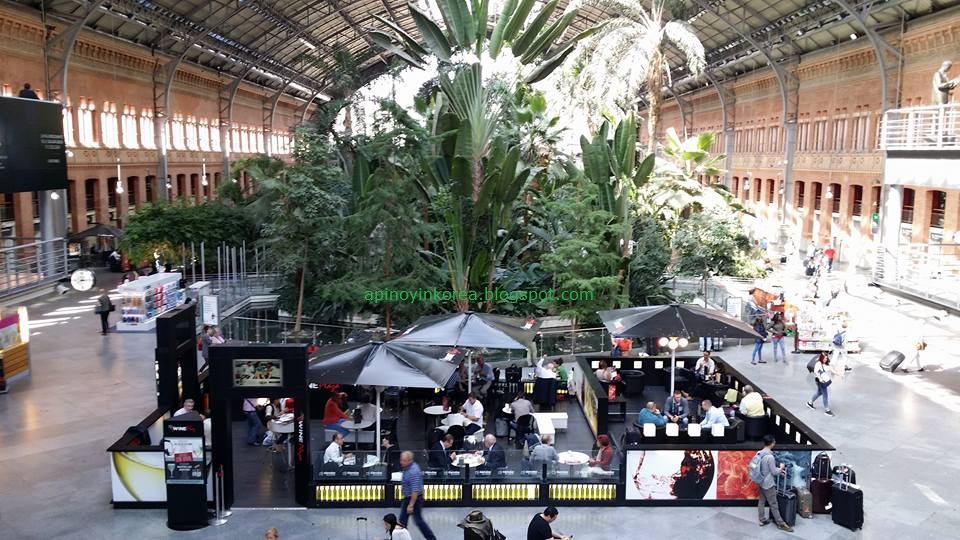
It was spacious with very high ceilings, airy and had shops, cafés, restaurants, a garden and a pond! With turtles! Lots of turtles! 

         (Turtles by the pond discussing 
                    Spanish politics)

The whole station was so interesting and unique that, if I didn't have a schedule to keep, I would have sat in one of the cafés, ordered coffee and watched commuters the whole afternoon! Atocha didn't feel like a train station; it felt like a plaza! It should be one of the most beautiful stations in Europe!

The station was inaugurated on February 9, 1851, under its original name Estación de Mediodía, but was rebuilt in 1892 after a fire. The architect of the 1892 structure was the Spanish engineer Señor Alberto Palacio Elissagne, who collaborated with no less than Gustave Eiffel, Señor Alberto's teacher. No wonder the station was all lines of steel and wrought iron that provided an 'industrial' feel.

(The Station's centerpiece clock telling the time through the wrought iron lines)

In the morning of March 11, 2004, coordinated terror bombings hit trains leaving Alcalá de Henares (which I was visiting during my trip), including one train heading to Atocha Station. One hundred ninety-two were killed, including one Filipino, and a memorial was built for the victims next to Atocha Station.   

                   *  *  *  *  *

Next stop, Alcalá de Henares.

Sunday, 11 September 2016

The Real Madrid: Plaza de Oriente, Royal Palace, and Queen Isabel II's Waistline

After meandering the ancient alleyways around Plaza Mayor and ending at Puerto del Sol, I suddenly felt my tummy complaining 'tengo hambre' (I'm hungry). 

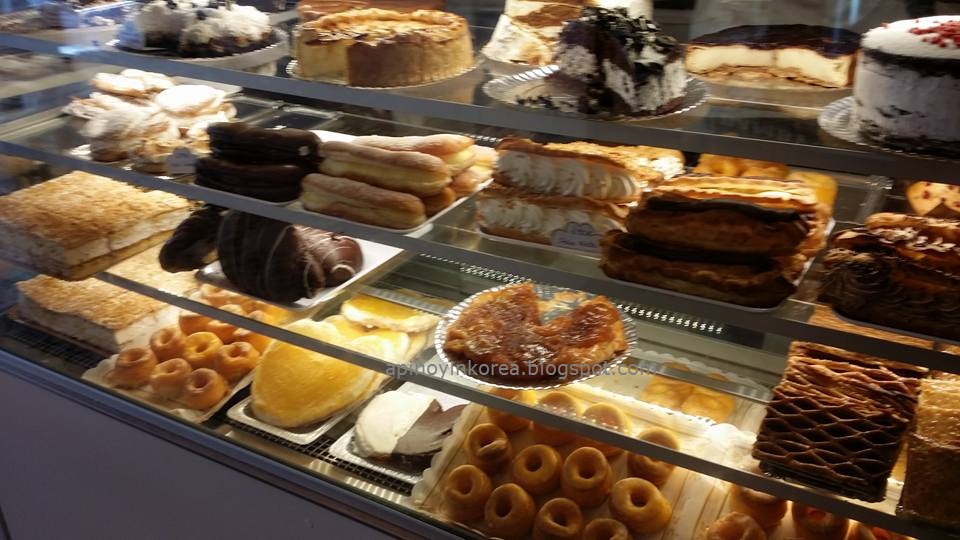
Though my eyes feasted with all the window displays of Spanish delicacies, spanish abanicos, bocadillo de jamon, tartas and brazos, my tummy was still empty! So, after dropping off my postcards at the post office at the basement of El Corte Inglés, Spain's largest chain of department stores, I headed towards Teatro Real, where the statue of Queen Isabel II stood.

El Corte Inglés was just a few meters out of Puerta del Sol, and tracing my Madrid map, I passed through again Puerta on my way to Plaza de Oriente.
   (Queen Isabel II before Teatro Real)

Before reaching Plaza de Oriente, I had to pass by Teatro Real, where the statue of Queen Isabel II stood, claiming sovereignty over the Opera Station, a subway station next to Teatro Real (Royal Theater), which hosts operas and theater performances; hence the station was named 'opera'.
                  (A royal waistline)

And while Queen Isabel II's subjects probably included commuters taking a subway ride, most of them probably ignore her quiet presence. But that day, one tourist became her curious subject, photographing and scrutinizing her statue. 

And something was not right, I thought. Her proportions were off! Ja-ja-ja!

I guess that's what I have learned all these years being an amateur photographer. I could easily spot what's not natural. If I could always spot a fake nose while walking around Seoul, spotting a fake waistline was easy. Queen Isabel II reigned from 1833 to 1868, and had I criticized her statue during those years, it probably cost me my head. Ja-ja-ja!

And by the time I was done admiring the queen's slim waistline, which bore no inflation from all the jamón ibérico, tapas, tartas (cakes) and bocadillos (sandwiches) she was served cada dia en su palacio, it was time for my own tummy to be filled.

I decided on a restaurant, and not just a bocadillo shop. Just like the queen, I had to be served. After all, there were 13 Spanish kings bearing my name; I crowned myself as the fourteenth. Ja-ja-ja!
(I wanted to order one plate of paella, but the waiter told me that the serving was too much for one person. Instead, he served me sliced tomatoes in Arbequinian oil and sprinkled with Maldon salt, bread and a mix of chorizo ibérico with Machego cheese. He didn't trust I could finish one paella.)

   (I asked Señor Paulo the marca(brand 
      of his delicious chocolate and vanilla
          ice cream; he didn't know.) 

The I reached Plaza de Oriente with a heavy stomach, burping as I stood in awe in front of the magnificent galloping statue of King Philip IV. The statue of the monarch riding a galloping horse was a tricky project. Its designer, Pietro Tacca, was worried that the statue would fall, considering that only the horse's two hind legs would be supporting the statue. But the Father of Modern Physics, Galileo Galilee, came to the rescue and calculated the weight distribution and design. He suggested that the elevated portion should be hollow, while the lower end should be solid, giving support to the whole elegant statue. I figured they had to consult the most famous physicist at that time, considering the king would also have been ignoring his own weight management with all the jamon iberico and tapas buffet in the palace.
             (Physics problem: how to balance 
           King Philip IV and his galloping horse)

               (Admiring a royal architecture)

Plaza de Oriente was actually to the 'east' of the Royal Palace; hence 'oriente'. And by the time I was done admiring the statues and sculptures in the Plaza, it was late afternoon and the Palacio Real, with all its 2,800 rooms, was closed. I wasn't planning to go inside anyways; I might just encounter a Spanish ghost and even with my basic Spanish, I figured we might not be able to understand each other. Ja-ja-ja! 
(Abre la puerta! They wouldn't let me in the palacio.)

                     (Cathedral of Almudena)

As expected, the Royal Palace looked magnificent but I was more fascinated with the architecture of the Cathedral of Almudena, completed in 1883, situated across the palace. I got there just as the sun was setting, and with the lights of the Cathedral bathing it, the colors of the sunset and the church were matching each other!
      (Soft light and shadows always bring 
      out the beauty of any architecture)


                      *  *  *  *  *

Fernando Magallanes (Ferdinand Magellan) left Seville, Spain, in August 1519 and arrived in the Philippines in March 1521, after about 21 months.

And I expected these two Madrid postcards, which I sent through the post office at the basement of El Corte Inglés for €2 each to arrive at my postal address in the Philippines for less than the time it took Magellan.

Sadly, the two postcards never arrived. :-(


Saturday, 10 September 2016

The Real Madrid Breakfast: Churros con Chocoláte!

Tired from dragging my luggage from Korea to Turkey, and then to Spain, and having not been able to sleep well in Istanbul, I finally got a good night's sleep in Madrid at Señor Tomas's Hostal Las Fuentes.

And walking around Plaza Mayor, Puerta del Sol (read blog here), Plaza España, Plaza de Oriente, Palacio Real and Almudena Cathedral from late afternoon till night added to the tiredness. I just had to squeeze in my visits to these places as I already lost a day due to Turkish Airline's delayed flight (read blog here)! 😨

If a journey of a thousand miles begins with the first step, mine began with a delayed flight! 😡

So, after waking up at 8AM the next morning, I immediately opened my hotel window and looked up the Madrid skies. ¡Buenos dias! 😊Time for churros con chocoláte desayuno (breakfast)!

      (Churros ready to be cut, served and enjoyed)

So, I just walked down a few alleys for about five minutes to Chocolatería San Gines, which was near the Church of San Gínes. This famous churros place is actually open 24 hours, but when I got there, I was the only one! I guess all the tourists in Madrid were still asleep!😴

"¡Hola! Churros con chocoláte, por favor!", I proudly blurted out to the señorita at the entrance, which was probably the same sentence the actual King Alfonso exclaimed when he sneaked out of the palace to visit this place in the early 20th century. 

I took a seat, surveyed the mirrors and black-and-white photographs on the walls, and convinced myself that I was not dreaming! I was finally in Spain and about to savor real churros with hot chocoláte! ¡Olé! ✈

I read somewhere that churros were first created by shepherds who needed snacks when they went out in the plains centuries ago. But thanks to those shepherds, today, churrerias are scattered all over Spain to feed shepherds without any sheep.

My churros con chocolate cost me €3.90, and although I have always enjoyed tablea chocolate at home made by my mom, the hot chocolate in the churreria was so rich and thick that you could feel the drink slide down your esophagus and settle heavily in your stomach! Que rico!


      (By the time I was done, San Gines was full!)

Aside from Chocolateria San Gines, I also visited its equally popular competition on the other side of the block, Chocolatería Los Artesanos 1902. But Los Artesanos have more variety of pastries compared with San Gines.
              (Señor churrero frying sus churros)

On the succeeding mornings in Madrid, I went to San Gines and had cafe con leche, pestiños and flor. Pestiños and flor are crunchy, sweet fritters popular in the Andalucian region of Spain. I decided I might as well enjoy all other breakfast goodies in the neighborhood.


                  (Cafe con leche, pestiños y flor)

When the shepherds during the old Spanish times created a batter and fried them into snacks, they might not have thought that, one day, the snacks they created would also bring such enjoyment, not just to the generations of Spanish families, but also to one tourist, who made his way through the alleys of Madrid and was welcomed with a cup of hot chocoláte and a plateful of churros! ☕