Showing posts with label Madrid. Show all posts

Wednesday, 17 May 2017

RENFE: The Train in Spain Stays Mainly in the Plain


           (Estacíon de Santiago de Compostela)

Before I flew to Spain, I was worried on how to move around from city to city. As I was doing my research, I realized, instead of flying between Madrid and Santiago de Compostela, or between Santiago and Barcelona, I could just take the RENFE trains and make those trips part of my tour. 

Even as I was preparing for my trip, I was already daydreaming of sitting on the train and watching the Spanish countryside go by while a guitar was playing Spanish Romance. Riding the train and watching the countryside would be part of my itinerary.


            (My seat on the train from Santiago to A                              Coruńa has a charger!)

                   (Ticket vending machines)

RENFE stands for Red Nacional de los Ferrocarriles  Espańoles, or National Network of Spanish Railways. And for me, it is the best way to see Spain if you're visiting several cities. No need to go through airports and squeezing oneself into domestic flights. Just hop into a cab and go straight to a train station.

Before I left for Spain, I tried to buy RENFE tickets through its website. Unfortunately, even after several tries, the website wouldn't let me. Even 'Irene', the RENFE online customer service assistant, wasn't able to help.


So what I did was to print a hardcopy of the train trips I needed to take with specific dates and target cities. I thought I could just present this when I queued at the RENFE ticket office when I got to Madrid. 

But as I was looking for the pre-paid airport transfer stand after landing at Madrid-Barajas Airport, I chanced upon a RENFE stand with one señor manning it. I immediately thought, perhaps, I should buy my tickets here already! So I went up to him and asked, "¡Buenas tardes! ¿Puedo yo comprar billetes aqui?

"¡Si!", he replied.

                 (My snacks on board the train. 
           I just bought Coke from the seńorita)

I whipped out from my handcarry bag the printout of my itinerary and just gave it to him. He asked me if I wanted 'Turista' seats or 'Preferente' seats. Of course, I was a turista! 

After he booked my tickets, I just paid with my credit card. This way, I saved on my Euros.

I was glad I bought my train tickets even before I left Madrid-Barajas Airport. I didn't have to spend time queuing at RENFE ticket office at Chamartin Station, which I later saw had a long queue.


          (The train has monitors showing the route 
            and the current location of your train)

On the day I left Madrid for Santiago de Compostela, I just took a cab from my hotel to Chamartin Station and my talkative cab driver talked to me about Pacquiao and Isabel Preysler after I told him I was from the Philippines. I think I ran out of Spanish during our 25-minute ride. Ja-ja-ja!

All in all, I had nine train rides during my vacación espańol, seven of which were short rides taking less than an hour. My ride from Madrid to Santiago de Compostela took about six hours, while the ride from Santiago to Barcelona took about 12 hours. 

My other short rides were from Madrid to Álcala de Henarés and back, from Ourense to Santiago de Compostela, from Santiago de Compostela to Á Coruńa and back, and from Barcelona to Monserrat and back.

 (I left Santiago de Compostela at around 8:30AM; I   arrived in Barcelona Sants Station at around 9PM)

When I bought the tickets, I asked for window seats because I wanted to see all the pueblos and open fields from my seat.

And as I sat there trying to figure out from my Spanish map the names of the cities, towns, and regions I was passing through, I remembered that, a few months back, I was only daydreaming about that moment, the moment of watching the Spanish countryside while Spanish Romance was ringing in my head. 


    (Tip: Put your suitcase on the next car if your          car's luggage corner is full. I put my ube maleta 
in the next car, and it was easy for me 
to retrieve when I got to my destination.)

It turned out, that sleepy song could never play in my head because sitting there watching the old cities, farms, rivers, and pueblos was interesting and fascinating. 

Well, though my trains in Spain really stayed in the plain, my rides offered me not just transports: they were part of my vacación, my travels, and my adventure!

¡Hasta la vista, Espańa!


Wednesday, 11 January 2017

A Pinoy @ The Movies: Assassin's Creed

This is why I liked the film: a sci-fi movie with 15th century Europe origins, lots of stunts and a Da Vinci Code-ish conspiracy!

When I saw the official trailer of Assassin's Creed, the interesting BASE jumping scenes from medieval Spain's towers and its intriguing genetics-slash-reincarnation-slash-medieval-Spain history were all I needed to decide to watch this. (BASE stands for buildings, antenna, spans, Earth - from which a BASE jumper jumps or takes off.)

As the movie's title says, Assassin's Creed is the story about assassins, whose main obligation is to fight the Knights Templar, the Pope's private army. This reminded me of Angelina Jolie's Wanted, where she also played an assassin for the Fraternity, a group of assassins who kill to change the course of human history.

The trained killers in Assassin's Creed were like ninjas who perfected the art of parkour, running through the narrow alleys of Madrid, jumping from rooftops and balconies while engaging their enemies in hand-to-hand combat. They also love to stand on rooftops to enjoy the view of the city.

The stunt director, as well as the stuntmen and women, deserves a Templar knighthood because, one, the action scenes in the buildings and narrow alleys of 15th-century Madrid and on the plains of Spain (where the rain mainly stays according to Eliza Dolittle!) were captivating, and, two, those stunts were not easy to do while wearing thick robes and passing through cafés serving yummy churros con chocolaté, and resisting to stop by. Ja-ja-ja!

Michael Fassbender, who played Magneto in X-Men: First Class, plays two characters: Aguilar de Nerha, an assassin during medieval Spain, and Callum, a convicted killer condemned to die through lethal injection in 2016. 

Marion Cotillard plays a scientist, who runs a high-tech laboratory in Spain, but whose accent is British when she's happy and becomes American when she's inside the lab.

Her father in the movie is played by Jeremy Irons, one of my favorite actors, who was elegantly sinister, just like in Reversal of Fortune, the movie that won him an Oscar.

Unlike Da Vinci Code, Assassin's Creed is more like an action film with a dash of sci-fi, conspiracy, and a few Spanish language lessons. Yes, if you speak a little Spanish like I do, you'd probably test your proficiency against the English subtitles while the actors deliver their Spanish lines. And you'd probably also realize that you badly need to review a lot of your Spanish lessons, too! Ja-ja-ja!

I didn't know this movie was based on a video-game series. But even if you're not a fan of the game, or even if you don't have an X-Box to play with after, you'd still enjoy the action scenes, the story and the Spanish lessons.


My favorite quote of the movie?

"We work in the dark to serve the light."

Monday, 12 September 2016

The Real Madrid: The Grandiose Atocha Station

Part of my Madrid tour was a side trip to Alcalá de Henares, the hometown of Miguel de Cervantes, Spain's greatest writer.

While researching before my trip, I learned that I had to take a Renfe train from Madrid-Atocha Station to Alcalá de Henares. On my second day, I took the tour bus around Madrid and hopped off at the Museo Reina Sofía stop to get to Atocha Station for a look-see.
      (Passing through Calle Mayor on the             Madrid hop-on-hop-off tourist bus)

But alighting at the stop and walking towards the station, I chanced upon KFC across the road, and since I was getting hungry, I decided to go in.

Interestingly, just like at Starbucks in Manila, Lidira, the KFC crew who took my order, asked for my name so she could call me when my order was ready. I told her, "Me llamo Alfonso, Rey Alfonso." ("My name is Alfonso, King Alfonso"). She smiled. I knew that the Spanish history was full of kings named Alfonso, and she probably smiled thinking that here was another pretender to the Spanish throne lining up at her counter and ordering fried chicken. Ja-ja-ja!

         (Fast food lunch fit for a king)

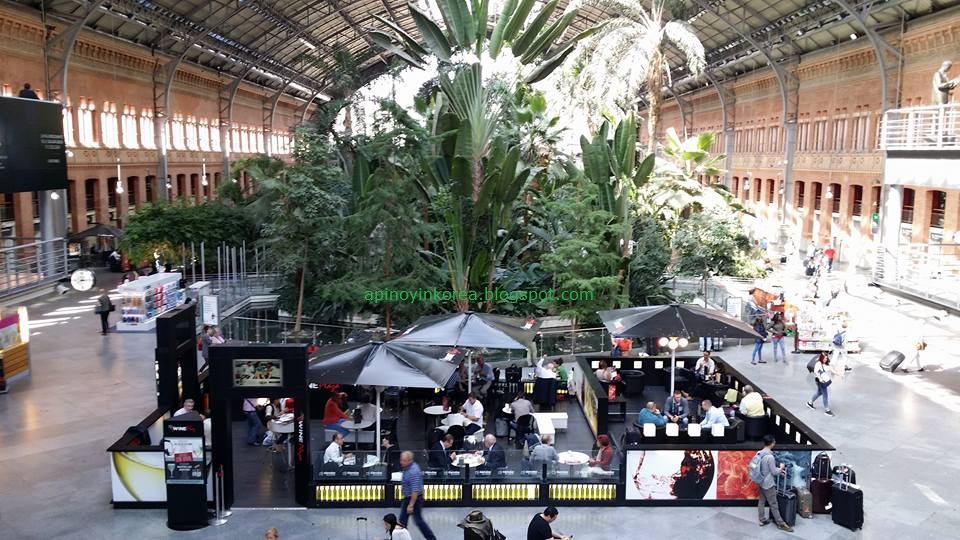
After munching down lunch, I hurried towards the Station, and even before I crossed the street, the whole structure was impressively huge. It didn't look like a train station; it looked like a sports stadium!
              (Atocha Station's dome)

Although the purpose of my look-see was to ask about the schedule of trains heading to Alcalá de Henares, I was distracted by the beauty of the whole station.

It was spacious with very high ceilings, airy and had shops, cafés, restaurants, a garden and a pond! With turtles! Lots of turtles! 

         (Turtles by the pond discussing 
                    Spanish politics)

The whole station was so interesting and unique that, if I didn't have a schedule to keep, I would have sat in one of the cafés, ordered coffee and watched commuters the whole afternoon! Atocha didn't feel like a train station; it felt like a plaza! It should be one of the most beautiful stations in Europe!

The station was inaugurated on February 9, 1851, under its original name Estación de Mediodía, but was rebuilt in 1892 after a fire. The architect of the 1892 structure was the Spanish engineer Señor Alberto Palacio Elissagne, who collaborated with no less than Gustave Eiffel, Señor Alberto's teacher. No wonder the station was all lines of steel and wrought iron that provided an 'industrial' feel.

(The Station's centerpiece clock telling the time through the wrought iron lines)

In the morning of March 11, 2004, coordinated terror bombings hit trains leaving Alcalá de Henares (which I was visiting during my trip), including one train heading to Atocha Station. One hundred ninety-two were killed, including one Filipino, and a memorial was built for the victims next to Atocha Station.   

                   *  *  *  *  *

Next stop, Alcalá de Henares.

Sunday, 11 September 2016

The Real Madrid: Plaza de Oriente, Royal Palace, and Queen Isabel II's Waistline

After meandering the ancient alleyways around Plaza Mayor and ending at Puerto del Sol, I suddenly felt my tummy complaining 'tengo hambre' (I'm hungry). 

Though my eyes feasted with all the window displays of Spanish delicacies, spanish abanicos, bocadillo de jamon, tartas and brazos, my tummy was still empty! So, after dropping off my postcards at the post office at the basement of El Corte Inglés, Spain's largest chain of department stores, I headed towards Teatro Real, where the statue of Queen Isabel II stood.

El Corte Inglés was just a few meters out of Puerta del Sol, and tracing my Madrid map, I passed through again Puerta on my way to Plaza de Oriente.
   (Queen Isabel II before Teatro Real)

Before reaching Plaza de Oriente, I had to pass by Teatro Real, where the statue of Queen Isabel II stood, claiming sovereignty over the Opera Station, a subway station next to Teatro Real (Royal Theater), which hosts operas and theater performances; hence the station was named 'opera'.
                  (A royal waistline)

And while Queen Isabel II's subjects probably included commuters taking a subway ride, most of them probably ignore her quiet presence. But that day, one tourist became her curious subject, photographing and scrutinizing her statue. 

And something was not right, I thought. Her proportions were off! Ja-ja-ja!

I guess that's what I have learned all these years being an amateur photographer. I could easily spot what's not natural. If I could always spot a fake nose while walking around Seoul, spotting a fake waistline was easy. Queen Isabel II reigned from 1833 to 1868, and had I criticized her statue during those years, it probably cost me my head. Ja-ja-ja!

And by the time I was done admiring the queen's slim waistline, which bore no inflation from all the jamón ibérico, tapas, tartas (cakes) and bocadillos (sandwiches) she was served cada dia en su palacio, it was time for my own tummy to be filled.

I decided on a restaurant, and not just a bocadillo shop. Just like the queen, I had to be served. After all, there were 13 Spanish kings bearing my name; I crowned myself as the fourteenth. Ja-ja-ja!
(I wanted to order one plate of paella, but the waiter told me that the serving was too much for one person. Instead, he served me sliced tomatoes in Arbequinian oil and sprinkled with Maldon salt, bread and a mix of chorizo ibérico with Machego cheese. He didn't trust I could finish one paella.)

   (I asked Señor Paulo the marca(brand 
      of his delicious chocolate and vanilla
          ice cream; he didn't know.) 

The I reached Plaza de Oriente with a heavy stomach, burping as I stood in awe in front of the magnificent galloping statue of King Philip IV. The statue of the monarch riding a galloping horse was a tricky project. Its designer, Pietro Tacca, was worried that the statue would fall, considering that only the horse's two hind legs would be supporting the statue. But the Father of Modern Physics, Galileo Galilee, came to the rescue and calculated the weight distribution and design. He suggested that the elevated portion should be hollow, while the lower end should be solid, giving support to the whole elegant statue. I figured they had to consult the most famous physicist at that time, considering the king would also have been ignoring his own weight management with all the jamon iberico and tapas buffet in the palace.
             (Physics problem: how to balance 
           King Philip IV and his galloping horse)

               (Admiring a royal architecture)

Plaza de Oriente was actually to the 'east' of the Royal Palace; hence 'oriente'. And by the time I was done admiring the statues and sculptures in the Plaza, it was late afternoon and the Palacio Real, with all its 2,800 rooms, was closed. I wasn't planning to go inside anyways; I might just encounter a Spanish ghost and even with my basic Spanish, I figured we might not be able to understand each other. Ja-ja-ja! 
(Abre la puerta! They wouldn't let me in the palacio.)

                     (Cathedral of Almudena)

As expected, the Royal Palace looked magnificent but I was more fascinated with the architecture of the Cathedral of Almudena, completed in 1883, situated across the palace. I got there just as the sun was setting, and with the lights of the Cathedral bathing it, the colors of the sunset and the church were matching each other!
      (Soft light and shadows always bring 
      out the beauty of any architecture)


                      *  *  *  *  *

Fernando Magallanes (Ferdinand Magellan) left Seville, Spain, in August 1519 and arrived in the Philippines in March 1521, after about 21 months.

And I expected these two Madrid postcards, which I sent through the post office at the basement of El Corte Inglés for €2 each to arrive at my postal address in the Philippines for less than the time it took Magellan.

Sadly, the two postcards never arrived. :-(


Saturday, 10 September 2016

The Real Madrid Breakfast: Churros con Chocoláte!

Tired from dragging my luggage from Korea to Turkey, and then to Spain, and having not been able to sleep well in Istanbul, I finally got a good night's sleep in Madrid at Señor Tomas's Hostal Las Fuentes.

And walking around Plaza Mayor, Puerta del Sol (read blog here), Plaza España, Plaza de Oriente, Palacio Real and Almudena Cathedral from late afternoon till night added to the tiredness. I just had to squeeze in my visits to these places as I already lost a day due to Turkish Airline's delayed flight (read blog here)! 😨

If a journey of a thousand miles begins with the first step, mine began with a delayed flight! 😡

So, after waking up at 8AM the next morning, I immediately opened my hotel window and looked up the Madrid skies. ¡Buenos dias! 😊Time for churros con chocoláte desayuno (breakfast)!

      (Churros ready to be cut, served and enjoyed)

So, I just walked down a few alleys for about five minutes to Chocolatería San Gines, which was near the Church of San Gínes. This famous churros place is actually open 24 hours, but when I got there, I was the only one! I guess all the tourists in Madrid were still asleep!😴

"¡Hola! Churros con chocoláte, por favor!", I proudly blurted out to the señorita at the entrance, which was probably the same sentence the actual King Alfonso exclaimed when he sneaked out of the palace to visit this place in the early 20th century. 

I took a seat, surveyed the mirrors and black-and-white photographs on the walls, and convinced myself that I was not dreaming! I was finally in Spain and about to savor real churros with hot chocoláte! ¡Olé! ✈

I read somewhere that churros were first created by shepherds who needed snacks when they went out in the plains centuries ago. But thanks to those shepherds, today, churrerias are scattered all over Spain to feed shepherds without any sheep.

My churros con chocolate cost me €3.90, and although I have always enjoyed tablea chocolate at home made by my mom, the hot chocolate in the churreria was so rich and thick that you could feel the drink slide down your esophagus and settle heavily in your stomach! Que rico!


      (By the time I was done, San Gines was full!)

Aside from Chocolateria San Gines, I also visited its equally popular competition on the other side of the block, Chocolatería Los Artesanos 1902. But Los Artesanos have more variety of pastries compared with San Gines.
              (Señor churrero frying sus churros)

On the succeeding mornings in Madrid, I went to San Gines and had cafe con leche, pestiños and flor. Pestiños and flor are crunchy, sweet fritters popular in the Andalucian region of Spain. I decided I might as well enjoy all other breakfast goodies in the neighborhood.


                  (Cafe con leche, pestiños y flor)

When the shepherds during the old Spanish times created a batter and fried them into snacks, they might not have thought that, one day, the snacks they created would also bring such enjoyment, not just to the generations of Spanish families, but also to one tourist, who made his way through the alleys of Madrid and was welcomed with a cup of hot chocoláte and a plateful of churros! ☕

Friday, 9 September 2016

The Real Madrid: Plaza Mayor, Puerta del Sol y Bocadillos De Jamon!

Visiting Spain has always been in my mind ever since those Spanish classes during college became my favorite subjects. ¿Por que? Why? Because having been under Spanish rule for centuries, Filipinos, I thought, would have an easier time learning and speaking Spanish. It turned out, it wasn't always the case. Not all my classmates were thrilled when the teacher gave out quizzes during our Spanish classes. Ja-ja-ja!

And even after college, I made sure I wasn't going to forget my Spanish. My high grades and exemptions from the final exams were not going to the basura. So, when I finished my Level 12 French at Alliance Francaise de Manille, I enrolled at Instituto Cervantes in Manila to review my español. And it paid off!

Yes, my spanish professors (Señores Sua-an y Billanes, y Señora Garde) in college and at Instituto Cervantes (Señora Lola Lazaro!) would have been proud! I was able to navigate 2,100 kilometers of Spain over 11 days armed with my confident español y una mapa de toda España! 

Although the first leg of my journey (Incheon Airport to Istanbul-Ataturk Airport) to Spain was riddled with disappointments, I tried to forget it once I was up in the air en route to Madrid.

Arriving at Madrid Barajas Airport, I was a bit worried about my ruined tour plan because the two-hour delay of Turkish Airlines flight made me lose a day in Spain! But I just had to carry on. Well, it's the reality of travelling; sometimes, you just have to brush aside delays and disappointments that weren't part of your itinerary.

Hostal Las Fuentes
About two months before I flew, I studied Madrid's geography and decided to book at Hostal Las Fuentes because, one, it was at the city center and was close to tourist sites, and, two, it had reasonable rates. Señor Tomas, the owner, was very helpful and even told me about the history of the whole building, part of which serves as his hotel. 
      
Hostal Las Fuentes was on Calle de las Fuentes, which is about eight minutes by foot from the royal palace. He told me that the building used to house those who worked at the royal palace, such as palace officials, writers and even prostitutes who catered to the 'royal needs'! Yikes! When he told me that, I immediately regretted I asked him about the building's history. I suddenly worried whether 'one' actually stayed in my room! Ja-ja-ja! 

Plaza Mayor
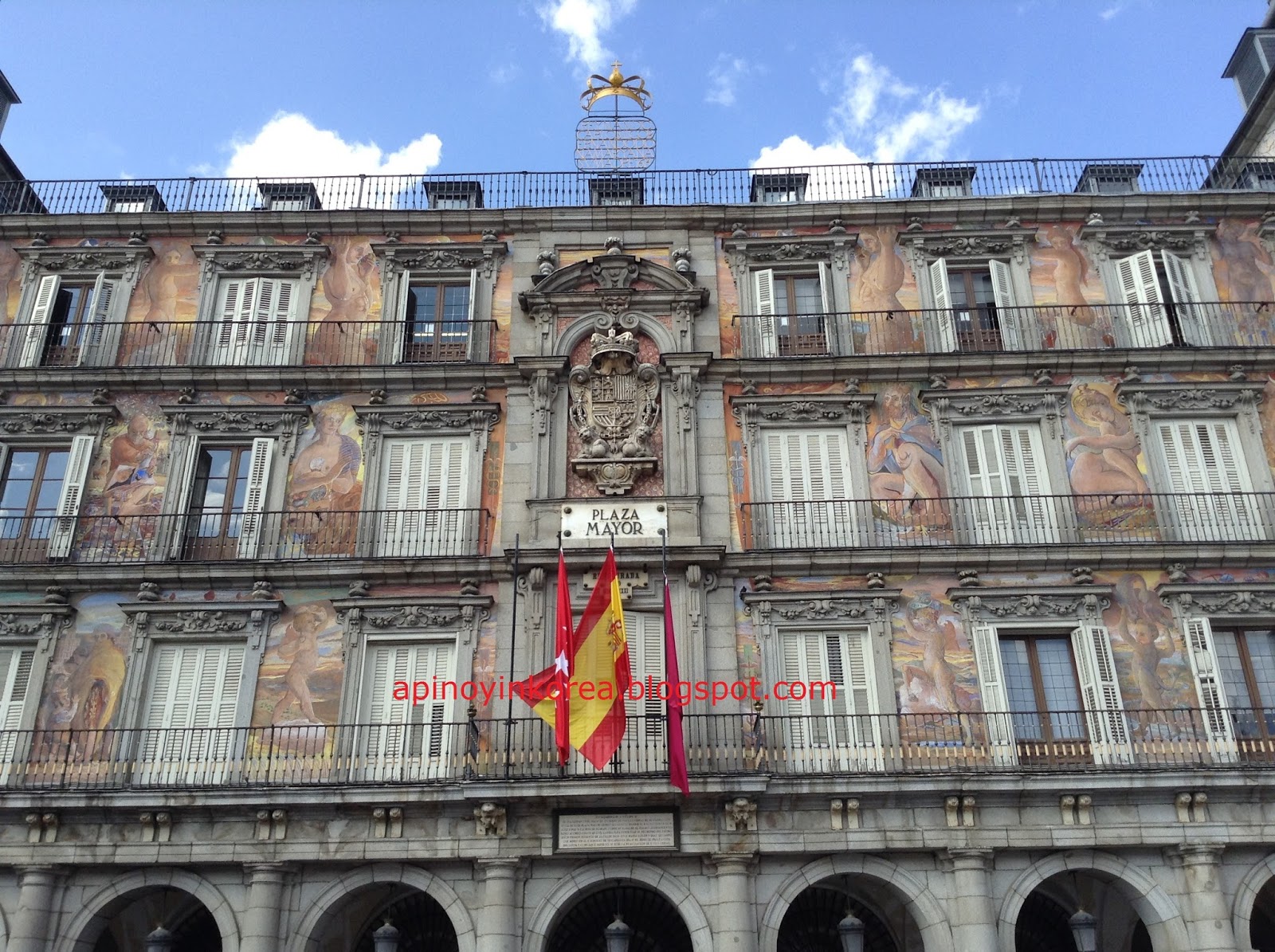
I got to the hotel mid-afternoon, and after checking in, I wasted no time and walked towards Plaza Mayor as my first stop. Plaza Mayor is the main square built in 1620. It's a popular hangout for locals and tourists due to the cafes and restaurants around it. 

At Plaza Mayor, I asked for a Madrid map at the tourist information center. I then wandered around the alleys admiring the shops selling authentic spanish abanicos (some souvenir shops in Spain sell abanicos made in China) and shawls. 
                         (Spanish abanicos!)

I had to stop at a shop selling cookies and bocadillo de jamon (ham sandwich). Of course, I also had to order Coca-Cola fria (cold Coke)! 
         (Not-your-ordinary-ham sandwiches!)

Puerta del Sol
Puerta del Sol literally means 'gate of the sun', and this square is one of the most popular in Spain as this has been a place where people gather since the 15th century.
That day, tourists, street performers, vendors, and probably a few pickpockets crowded Puerta del Sol. As I was advised, I kept my wallet in a sling bag and was aware of it all the time. 

Even though the sights and activities during one's travel may occupy your attention, you should always be aware of your surroundings, and avoiding crowds is always a good precaution. 

I have to admit I almost got pickpocketed right along Calle Mayor! The two college-age female pickpockets were really quick! Luckily, they weren't able to get anything. I caught them and shouted "Hey!". And their ready response? "It was open!" Then they just casually walked away. They struck during the moment when I let my guard down. I learned a lesson. From then on, I was always careful.

                                                                          *  *  *  *  *
Next stop, churros con chocolate for breakfast!

Tuesday, 16 February 2016

The Rain in Spain: Travel Tips Before Visiting Spain!


I recently covered about 2,100 kilometers traveling around northern Spain, discovering six cities over 11 days, and seeing a lot more from my train seat.

I wished I would have had more time (and budget!) to explore Viva España!, but sadly, my vacation days estan limitado. 

And in case a few of you want to embark on the same trip (and in case I'm revisiting España otra vez!), I am writing everything down for a few tips and website to use.
  (The 'WELCOME' sign at Madrid Airport)

             (Churros con chocolate for 
                 breakfast in Madrid!)

1. DO YOUR RESEARCH
I didn't want to buy any guide book as I knew I could only visit a few cities over 11 days. Guidebooks cover a whole country; I only needed brochures, which, fortunately, I was able to get from the Spanish tourism office in Seoul. Although these brochures were in Korean, the maps inside were useful. And thanks to the Spain tourism office staff, Abel, my questions regarding the jamon serrano I could bring back to Korea were answered! Yes, I was able to bring a few vacuum packs!

And for planning the whole trip, I got a lot of information from this site:

http://www.spain.info/en/

Since I already speak basic Spanish, I just needed to brush up on it using a small Spanish dictionary. I was able to engage locals in conversations in Spanish during my out-of-town trips, where most people may not be conversant in English.

(The statue of Miguel de Cervantes in Plaza de Cervantes in Alcala de Henares)
         (Baked goods at a panaderia 
          in Santiago de Compostela)
             (Praza de Obradoiro in 
          Santiago de Compostela)

2. DECIDE ON YOUR ROUTE
When I finally decided how many days I could spend in Spain based on my vacation leave, I locked on Madrid, Barcelona, and Santiago de Compostela as the cities. I then researched on their neighboring cities that I could visit for a day. 

So, while I was in Madrid, I visited Alcala de Henares, and when I was in Barcelona, I visited the Monserrat Monastery.  And when I was in Santiago de Compostela, I made a day-trip to A Coruña, where my Spanish friend Kiko lives.
        (Torre de Hercules is the oldest 
        working lighthouse in the world!)

  (The charming singers of Tuna Derecho 
          de Santiago de Compostela)

3. DRAW YOUR FLIGHT PLAN
After I decided that I would fly into Madrid and fly out from Barcelona, I visited my travel agent in Seoul and explored the most popular online airfare sites to decide on the airline and the time table. Well, although the Turkish Airlines fare was reasonably the lowest I found with the flight schedule perfect for my visit, I was a bit disappointed with the airline service. Twice I missed my connecting flights because of delays, and both the airline service and their customer service at Istanbul Ataturk Airport were very disappointing. 

I also booked my airport transfer from Madrid airport to the hotel online. That way, I didn't have to worry about transport when I arrived in Madrid tired and sleepy.
           (Santiago de Compostela train 
            station in the early morning)
            (The Spanish countryside 
                 from my train seat)

4. BOOK YOUR ACCOMMODATION
One doesn't need to stay at those expensive hotels. There's airbnb, booking.com and other sites. My criteria for choosing the hotel were the price and location. Since I was already familiar with the geography of a city, deciding on the location of my accommodation was easy.

In Madrid, I stayed at an interesting hotel near the Opera Subway Station, and a few minutes by foot from Plaza Mayor, Puerta del Sol and the Royal Palace of Madrid.

In Santiago de Compostela, I stayed at a small hotel five minutes from the Santiago train station.

In Barcelona, I stayed at a business hotel five minutes from Las Ramblas and Licieu Subway Station.

Although airbnb.com accommodations could have been cheaper, they didn't have cable TV, wifi, or elevators. Since I was a stranger to the city, paying extra for convenience and safety was a given. I booked my hotels through Booking.com.

              (Barcelona train station)
             (Train bound for Monserrat)
         (The imposing Sagrada Familia 
                       in Barcelona)

5. RENFE, THE TRAIN IN SPAIN
After settling all the flights and hotels, I had to figure out my train rides: from Madrid to Santiago de Compostela, to Barcelona. 

Renfe, Spain's national rail transport, has a website containing all the train schedules, stops and fares. But somehow, before I flew to Spain, I could not book and pay through the site. So, what I did was to write down my train itinerary and desired dates on a paper, thinking that when I visit the Renfe office in Madrid to buy the tickets, there wouldn't be a misunderstanding.

But luckily, when I arrived at the Madrid-Barajas Airport, there was a Renfe booth next to my airport transfer desk! And that piece of paper containing my train travel dates was very helpful! I just gave it to the señor after I asked him, "Buenos tardes, puedo yo comprar los billetes aqui?" I didn't have to visit a Renfe office in the city and fall in line to buy my cross-country train tickets. 

Although there were flights from Madrid to Santiago de Compostela, the airport was way out of town and not practical. For me, the train ride was part of the tour: watching the Spanish countryside, the landscape and the cuidades y pueblos along the way was an experience to be remembered. My train ride from Madrid to Santiago de Compostela took about 6 hours with one transfer at Ourense Station; and from Santiago de Compostela to Barcelona took 12 hours. It was like watching the Spanish National Geographic channel from my seat! 
   (The fascinating Monserrat Monastery!)
         (Jamon at Gadi's supermarket!)
                         (Paella in Barcelona!)

6. BOOKING TOURS and VISITS
Before I left for Spain, I also booked my city tour buses for Madrid and Barcelona, as well as visits for Sagrada Familia and Santiago de Compostela Cathedrals, and Monserrat Monastery. They have their own official websites. Just make sure you bring your printed tickets and receipts with you.

For my visits to the Real Madrid and FCB stadia, I just bought the tickets when I got to the site.

For the train rides during my day-trips, I just bought round-trip tickets at Atocha Station for my ride to Alcala de Henares, and for A Coruña, I bought tickets at Santiago de Compostela. For my trip to Monserrat Monastery, I bought the package tour that included two subway rides to/from Plaza España Station from anywhere in Barcelona, and train ride from Plaza España up to Monistrol Monserrat. Station. 

             (The map of Spain and 
           my actual route highlighted!)

7. KEEPING YOUR CASH SAFE
And as to safety, as long as you carry your bags or valuables safe right in front of you, you'll be fine. Those chest bags should be handy. The pickpockets around Puerta del Sol in Madrid and Las Ramblas in Barcelona are very quick, and they could be anyone. Just don't let your guard down any time like the way I did on my last morning in Madrid. I was almost pickpocketed by two señoritas along Calle Mayor. Luckily, I caught them just in time! I learned my lesson! 

Leave your passports and most of your cash at your hotel room safe. When you walk around the city, just bring with you the cash amount you think you'll need for the day, and also carry a photocopy of your passport and visa. I have a photo of my passport in my iPad, which I needed for identification when I used my credit card at the FCB store in Barcelona.

                        *  *  *  *  *

Just like most tourists, I'd like to visit Spain again someday. And for me to relive the memories, I will be blogging about my trip in the weeks to come.

¡Hasta la vista, España!