Showing posts with label history. Show all posts

Saturday, 18 October 2025

VICTORIAS TOWN HISTORY: THE TOWN COUNCILORS AT THE WAKE OF DON FELIX MONTINOLA

On the previous post, I talked about the photograph of the wake of Don Felix Montinola on the second floor of municipio that he helped build. He died on September 25, 1949, seventy-six years ago this year (see blog here)

Somehow, another photograph taken during the wake surfaced. This is where the respected Victoriahanon and certain town officials of 1949 posed with the coffin of Don Felix.

Although some of the gentlemen's faces were familiar, I had to research the ones I was unfamiliar with. And with the help of some sources, including the Sangguniang Panlungsod archives (thank you to the very helpful SP staff!馃槉), I was be able to name almost all of them.


Standing on the lower left of the photo:

Don Agustin 'Toting' Jereza (left)(read Don Agustin's contribution to Victorias here) and Don Benito Montinola, Sr. (right) (read Chapter 21 about Don Benito Montinola, Sr. here)

Standing at the back from the left down to the lower right:

The first gentleman is yet to be identified; the second gentleman is Mr. Cesar Hedriana. Next to him is former Mayor Hector M. Montinola (mayor from 1946-1950), then Mr. Jose Ma. Fernandez, Mr. Vicente Vitar, Mr. Genovevo Bainosa, Mr. Juan Villegas, and Mr. Jesus Suarez.

The wreath behind Mr. Hedriana was from the "Municipal Council", while the wreath at the center was from "Rep. and Mrs. Carlos Hilado". Yes, it was from Representative Carlos Hilado of the Second District of Negros Occidental, after whom the Carlos Hilado Memorial State University in Talisay City was named.

Although this photograph is an image of sadness because of a passing of a former town leader, it is historical portrait of the former town councilors of Victorias.馃槉


#victoriashistory #victoriascity #negrosoccidental #history #historian #blogger #donfelixmontinola

Thursday, 8 February 2024

Foto-贸leo: A Portrait and The Lost Art Form

I stumbled upon the exhibit (link below) of the National Museum of the Philippines titled "Larawan at Litrato: Foto-贸leo and Picture Portraits of the Philippines (1891-1953) (see link below) and realized that I have seen recently this kind of a portrait somewhere at home.

National Museum - Foto-oleo exhibit

So, I inspected the 'portrait' by following the description of a foto-贸leo provided by the National Museum of the Philippines. The 'portrait' is foto-贸leo!馃槃

It's a portrait of Don Felix Montinola, former mayor of Victorias in the 1934-1940. It was during his term that the munic铆pio of Victorias was built (read blog here).

His foto-贸leo portrait was made by Tinsay Art Studio in Manila before World War II broke out and was brought by the family to their old home in their hacienda in Manapla when they evacuated in the early months of 1942. Before the Japanese Imperial Army arrived in Victorias on May 27, 1942, the Montinola family already brought their belongings, including family portraits and furniture, to the hacienda. 

Their original mansion in Victorias standing in front of the public plaza, like all big houses then, was eventually burned down by the Filipino guerillas to prevent the Japanese from using them. Even if the mansion was spared by the guerillas, it would still have been burned down by the Japanese soldiers themselves when they had to flee Victorias to retreat to the mountains of Silay in order to escape the US Armed Forces of the Far East (USAFFE).(read blog about Victorias during World War II here).

This foto-贸leo portrait was done around 1939-1941, a few years before World War II, to celebrate Don Felix Montinola's mayorship in Victorias. It must have been 'ordered' by her second eldest daughter, Salud Montinola, in Manila, and their relatives there must have recommended the Tinsay Art Studio, among other studios that made the same foto-贸leo art then. (Read blog about Salud Montinola here).

According to the National Museum of the Philippines, "foto-贸leo is an art form popular during the mid-19th to mid-20th centuries, prior to the invention of color photography. It was executed by applying oil paint directly on black and white photographs to make it more life-like and visually-pleasing.

While the practice may be traced in Europe and the Americas, foto-贸leo artmaking was adopted by artists in the Philippines and made them their own, turning unique portraits that highlighted jewelry, rosary beads and medals. Artists in Negros may have invented the decoupage style of portraiture, on which painted headshot photographs were fixed on the shaped wood and framed and glazed on both sides. In the course of our research, we found that foto-贸leos were especially popular among prominent Filipino families. These were mainly kept by succeeding generations in family homes, serving as memento of loved ones. Among the photographic studios in which they were produced were Filipino, Hollywood Art, Luz, Luzon, Sabater, Tinsay Art, United Portrait Artists, Venus and X'or Studio." 

Don Felix Montinola did not have to travel to Manila for this foto-贸leo portrait. Tinsay Art Studio only needed his black and white photo which the studio then turned into foto-贸leo.

The portrait's size is 17 inches by 23 inches and is encased in a glass frame with heavy wood panels. The width of the panel is 3 inches, and the size is 23 inches by 29 inches. The back shows that the panel was closed by nails and has an eye hook for hanging. It was a surreal experience for me to run my hands on and around the wooden frame as I feel the artistry and the craftsmanship of the artisan who created this foto-贸leo portrait that has since become a family heirloom.馃槑

In the exhibit of the National Museum, there are portraits from homes around the country, including the beautiful foto-贸leo portraits borrowed from the Balay ni Tana Dicang Museum in Talisay City, Negros Occidental. 

Don Felix Montinola's foto-贸leo portrait was left behind in their hacienda in Manapla when the family went back to Victorias after the war ended and was kept there until recently. 

The foto-贸leo art form has been lost forever when color photography was introduced in the Philippines, which means these portraits are rare, and must be properly cared for and treasured.

Do you have an foto-贸leo portrait hanging in your living  room?馃槉   

         (A painting of Don Felix Montinola y Lozada)

#nationalmuseum #Philippines #art #fotooleo #Tinsayartstudio #donfelixmontinola #history #historian #portrait #museum #heritage

Sunday, 4 February 2024

Philippine History: CHAPTER 28: The Historical Timeline of Victorias Milling Company (1915-1989)

Since its incorporation in May 1919, the Victorias Milling Company (VMC) has tremendous contribution to the economy of Victorias. According to Dr. Bernardo Villegas, in one of his Economics books, the VMC had been "fatherly" to its employees as it took care of them from birth to death. It had its won hospital, free housing for its employees that came with free water and electricity, and it had schools and a world-famous chapel within its compound.  Its employees did not have to go to the 'town proper' of Victorias to purchase food and daily needs as it had its own market and grocery. It even had a small airport for planes that flew the Manila-Victorias route.


Although VMC has been mentioned in Chapters 14 and 17 (links below) in The History of Victorias City Philippines, the said mentions were very limited.

As a tribute to VMC and to the memory of its founder, Don Miguel Jose Ossorio, I am providing its historical timeline that I am quoting and paraphrasing from “Victorias – A History in Pictures”, a book of photographs and historical information published by the Victorias Milling Company. In the previous chapters about the World War II experience of the Victoriahanon, I only noted that the machinery and equipment of VMC were ruined during those years. The book, on the other hand, has more details that are worthy to share.

The history of Victorias Milling Company starts in 1916 when…

The 26-year old Miguel Jose Ossorio draws plans for a centrifugal sugar mill in Manapla, Negros Occidental. Ossorio was a businessman born in the Philippines from Spanish parents. His team includes his brother, Jesus, an electrical engineer educated in England; Norberto Capay, a mechanical and marine engineer; and Claudio R. de Luzuriaga, Sr., a lawyer.


1916: The construction of a 300-ton per day sugar mill begins.

1917: In December 1917, the North Negros Sugar Company, or NONSUCO, is established with Francis Greenfield, a sugar expert from Hawaii as its manager.

1918: NONSUCO produces 43,752 piculs of raw sugar on its first year. (A picul is equivalent to 60 kilograms and is an Asian unit to measure weight. It is originally a Javanese term that translates to "to carry on a shoulder", meaning whatever a man can carry on his shoulder with a pole. Picture a man with a pole resting on his shoulder with two vats hanging on opposite ends - that is 'pikul'. The term was then adopted by Portuguese and Spanish colonizers.)

1918: A drydock is completed in Balolan, Manapla.

1918: M. J. Ossorio starts his plans for a 700-ton sugar mill in Victorias and offers the sugar planters in Victorias 25% of the shares of stock of the new mill. The planters in Victorias buy P200,000 worth of shares.

1919: May 7, 1919, the new company, Victorias Milling Company, is incorporated with initial paid-up capital of P1,000. M. J. Ossorio is its managing director and chairman of the board of directors. VMC became the 17th centrifugal sugar mill in the Philippines.

1919: VMC’s magneto telephone is installed.

1920: The construction of the VMC sugar mill starts and is supervised by Norberto Capay and Jesus Ossorio, based on the design of Cornelius Johannes Hugo Penning, a Dutch, who is considered a master builder of centrifugal sugar mills.

1921: Production for crop year 1920-1921 is 180,084 piculs with revenues of P254,141.96.

1921: VMC’s Research Department is established. Its initial mission is to create a rational fertilization program in sugarcane agriculture.

1921: M. J. Ossorio invites Carlos L. Locsin, a chemist from Silay City, to join VMC. Mr. Locsin accepts.

1921: VMC’s port in the Daan Banwa area of Victorias becomes operational.

1921: NONSUCO’s farms start using fertilizers.

1923: VMC’s Department of Field Experiments promotes modern sugarcane agriculture methods among its planters. The Department’s two biggest concerns are the experiments on fertilizer response, and the tests on sugarcane varieties such as “Badilla H-109”,the outstanding Hawaiian hybrid, and “Negros Purple”, the dominant local variety.

1925: Cornelius Joannes Hugo Penning becomes the manager of VMC. He designed the mill.

1925: A two-day thanksgiving celebration is held for producing the first large crop of 23,743 metric tons.

1925: NONSUCO celebrates its 8th year in December.

1926: VMC pays all of its debts to the Bank of the Philippine Islands by issuing a US$ 1 million bond through the Pacific Trust Company of Honolulu.

1927: NONSUCO opens its railway through Cadiz in April.


1927: Tamasoc, a pest, starts to spread among crops of NONSUCO and VMC districts. Dr. Dwight Pierce, an entomologist from California, is hired.

1927: M. J. Ossorio buys a seat at the New York Coffee and Sugar Exchange.

1928: A refinery is opened in VMC, the second only in the Philippines.

1928: NONSUCO opens a distillery.

1929: NONSUCO exports first shipment of 2,800 tons of first raw sugar to US in October.
Starting 1929, VMC and NONSUCO will export sugar to US. One of its biggest buyers is the American Sugar Refining Company (AMSTAR).
1931: M. J. Ossorio’s second son, Luis C. Ossorio, arrives from the US to train in the management of VMC and NONSUCO.

1931: Jesus J. Ossorio assumes acting manager role after Cornelius Joannes H. Penning resigns.

1931: Carlos L. Locsin initiates the organization of the Philippine Association of Sugar Technologies in Bacolod and is elected as its first president. This association is the forerunner of the Philippine Sugar Technologies Association or PHILSUTECH.

1932: Shiras M. Jones takes over the management of NONSUCO and VMC when Jesus Ossorio gets sick due to appendicitis while Francis Greenfield, NONSUCO manager, is in the US for vacation.

1932: VICMICO Athletic and Social Club opens a store, billiard and table tennis halls, a bowling alley, a barbershop, and a refreshment shop. Later, a rice mill, an ice plant, and a soap factory are added.

1933-34: During the crop year, POJ high yielding cane variety from Java gives VMC and NONSUCO their all-time prewar high of 990.342 piculs and 1,225,737 piculs, respectively.

VMC refinery also produces 337,129 bags (100-pound bags).

1934: Jose Maria Ossorio, the third son of M. J. Ossorio, arrives in the Philippines from the US to start his management training in NONSUCO and VMC.

1934: In July, VMC signs a contract with the US Army in the Philippines to deliver
1,300,000 pounds of refined sugar.

1937: M/V Nonsuco is purchased for interocean operations and sails for the first time in September.


1938: Saint Joseph’s Hospital is established with Dr. L. Greentree as its director.
1939: Jose M. Ossorio takes over as manager of VMC in Manila as Mr. Francis A. Greenfield, NONSUCO manager, dies in a car accident in California.

1940: A sugar bag factory is set up.

1940: Dr. L. Greenfield resigns as director of St. Joseph’s Hospital. He is replaced by Dr. D. Davies.

1941: Preparations in Manapla and Victorias for the impending war: air-raid shelters, war drills conducted by the Philippine Constabulary, organizing a group of civilian guards, building of evacuation sites at the Aloyan Hills in Cadiz and Cansilayan in Victorias for employees and families who will stay behind to guard the centrals.

1941: Able-bodied NONSUCO and VMC employees signed up to join the United States Armed Forces in the Far East (USAFFE), including Luis C. Ossorio. Don Miguel, Do帽a Paz and the Ossorio clan stay in the US, except for Luis, Miguel Jr., and Jose, who stay behind to manage the two centrals. Luis is sent to Lanao del Norte as part of the Panay Regimen of the USAFFEE. He brings most of the staff and supplies and equipment from the Saint Joseph’s Hospital.

1941: War comes to the Philippines on December 8 when Japanese warplanes bomb Manila.

1941: By the time the war broke out, the production of NONSUCO and VMC was 1.5 million piculs of raw sugar from 17,000 hectares of plantations.

1941: VMC’s total production is 397,523.62 piculs of raw sugar and 152,305.48 100-pound bags of refine sugar.

1942: Management orders Norberto B. Capay, the supervising engineering, to render the NONSUCO and VMC mills inoperable by dismantling the crucial parts of the machinery and hiding them at Sitio Magbanua in the Marapara Peaks of Silay.

1942: May 20, the Japanese Imperial Army lands in Bacolod City. Jose M. Ossorio and family evacuate to Aloyan Hills in Cadiz. Carlos L. Locsin is left to guard NONSUCO in Manapla. The Japanese soldiers later took over the NONSUCO and VMC centrals.

1942: June 20, Jose. M. Ossorio, his family and other nationals allied with the US surrender to the Japanese army and are temporarily detained in Bacolod City. They are then shipped to Manila and detained at the University of Santo Tomas campus during the war.

1942: Norberto B. Capay, supervising engineer, is left to manage NONSUCO and VMC as Carlos L. Locsin has to flee Negros with Don Claudio R. de Luzuriaga, Sr. due to threats to their safety.

1942: Norberto B. Capay also flees Negros on November 14 for his safety. NONSUCO is now managed by Mr. Sensake while VMC is managed by Mr. Noda.

1943: NONSUCO mill is reactivated to produce final molasses that will be turned into alcohol needed by the Japanese for fuel.

1944: VMC is also reactivated to produce final molasses to produce alcohol. A distillery is built at the site.

1944: On October 20, General Douglas MacArthur and the US liberation forces land in Leyte.

1945: The VMC distillery produces 47 drums of alcohol for the Japanese military.

1945: The detainees at the UST compound that included Jose M. Ossorio and family are liberated by the 1st Cavalry Division of the US Army on February 3. They are later reunited with Luis C. Ossorio and family, and with Michael Clive Ossorio, the eldest son of Jesus Ossorio. They all leave for the US on board an American troop transport ship.

1945: On March 25, the Japanese soldiers occupying NONSUCO leave for the mountains of Patag in Silay where they make their last stand. The NONSUCO central is left in ruins.

1945: On March 30, the Japanese troops leave the VMC site after destroying machinery and setting on fire homes and sleeping quarters.

1945: On the night of March 30, Bacolod is liberated by the 40th Infantry Division of the US Army.

1945: On April 8, Norberto B. Capay returns to VMC from Panay and restores order to stop the looting.

1945: On May 9, the Japanese resistance at Patag falls to the American and Filipino guerilla forces.

1945: In June, NONSUCO is secured from looters.

1945: In the later months of the year, 400 hectares of land are planted with cane seedlings to be sold to the planters to start the rehabilitation of the plantations/district covered by VMC.

1945: Total damages from World War II for NONSUCO and VMC total P1,957,595.91.

(NOTE: Under the Philippine Rehabilitation Act of 1946 passed by the US Congress, the Philippine War Damage Commission compensated sugar centrals that existed before World War II and suffered war damages a total of US$13.3 million for war damages. VMC must have had received part of this for its rehabilitation).

1946: Management decides to give up the NONSUCO central as damages were too costly for rehabilitation. Surviving machinery and assets are integrated into the VMC central.

1947: On April 28 and May 6, the refinery and raw sugar factory, respectively, restarted operations. For 1946-47, the post-war operations, VMC produces 122,208.33 piculs of raw sugar, 2,711 tons molasses, and 121,889 100-pound bags of refined sugar.

1948: The Pension Fund for employees is set up.

1948: Saint Joseph’s Hospital is reopened with Dr. Ricardo Jara as director with Maryknoll Sisters handling the administration.

1948: The athletic and social club is reopened.

1952: The St. Joseph the Worker Chapel is completed. Frederick E. Ossorio has been the prime mover behind the building of the Chapel. Alfonso Ossorio paints the Angry Christ at the altar of the Chapel. The 'Angry Christ' painting made the chapel famous around the world.

1952: Carlos L. Locsin is appointed vice-president and a member of the board of directors.

1952: VICMICO Elementary School is established.


1952: Don Bosco Technical Institute is established after the Salesian Order in Hong Kong accepts the offer of M. J. Ossorio to open a school in VMC.
1953: Norberto B. Capay, the supervising engineer, dies.
1953-54: VMC produces its biggest post-WWII production of 2 million piculs of raw sugar and 1,745,000 100-pound bags of refined sugar.
1955: Carlos L. Locsin is appointed president, succeeding M. J. Ossorio who relinquishes his position as managing director.

1955: In July, the Balolan drydock reopens.
1955: The Industrial Engineering Department is created.
1955: The Pension Plan with group life insurance becomes effective on November 1.
1955: Claudio R. de Luzuriaga, Sr. takes over as the treasurer, vice-president and manager of the Manila office when Harry J. Young dies.
1960: On March 31, the first issue of VICMICO Gazette, the newspaper for employees, is published.
1960: In September, the C-Mill, the first automatic mill in the Philippines, is installed at the raw sugar factory.
1960: The first diesel-electric locomotive (train) is added to the fleet.
1960: Claudio R. de Luzuriaga, Jr. becomes the vice-president and a member of the board.
1961: In January, the St. Joseph’s Arts Guild Choir is organized.
1961: The first pig iron in the Philippines is produced in the blast furnace.
1961: The VICMICO Industrial Workers’ Association is organized.
1964: The foundry is established.
1964: The Rosary Kindergarten is renamed as St. Mary Mazarello School after it is placed under the care of the Figlia Maria Auxiliatrice nuns.
1965: Pacific Airways Corporation, a subsidiary of VMC, starts its airline service between Victorias and Manila.
1965: M. J. Ossorio is elected chairman emeritus while Carlos L. Locsin is elected chairman of the board. Mr. M. Mendez becomes president.
1965: On February 10, Francisco P. Ossorio dies in Spain.
1965: On October 25, M. J. Ossorio dies in Greenwich, Connecticut.
1965: The VICMICO Rural Electric Service Cooperative (VRESCO) is established.
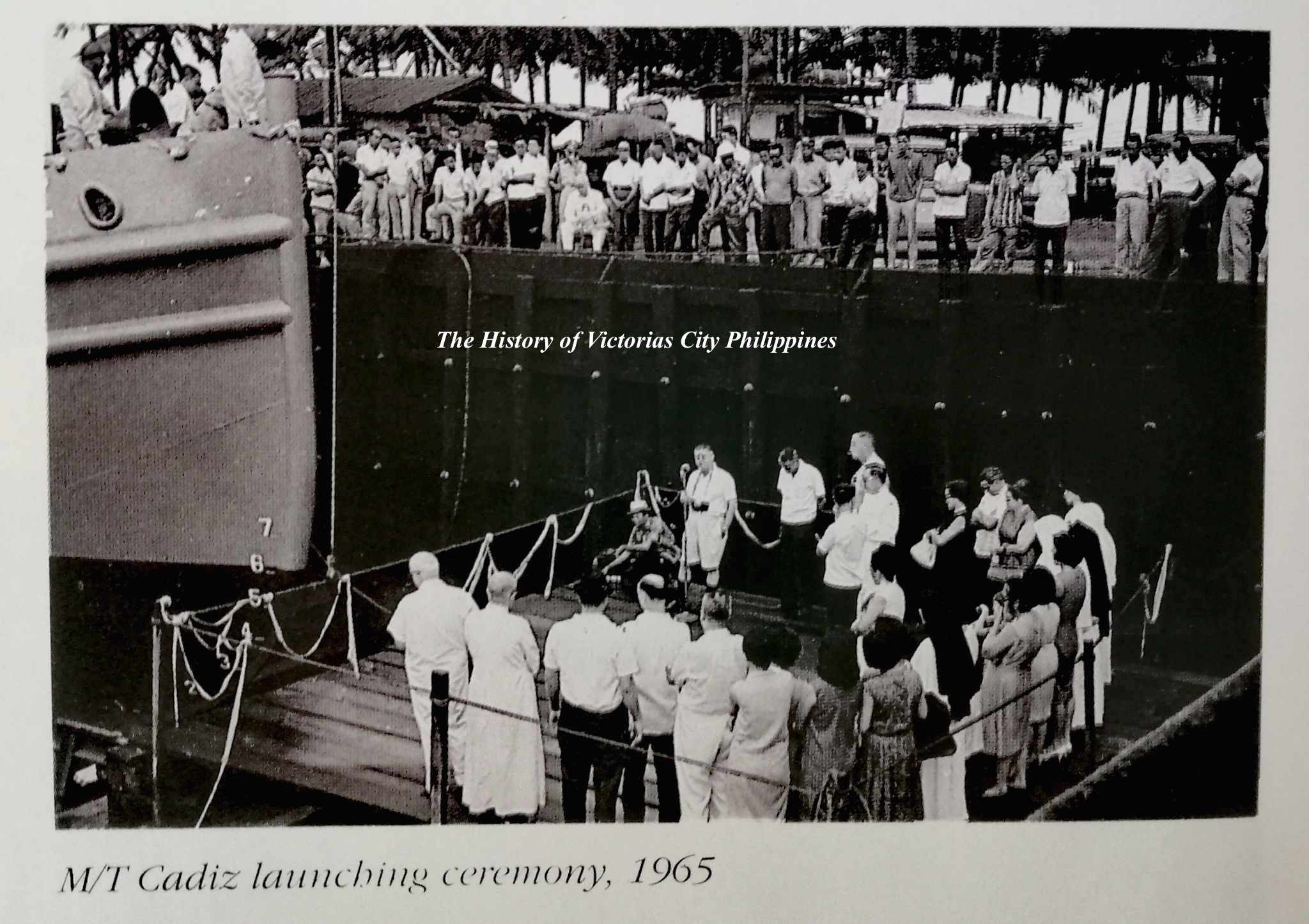
1966: M/T Cadiz, the first company-made tugboat, is launched at the Balolan Drydock.
1966: In November, Jesus J. Ossorio is elected to the board.
1967: Large-scale cane breeding and selection programs are started by the Research Department for high-yield varieties
1967: Jose Maria Ossorio is elected chairman of the board directors.
1967: Carlos L. Locsin is conferred the lifetime title of chairman emeritus.
1968: Cattle and swine breeding and fattening operations are started.
1969: A carbonation plant is set up, the first in the Philippines.
1969: On May 7, VMC’s 50th anniversary is celebrated.
1969: Management Information Service is established.
1970: The largest ever production of 3,385,209 piculs of raw sugar is achieved.
1970: Manuel V. Locsin becomes president of VMC.
1972: Victorias Chemical Corporation (VICHEMCO) is the first company affiliate is established.
1973: Another record high of 3,408,322 piculs of raw sugar is achieved, breaking the record set three years before.
1974: VMC takes over the management of Insular Refining Company in Mandaluyong, Metro Manila.
1974: Do帽a Paz Yangco-Ossorio passes away in Greenwich, Connecticut.
1974: A new milling contract is signed with a group of planters in Panay Island.
1974: On October 31, the Maryknoll Sisters turn over the administration of St. Joseph’s Hospital to the staff.
1974-75: Sugar price goes up as high as US$ 0.65 per pound in the world market.
1975: Canetown Subdivision is set up through a subsidiary, Canetown Development Corporation. The Subdivision’s Phase 1 covers 27 hectares and is divided into 440 residential lots.
1975-76: Victorias Agromachinery Corporation is established.
1975: On June 17, VMC starts Panay Cane Purchase Project with the planters of Panay Island.
1975: On July 6, the cane transloading station in Bay-ang, Ajuy, Iloilo, is inaugurated.
1975: The 1920 telephone is improved with the installation in the VMC compound of a new dial system with 410 lines and 40 connections.
1975: On September 18, VICHEMCO’s furfural plant starts operations.
1975: The post office in the VMC compound is established.
1976-77: New production records are set: 3,951,241 piculs of raw sugar for the crop year, and daily production of 28,770.32 100-pound bags.
1976-77: Agribusiness Division and Management and Administrative Services are established.
1976-77: St. Joseph Cottolengo School for the disabled is established.
1976-77: Claudio R. de Luzuriaga, Jr. succeeds Manuel V. Locsin as president.
1977: The VICMICO Institute of Management is established in partnership with the Univesity of Negros Occidental – Recolletos in Bacolod City.
1978: The refinery produces the all-time record of 8,095,894 LKG.
1979: VMC acquires North Legaspi Land Development Corporation and inaugurates the building onwed by the subsidiary located at Legaspi St., Legaspi Village, Makati City.
1985: VMC food processing exports tuna chunks to Canada.
1987: The First Planters’ Day is held. VMC confers awards to outstanding planters.
1988: A Yoshiimine boiler is operated to add steam supply and add electricity-generating capacity to bring down bunker oil consumption and electric power cost.
1988: VMC, through its subsidiary, Canetown Development Corporation, turns over to the University of St. La Salle a new building and a 1.8 hectare lot for a Victorias Campus of the University.
1988: Prawn ponds expand to 35 hectares in Guisok.
1989: In March, Michael Clive Ossorio dies. He was a former resident director.
1989: In May, Luis C. Ossorio dies in Greenwich, Connecticut. He was a former vice president and director.
The timeline in the book ends in 1989.
* * * *
VMC is the reason why Victorias, now a city, is in the map, so to speak. With the billions of pesos in economic activities that VMC has created, be they direct or as a multiplier, it practically transformed a sleepy town into a city. Since 1919, it has caused the migration of people, attracted skills and labor, introduced and created new technologies, and enabled local businesses to flourish in Victorias, although the financial crisis that forced VMC into debt restructuring in late 1990’s revealed stories about mismanagement, corporate corruption, improper use of bank loans, and other practices that brought it to its knees.


One other legacy that its founder, Don Miguel Ossorio and his brother, Jesus, left in Victorias City is the church of the Our Lady of Victory Parish that is located along Osme帽a Avenue. The Ossorios helped construct the church through building materials and labor.

VMC celebrated its 100th year in 2019.
* * * *
Photo credits: “Victorias – A History in Pictures”, Mr. David Granada, photographer.

#history #victoriaslgu #VictoriasCity #historyblog
#victoriasmillingcompany #VMC #sugar #NEGROS #NegrosOcc #historian #victoriashistory


Saturday, 13 May 2023

Philippine History: Chapter 27 - Don Gonzalo Ditching and His Legacy in Victorias City (Part One)

We should all be grateful to the people who came before us and who contributed to make our towns and villages better than how they found it. In Victorias, each generation since the days of the earliest settlements by the mouth of the Malihaw River has contributed to the growth and expansion of our hometown.

Unfortunately, in my research about its history, I discovered that there were people in position who twisted and exploited our history to serve their own political agenda, even immorally wasting taxpayers' money for it.  A perfect example of this historical negationism is discussed in Chapter 8 and the October 22, 2022 article. (Please see links below)


But let us pay tribute to those who helped but never asked for any recognition. Let's remember those generous individuals whose descendants never asked a statue for, and whose descendants never wasted taxpayers' money for a political propaganda disguised as an annual wreath-laying at the Victorias public plaza.

On the wall inside the Our Lady of Victory Parish church in Victorias City, there is a marker that reminds the parishioners of the names of the generous individuals who donated the land for the church, who built the church, and who donated the land for the Victorias public cemetery.


These generous individuals were Don Manuel Lopez and his wife, Do帽a Paz Tongoy; they donated the land where the church stands today. Don Miguel and Don Jesus Ossorio "helped build" the church with building materials like the concrete, steel, trusses, as well as the manpower to do the work. Don Gonzalo Ditching and his wife, Do帽a Simeona Jingco, donated the land of the current public cemetery, the one located at the northern end of Victorias City along the national highway.  I said 'current' because the previous cemetery in Victorias was at the present-day 'Malinong' in Barangay 7 of the City.  The Hiligaynon word 'malinong' meaning quiet or serene, was probably first used by the people in 1934 when the old cemetery was created in that area as it was probably the most peaceful part of a growing town then, and that description stuck and became one of its names until now.

In this Chapter, we pay tribute to the names and to the generosity of Don Gonzalo Ditching and Do帽a Simeona Jingco-Ditching, who gave us the Catholic cemetery by tracing the journey of the family of Don Gonzalo from China up to Binondo in Manila, while the succeeding chapter will try to continue their journey after they left Binondo.

In my conversation with certain individuals for this Chapter, I always emphasized that we, as Victoriahanon, should be grateful to their kindness because all our departed have been given a final resting place.


And from the words of his descendant, Mr. Cielo Ditching as told to him by his father, Mr. Vicente Ditching, Sr., plus my research on the circumstances faced by their ancestors during their time and with the help from notable historians, this is the story of Don Gonzalo Yusay Ditching as I trace his journey through parts of Chinese and Philippine histories.

                       * * * * *

FROM CHINA TO LAS FILIPINAS

The original family name of the Ditching clan was the Chinese surname Ching, having their roots in China. In 1868, when Don Gonzalo was just seven years old, his grandparents made a difficult decision to uproot the whole family and leave their friends and livelihood behind in China in order to start a new life in Las Filipinas. This Ching clan had a mixed Chinese and Dutch ancestry.

The main reason for this decision was to escape the Taiping Rebellion in China.

According to Dr. Jely A. Galang, the Associate Professor of History at the University of the Philippines in Diliman, the Taiping Rebellion, that took place from 1850 to 1868, was the reason why there was an influx of Chinese immigrants from the Fujian Province to Las Filipinas during that time. This rebellion, along with the discontent of the Chinese people that time during the Qing Dynasty (1636-1912), was the cause of Chinese emigration to other colonies and countries in Southeast Asia. The Taiping Rebellion that happened in the central and southern parts of China was said to have been bloody with written accounts of massacres and brutality. Millions of innocent Chinese died. It is then understandable that Don Gonzalo's grandparents put their family's survival and safety above everything else, and they had to find a safe place for the Ching clan, even if they had to cross the seas to find it.

Like most of the Chinese families in Binondo, the Ching clan spoke Hokkien as they were from Fujian Province, a southeastern province in mainland China that is only 200 kilometers from Taiwan. And this must be the reason for their Dutch ancestry.

The Dutch colonizers had presence in China since 1603 when they ventured into putting up colonies in Asia after having seen what Spain and Portugal had done with their maritime superiority. But after they were driven out of Formosa, present-day Taiwan, in 1662 by the legendary Chinese sealord, Koxinga, after a bloody battle, most of the Dutch officers and soldiers were executed, while the Dutch women and children were spared and taken back to the mainland by the Chinese commanders and soldiers as wives or concubines.  The Dutch ancestry of Don Gonzalo's grandparents could probably be traced to a wife of one of Koxinga's soldiers, or a concubine of one of his commanders.

The decision of Don Gonzalo's grandparents to choose Las Filipinas over the Southeast Asian countries or colonies must have been influenced by the stories brought home by the Chinese merchants who traded with Spaniards and native Filipinos in Binondo.


The maritime trade between China and the neighboring colonies in Southeast Asia had been flourishing for centuries even before the arrival of the Spaniards in our archipelago, with recorded mentions in history books as early as the Song Dynasty (960 CE - 1279 CE), and the Chinese families in Fujian that eventually moved to Las Filipinas, including Don Gonzalo's, must have heard about the interesting stories and the profits from the trade, but also about the Chinese communities that existed in other countries at that time, including Binondo in Las Filipinas.

The Ching family must have crossed the South China Sea from Xiamen (known in Old China as Tong'an County and as Amoy, its old English name), one of the major seaports in the Fujian Province, on a Chinese junk that traveled as part of a fleet.

Depending on the weather and sea currents, the trip took ten to 15 days for these Chinese junks that were loaded by Chinese products and animals intended to be traded, Chinese families seeking new life and fortune in Las Filipinas, and on some occasions, Chinese fugitives trying to escape punishment for their crimes in China. These Chinese junks were operated and manned by able boatmen and purposely traveled with other junks as a fleet for protection against sea pirates. The people who joined the trip just had to pay.

The sea voyage from Fujian Province in China to Binondo in Las Filipinas simply followed a short route, which, by that time, was already used by merchants for a thousand years as the route was a part of the ancient Maritime Silk Road, a network of maritime routes that took merchants to China, Persia, India, Europe, and Southeast Asian kingdoms and settlements, including those in the Pre-Hispanic Philippines. It was simply a straight path from the southeastern part of China down to Luzon. Had the fleet left China during the winter monsoon, the currents would have helped them sail faster as compared to crossing the South China Sea during the summer monsoon when the currents moved against them. 

When the fleet of Chinese junks that carried the young Don Gonzalo and his family finally arrived in Las Filipinas and was tracing the western coastline of Luzon that was dotted with coconut trees, forests and occasional seaside communities, they must have been relieved that they were now safe from notorious sea pirates, and most important, that the Ching family was safe from the dangers of the Taiping Rebellion and was now ready to begin a new life in Las Filipinas.  What could have been the conversations on the junk among the Ching family members? Was the young Gonzalo excited for the new life ahead?

And as their fleet turned left to enter Manila Bay, their arrival was already signaled to the Spanish authorities in Manila by a fire signal of the watchmen posted in Mariveles in Bataan. Upon docking at the banks of the Pasig River, the Chinese junks were boarded by Spanish officers who inspected and collected tax for the goods they brought in and also listed the passengers that rode along with it.

NEW LIFE IN BINONDO

When the family reached Las Filipinas in 1868, Binondo was already the backbone of the Philippine economy for centuries. Its old name was 'binundok', meaning, hilly, and was officially named by the Spaniards 'Isla de Binondo'. Binondo's status as the center of trade and economic activities in Las Filipinas was fueled by Chinese merchants, artisans, laborers, and the trading of popular Chinese goods like porcelain, precious stones, ivory, silk, kitchen utensils, and food products from China, as well as animals like horses and exotic birds, especially the ones that could talk.

These popular Chinese commodities were also shipped to Mexico via the Manila-Acapulco galleon trade from 1565 to 1815 with a good portion of these goods eventually reaching Europe.  The galleon trade stopped because Mexico waged war for its independence. But even without the galleon trade, Binondo remained to be one of the centers of trade in Asia. This was why the British and Dutch attempted to invade Las Filipinas. They were interested in taking over the islands from the Spanish due to its strategic location.

On their arrival in 1868, Don Gonzalo's family must have had a ready arrangement on where to stay in Binondo. His grandparents probably had friends or even relatives who arranged for their temporary lodging before the family arrived. And having planned on what business to open in Binondo, the family could have even brought with them cooking ware and baking utensils, perhaps even goods that they would trade or sell for their start-up capital.  Since they left China for good, they brought along personal belongings and family heirlooms. The young Don Gonzalo must have brought his toys, too.

Don Gonzalo's grandparents' cooking and baking business was able to feed the family. While life was difficult for the family at first, their hard work enabled the family to prosper through the years. As Binondo was the main food source for the Spanish families living inside Intramuros and the communities surrounding Old Manila, the Ching family's food business was part of the food supply chain that fed the Spanish populace in Intramuros, the Chinese community in Binondo, and Filipinos living in the surrounding villages in the Spanish-era Manila. Since the family were bakers and cooks, they, too, contributed to the evolution of what we call today as the Filipino cuisine.  According to Filipino food historian, Ms. Felice Prudente Sta. Maria, it was the Chinese cooks who introduced to the Philippines quick stir-frying over high heat, the slow cooking over low fire that is called 'tim', and, of course, the Chinese ham, which is a Christmas staple, not only on noche buena tables of Chinese families, but also of Filipino families, and as early as the 1700s, there were already Chinese noodle makers and pansiterios in Binondo.

Before Binondo, the area of the old markers and settlements for the Chinese migrant was the Parian de Arroceroes, which, today, are the area of Liwasang Bonifacio and the Manila City Hall.

Arroceros means rice farmers, and the area was where rice farmers from surrounding areas and provinces sold rice. Parian came from the Tagalog word 'pariyan', meaning 'to go there'. In Hiligaynon, it means 'kaladtuan', a place where people frequent. Parian was a busy place where people bought their everyday necessities from rice, clothes, fabrics, utensils and things for the home, alcohol, tobaccos, and much more. It was like the Divisoria of the old days.  It was full of shops that were built to have a store on the ground and the living quarters of the families and workers on the second floor. This must have been the type of shop and the living quarters of Don Gonzalo and his family. Even today, there are still shops in Binondo where the family lives upstairs, while the ground level is the family business.

In 1594, then Governor-General Luis Perez Dasmari帽as ordered that Binondo be the permanent settlement for the converted Chinese and the Chinese who wanted to be converted to Catholicism. The Chinese who converted to Catholicism were called 'sangleys', which might have been borrowed from the Hokkien word 'sionglai' which meant 'frequently coming' or frequent travelers'. It was the indios, or the native Filipinos, who used the word after learning it from the Chinese, but ended up sounding as 'sangley' because the Spaniards could not pronounce the original 'sionglai'. The term 'sangley' was used by the Spaniards for Chinese  immigrants who converted to Catholicism, and to convert more Chinese immigrants, the Dominicans were allowed to build the Binondo church in 1596. And having been allowed to live in Binondo, Don Gonzalo's grandparents must have decided that it was the best for the family to convert to Catholicism as well.

During the Spanish colonial period, the Chinese living in the Philippines were the lowest group and were burdened with the most taxes. The Spaniards and Spanish mestizos were on top of the hierarchy, then the indios, the Chinese mestizos, the lowest were the Chinese, who paid the most taxes.

According to the late historian Antonio S. Tan, it was in 1741 when the whole population in Las Filipinas was reclassified to assign a legal status to Chinese mestizos, the sons and daughters of Chinese immigrants who married indios. This created four classes for tax purposes. In the 1800s, the taxes imposed on the four classes were as follows: The Spaniards and Spanish mestizos were exempted; an Indio had to pay P1.50; a Chinese mestizo had to pay P3.00; and a Chinese had to pay P6.00. Through the centuries, the Chinese in Las Filipinas had resented the abuse and exploitation, and as early as 1603, they already had revolted against the Spaniards. Unfortunately for them, their revolt that time was suppressed with the help of the indios, native tribes of pintados, and some Japanese living in Las Filipinas. The Spaniards had always been wary of the Chinese populace in Las Filipinas over the centuries as the former had always been outnumbered by the latter. The census data from 1838 tallied the Spanish peninsulares (born in Spain) to about 1,500, while the Spanish insulares (born in Las Filipinas with both parents Spanish) were about 3,500. The Spanish mestizos (mixed Spanish and indio heritage) were about 20,000, while the Chinese mestizos were 240,000.


But in the 1890s, when Filipinos were organizing their own revolt, certain prominent and rich Chinese businessmen in Binondo secretly provided money and support for a successful revolution. Although the most prominent Chinese at that time was Roman Ongpin, there were unnamed Chinese businessmen who aided the Filipinos, and Don Gonzalo's family must have been one of them as this rebellion, this time in Las Filipinas, caused the family to worry again about their safety.


When news got around that the Spanish authorities were hunting down members of the Chinese community who supported the rebellion against Spain, the Ching family, once more, had to look for a safe place. By that time, the family must have heard about the other thriving Chinese communities in Cebu and Iloilo, and they chose to move to the latter.

(Next: FROM BINONDO TO MOLO, ILOILO on Part 2)


* * * * *

Photo: Don Gonzalo Ditching (from the Ditching Clan)
Photo: The marker inside the Our Lady of Victory Parish Church in Victorias City, Philippines)
Photo: The Maritime Silk Road used by Chinese merchants since the 10th Century
Photo: Sangleys (converted Chinese) from the Boxer Codex
Photo: Binondo in 1899

#VictoriasHistory #VictoriasCity #NegrosOccidental #history #Philippines  #Philippinehistory #Binondo #Tsinoy #Chinesemestizo #Fujian #historian