Friday, 16 November 2018

Philippine History: Don Felix Montinola and The Victorias Municipal Hall


Juan and Ysidra from Spain

Felix Montinola y Lozada was the fifth child of Benito Vasquez Montinola and Quintina Villa Lozada. Benito Vasquez Montinola, born in 1827, was the grandson of Juan Montinola and Maria Ysidra de Fuentevilla. Juan was said to have been a captain of the Spanish soldiers assigned to Iloilo at that time, while Maria Ysidra was a lady from Spain. 

Juan and Ysidra were probably betrothed to each other when Juan left Malaga, Spain, and sailed to the colony in the Pacific in 1781 (or earlier?). Juan must have had invited Ysidra to join him when he finally settled in Iloilo, a charming city in one of the beautiful islands in Las Islas Filipinas, where she could hit the beach and enjoy fresh seafood any day of the week! Their first of five children, Manuela de los Dolores, was born in Jaro, Iloilo, in 1781.

From Jaro with love

Born on February 16, 1864, also in Jaro, then a city separate from Iloilo during the Spanish period, the young Felix Lozada Montinola crossed the Iloilo Strait and settled in the old town of Saravia (now the Municipality of E.B. Magalona) in the northern part of Negros Occidental in the Philippines.

In Saravia, he met and married the mayor's daughter (no less!) in 1897. Dorotea Gopulco Magalona was a daughter of Don Carlos Ledesma Magalona and Doña Agapita Gopulco Magalona. Doña Dorotea had seven siblings; she was also a cousin of Enrique B. Magalona. When Don Felix married, he was 33, while she was 24. (Enrique B. Magalona later became the town mayor of Saravia and a senator of the Republic of the Philippines. He was the grandfather of the late rapper, Francis M.).

And speaking of crossing from the Iloilo Province and into the Negros Island, migrating from Panay was not uncommon at that time. Even a number of Ilonggo soldiers made the same trip and joined Elias Magbanua in Sitio Guintabu-an in the old Saravia on August 19, 1899, to help revolt against the Americans that time. Some of the soldiers, after their successful excursion to Negros, must have stayed behind and settled in the old Saravia.

When he moved to Saravia, Don Felix brought along two of his unmarried sisters, Encarnacion and Priscila

Don Felix and Doña Dorotea (Lola Teang to her grandkids) had eight children, who were all born in the old Saravia. But when the kids were grown and in order to be closer to his haciéndas situated at the north, the family decided to move to Victorias, then a growing, small town.


                    (Don Felix in his favorite pose)

Alcalde de Victorias

Don Felix was a quiet, dignified gentleman, always with his hands at the back when standing or walking about. On his free days, he'd visit his friend Sebastian Gonzaga, who had a home along the southbound side of the main highway in Victorias. Señor Gonzaga's house had a pharmacy in front and a small courtyard at the back (this spot is now occupied by a bank). The two friends would pass the morning playing chess and talk about the current events in their young town and province in Spanish.

When Don Felix became the ninth town leader of Victorias in 1934, he immediately started working on constructing the municipal hall, an idea he originally envisioned even before he became mayor - to build a municipal hall of Victorias that was worthy of its status.

Don Felix and President Quezon

When he became the municipal mayor, as part of his efforts to raise funds to build the municipal hall, Don Felix traveled to Baguio City to join President Manuel L. Quezon and other mayors. There, at a mountain resort caressed by fresh pine breezes, Don Felix asked the President's help to realize his dream for the town. 

His project cost about 30,000 pesos, a huge amount in the late 1930s. But with the help of President Quezon, local haciénderos and businessmen, as well as the people of Victorias at that time, Don Felix's dream, became a reality. (So, if you're a descendant of a Victoriahanon who lived here in the 1930s, your lolo or lola must have contributed to the construction of the município.).


(Mayor Felix Montinola, center and with hands at the back, posing with other mayors;
President Quezon stands to his immediate right.)


In the 1930s, traveling wasn't exactly as comfortable and speedy. It took him about three days to reach Baguio City: a boat ride from Bacolod to Manila, and a long car ride up the Mountain Province. With the roads that would eventually become the national highways not as wide, paved, and efficiently routed as they are now, sitting in a car that would pass through the Luzon countryside with pre-WWII roads was more of a sacrifice than a journey, especially if you were 73 years old! Yes, the things Don Felix at his age had to do just to make his vision for Victorias a reality!

Palacio municipal de Victorias: a statement and a tribute to Spain

In 1933, when the Provincial Capitol of Negros Occidental was completed in Bacolod City on the land previously owned by the Gonzaga family, its scale, grandeur, and beaux-arts architecture, not before seen on the island at that time, impressed those who had seen it up close, including Don Felix

Being the richest province in the Philippines in the early 20th century, Negros Occidental could afford to build its Provincial Capitol, which was more of a statement rather than just a huge office for public servants. 

This was where Don Felix got his vision: to build a 'palacio municipal' or municipal hall for Victorias, an edifice whose scale and architecture would serve as a statement for the young town, a message for all its visitors, and a source of pride for all Victoriahanon

Don Felix was proud of owning how the municipal hall would look like. Inspired by the Palacio Reál de Madrid (Royal Palace of Madrid) in Spain where his ancestors came from, he envisioned a stone building with an imposing facade and appearance that would awe and impress anyone standing before it. Following a few characteristics of the royal palace was Don Felix's way of paying tribute and homage to Spain.


Madrid's Palacio Reál also lent Don Felix the idea of placing a coat of arms that rests at the center of the building that is slightly elevated than the rest of the body. The municipal building's ground floor does not touch the ground because, being the preeminent public structure of the town, it had to be elevated above the earth by a few steps. Just like royalty, it is above everyone else.

And 80 years ago, after it was completed, the municipal building of Victorias became more than just a building that housed public service offices; it was one Victoriahanon's statement about his young town's place in the political and economic landscape, not just in the province, but in the whole country as well. 

That time, when the surrounding spaces in the young town were grassland, wooden homes, and trees, a huge structure made of stone, standing with exaggerated proportions in all of its dimensions made everyone stop in awe.

Before it was horribly painted forest-green and white (a shade that reminds me of a laundry powder), the ivory color of the municipal building reflected the red-orange hues of a setting sun as it faces northwest. Today, with those cheap-looking colors, there's no more semblance of the 'old world' character this historic building used to display.😂 

Who paints Roman columns green?! Or who paints royal palaces super-white?

Kabukî guid tulokon sang hitsura sang city hall naton.😡 

(They might as well throw in red paint 
to make it Christmas-sy.😒)

And they painted the coat of arms green?! It is the freakin' symbol of the town for crying out loud! Instead, they made it look like a Christmas decor. SMH.😖 And while they're at it, why didn't they just put Christmas lights around it so we could put wrapped gifts under?😕

(This old photo of the municipal hall shows its original classy and classic look with the prominence of the town's coat of arms and the twin Roman-Tuscan columns in stucco-ivory color that attracted one's attention. Now that the columns and coat of arms are horribly painted green, they are hardly noticeable as the dark color subdued their appearance. Sigh.😢)


Columns: a message in Roman architecture

Aside from its height, one character of the municipal hall that catches one's attention is the twin columns that followed the Roman Tuscan design.

During the Roman times, those meters-high, round, solid columns were not put there right in front of a building as decoration or a structural support; they were statements. As they were carved from huge stones and sourced from the far reaches of the Roman empire, they were costly and very difficult to transport to Rome where they eventually became part of an emperor's capricious building or another rich Roman's villa, using hundreds, or thousands, of workers and slaves in the process. The erected Roman columns' message: We are powerful and have vast imperial resources; so, we can afford these! 

Although I'm sure no slave worked on the columns of Victorias, nor was a solitary solid rock used for one, the engineers and workers still had a tough time perfecting the twin columns that greeted visitors to the building. 

One story I heard about the columns is this: The column on the left before it was painted over, bore two dents from bullets, the rustic remains of which left two brown trails that flowed downwards like tears of a tragic past, tragic because these holes were made during World War II. 

How I wished they should have left the bullet holes untouched as they were genuine trails of history and should have been worn by the municipal hall as a badge and a part of the Victoriahanon history that should be told.

Don Tuting Jereza and the two municípios

The late Don Agustin M. Jereza executed Don Felix's plans. He was a graduate of civil engineering at the University of Iowa and a nephew of Don Felix, being a son of Don Felix's older sister, Valentina. 

Agustin 'Tuting' Jereza was the man behind the actual construction. He was also the one who constructed the município of Saravia. That's why the municipal hall of E.B. Magalona looks like a miniature version of Victorias's. With Saravia's town mayor a cousin of Dona Dorotea at that time, a ready architectural design was already on hand; they just had to reduce the scale.

Don Agustin's contribution to Victorias also included his help in the development of the town's educational system. A few years after Don Felix's death, he helped the Montinola family found the Don Felix Montinola Memorial Institute in 1951 by lending the curricula, experience, and expertise as well as the teachers of the University of Southern Philippines, a university Don Agustin founded in 1927.

Born an Ilonggo mestizo, died a Victoriahanon

Don Felix died peacefully at the Montinola family's ancestral home in Victorias City, surrounded by his family on September 25, 1949. He lay in state for days on the second floor of the município he built before being finally laid to rest at the Montinola family's mausoleum in E.B. Magalona, Negros Occidental, Philippines. 

During the wake at the second floor of his município, his beloved Victoriahonans came to view his remains, while officials and politicians from the province and neighboring towns as well as ordinary citizens joined his family at the requiem mass and funeral.


(Victoriahanons paid their respects to the late municipal mayor when he lay in state on the second floor of the municipal hall he built for them)

Although he was born in Jaro, Iloilo, it was in Victorias where Don Felix left his legacy. He was born as an Ilonggo mestizo, but he died as a real Victoriahanon.


(Tio and Lola Teang were buried next
to each other in Saravia where he settled
in when he first arrived in Negros island.)

Thursday, 25 October 2018

A Victoriahanon History: President Diosdado Macapagal Visits Victorias

I have always said that the black-and-white photographs tell the most colorful of stories. And my Mother's 'ba-ul' is full of them! ('Ba-ul' is the Hiligaynon word for a big, wooden treasure box where one keeps valuables, and I loosely use it to figuratively mean the places where these treasured photographs are kept. These days, the ba-ul's you'd see are mainly sold at antique shops.😓)

The last time I rummaged through my Mom's photo albums, I discovered the belles of the town in their diamond tiaras, and Ramon Valera and Toti Evangelista gowns during the time when the fiestas in the Negros Island (in the Philippines) traditionally invited the mestiza daughters of haciénderos to be their muses or reinas (read blog here).

And one very special historical photo I found was a 1940 photo of Victorias town's former mayor, Don Felix Montinola (read blog here), taken during his birthday celebration at the Montinola's ancestral home in Victorias City, the house everyone calls 'balay-dako' (big house). He was surrounded by his wife Doña Dorothea Magalona Montinola, former Negros Occidental governor, Valeriano Gatuslao, and Don Jose Gaston, among other guests.

Aside from those black-and-whites, other mementos I stumbled upon were postcards, one of which became a blog that drove one reader to tears; she knew both the mother and the daughter (read blog here). 😂

And recently, I came across one more black-and-white, which is from another era, a generation after Don Felix Montinola's. This one comes from the 'ba-ul' of Don Benito Montinola, Sr. (a son of Don Felix)'s family.

The photograph was taken at 'balay-dako' at the home of Don Benito Montinola (in floral shirt), the municipal mayor of Victorias from 1952 to 1959. The photo shows him and his wife, the late Doña Luisa Campos Montinola, attending to a very special lunch guest, Diosdado Macapagal.

This was during the campaign period in 1961 when he was still the vice president.  Months after this, he won the election and on December 30, 1961, Diosdado Macapagal became the Ninth President of the Republic of the Philippines.


(From left, Doña Luisa, Don Benito, Diosdado Macapagal and Don Jose Gaston)

In the photograph, the late President has just finished his dinner as Lolo Nitong (as Don Benito was fondly called by his grandkids) hands him a glass of water while Lola Luisa is taking away his dinner plate. The other guest with white hair and still finishing his dinner is Don Jose Gaston, the father of Monsignor GG Gaston, owner of the Gaston Mansion at Hacienda Rosalia. Don Jose Gaston's father, Don Victor Fernandez Gaston, built Balay Negrense, Silay City's most famous tourist attraction (read blog here).

As in any special occasion, I see a lot of dishes on the table and I'm counting seven plates with dishes that look like crab relleno and meatballs; the others I couldn't figure out. If the photographer were a food blogger, he would have zeroed in on the dishes first, then to the guests. 😀 Although it would have been fun naming the dishes, I am more interested in the dessert. 😋

The late Don Benito Magalona Montinola, Sr. became the undersecretary of the Department of Natural Resources in the cabinet of President Macapagal and a delegate to the 1971 Philippine Constitutional Convention (one of six delegates representing the 1st District of Negros Occidental).

Lolo Nitong was also a good friend of another president, the late President Ramon Magsaysay, who died in a plane crash on March 17, 1957. That's why Lolo Nitong named one of his sons after the late president who was born a day after the crash (read blog here)

Lola Luisa, on the other hand, was an educated lady who spoke many languages, including Spanish and Japanese. During the Japanese Occupation, when Japanese soldiers roamed around the Montinola family's haciendas in the Manapla area looking for guerillas and other able-bodied men, Lola Luisa was the one tasked to 'meet and greet' them, offering them water and 'botong-botong', the sweet candy made from sugar, as refreshments for the tired Japanese. This 'friendly' engagement was meant to prevent the Japanese officers and soldiers from being belligerent to the locals and, of course, to take their mind off from hunting down guerillas hiding in the sugarcane fields.    

Aside from the late President Macapagal, the late Ferdinand Marcos and his wife, Imelda, were also welcomed in May 1978 by then Victorias mayor, the late Jesus Fermin, who was a grandson of Don Felix Montinola and a nephew of Don Benito Montinola


They were welcomed by Mayor Jesus Fermin at his 'punong' (fishpond) where they probably enjoyed the summer breezes, fresh catch, and some political conversations.  

(Photo courtesy of Victorias, Then and Now - a Centennial Compilation)

It's always fun to dig up black-and-whites and the stories behind them. And the best part is writing about them and sharing them. These photographs and stories are now part of our Victoriahanon history.

So, do you know of any other Philippine president who came to Victorias for dinner?😄

Tuesday, 23 October 2018

Why I Think BTS Got New Digs @ My Hannam-dong Neighborhood in Seoul

For more than ten years, I have only lived in two districts in Seoul, South Korea: Yongsan and Dongdaemun. 

The two have its own distinct character. Dongdaemun offers cheaper fruits, veggies (blog) and apartment rentals while Yongsan is way more expensive.

Yongsan is the geographical center of Seoul, which made it convenient for me to travel to any part of the city. I just cross the Hannam Bridge and I'd be in the Gangnam District; one five-minute bus ride through the Namsan Tunnel No. 1 and I'd be in Myeongdong. Another 20-minute subway ride from Hannam Station's Line 1 to Mang-U Station and I'd be in Costco Sangbong enjoying their KRW2,500 combination pizza! 🍕

International tourists probably don't know that Namsan and its NSeoul Tower sit in the Yongsan District, but foreigners in Seoul definitely know that their favorite drinking spots are in Yongsan's main attraction, Itaewon, which is right next to Hannamdong (blog).

I used to walk to Namsan from my apartment without taking the bus (blog), and Hannam-dong's fabulous, clay tennis courts are just ten minutes (blog) from my apartment on foot. This district though is quite expensive. The residential areas of UN Village (pronounced by local taxi drivers as 'yoo-en-bee-lee-jee') and the neighboring Hannam The Hill (which used to be the site of Dankook University) are among the priciest. 

Hannam-dong's gingko tree lane is also (blog) an interesting spot when the trees turn yellow in the fall and because it's next to the Han River, you can stroll along the river bank any day (blog) or night like I used to.

And that's where the Korean boy band BTS reportedly moved to. 

According to a recent news article, their new apartment costs KRW 7.4 billion, or more than US$7 million, but then, the report says they're just renting. It's not theirs. Their PR probably thought fans or online readers would be impressed by dropping the price tag of the apartment in the news article. 

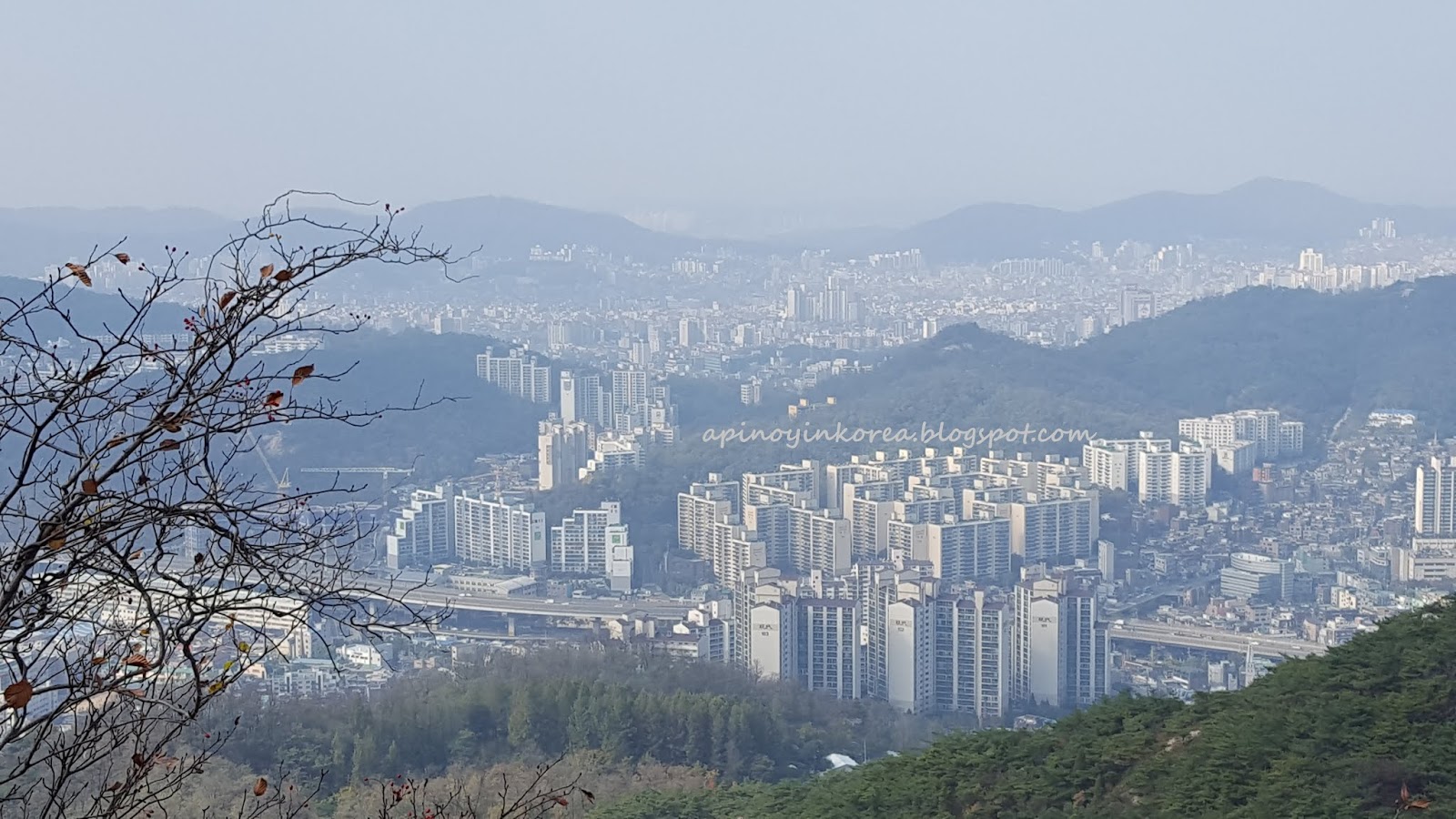
(The view of the Hannam-dong neighborhood 
as seen from the Itaewon side)

For comparison, the market value of the studio-type apartment I'm renting in Hannam-dong just outside the UN Village is about KRW 1 billion, according to my real estate agent. Theirs is KRW 7 billion and got only two bathrooms for the seven of them; I got my bathroom all to myself. 😀

I have explored the whole Hannam-dong (blog) neighborhood over the years. I got to know its corners, hidden alleys, and trails, except, of course, those areas not accessible to non-residents. And to all the BTS fans who want to stalk them, I know of a spot where you can actually snoop, although I think I might get into trouble if I actually share it. I might get booted out from the neighborhood! 😆


(Hannam The Hill is right behind the 
brown building on the left of the photo)

I was suspicious when I first read about this BTS article. No management company would disclose where its band lives unless there's a reason why. 

I think the real reason is purely about branding. Because if security or exclusivity is the main reason, there are other apartments in other areas of Seoul that could provide that. 

Hannam The Hill, according to another news article, has the most expensive apartment in the whole of Korea, which makes it sound really luxurious. This alone, in my opinion, gives management the reason to overprice BTS merchandise and talent fee because, as we all know, all Korean boy and girl bands, including BTS, have a limited shelf life. As these so-called 'talents' were just manufactured, they have expiration dates. Think 2AM, Miss A, 2NE1, and Wonder Girls

So, to probably give the BTS brand an air of upmarket-y or very upscale, their residence at Hannam The Hill was disclosed because if it's privacy they were after, they wouldn't have leaked, disclosed or even discussed their new digs' location. Taeyang of Big Bang, I was told, lives in Hannam-dong and I know where his apartment is, but I haven't really heard his management broadcast it everywhere. 😏

In the Hannam-dong gym where I used to go, I have seen familiar K-pop faces like Minwoo of Shinhwa and a few other tall guys who looked like from another boy band. But since I am not into K-pop, I just ignored them while I tried to finish my 30-minute routine on the treadmill. But I must say, they have better abs than everyone else in the room. 😄

So, do you think if you live in Hannam-dong you'd bump into these celebrities? Maybe.😏

Sunday, 14 October 2018

#itsmorefuninthePhiippines : What MassKara Festival Can Learn From Dinagyang Festival

Yes, Bacolod City's famous Masskara Festival can definitely learn from Iloilo City's Dinagyang Festival (read blog here), which, ironically, is just a short ferry ride away.

Last year, I attended both Dinagyang and Masskara Festivals. Dinagyang is held every January (read blog here); Masskara in October.

Dinagyang Festival, which is one of the most popular festivals in the Philippines alongside Ati-Atihan of Kalibo, Aklan, Sinulog of Cebu City, Masskara of Bacolod City, and Kadayawan of Davao City, showcases the aeta, or ati, history of Panay Island.

Although the streets of Iloilo City were closed to vehicular traffic, the residents and local and international visitors to the city were able to watch the performances of the competing tribus, or tribes, because the organizers of the Dinagyang Festival assigned five (5) performance stages around the city center where the tribes performed.

The closest performance stage to our hotel in Iloilo City was just a hundred meters away, but since the tribes had to move from one performance stage to the next, all of them passed right in front of our hotel, where we just conveniently waited and took photos.

After a weekend enjoying the Dinagyang Festival, we left Iloilo City as very happy tourists.

Then came the Masskara. 


                   (Masskara souvenir masks)

Having lived in Bacolod City, the host of Masskara Festival, I thought it was just easy to watch and enjoy the performances of the participating tribes.


I was wrong.

Since the tribes competing at the Masskara Festival were performing only at one spot, the Bacolod public plaza, you have to squeeze through the tight crowd to get a seat around the performance spot. Those seats I think were reserved for local officials and local sponsors. So, if you're not a politician or a bigshot businessman, you can never get a seat in there; you'd never be able to watch the performances during the Masskara Festival highlights at the public plaza.

In short, if you're a nobody, you never get a seat at the grandstand.


(Bacoleños at the Araneta Street entrance could not get into the Bacolod public plaza grounds)

Last year, I attempted to watch at the public plaza but it was locked down by the police. They closed off the area mid-afternoon and only the people who were there early were inside. If you were trying to get inside the public plaza premises before the performances, you could never get in. Disappointing.


(I joined the disappointed people who 
were turned away by the police at the 
Bacolod public plaza entrance) 

(Kept out: The scene at the Araneta St. 
entrance to the public plaza)

I tried entering through the entrance in front of the San Sebastian Cathedral, they wouldn't let us in. I walked around the plaza and ended up at the Araneta Street entrance, still no luck. There, I joined the crowd of unhappy Bacoleños who couldn't even enjoy their own festival.😠


(A baby and her mom hoped to watch and enjoy the performances. Like me, they were disappointed.)


If only the organizers of the Masskara Festival assigned a few other performance stages around the city center, more Bacoleños, and local and international tourists would have been able to enjoy the dancers' elaborate costumes and their performance.😢

If the issue is the energy of the dancers or the heaviness of their masks and costumes, then they could probably just perform a snippet (maybe for a minute or two) of their full performance during these 'stopovers' en route to the Bacolod public plaza. 

Because the whole point of the Masskara Festival is to provide enjoyment to the public through street dancing wearing those colorful masks and elaborate costumes. This was the main reason why it was organized in 1980. 

And aren't there separate prizes for the street dancing and choreography? So that their dancing and performances could be appreciated by the public?

If ONLY the government officials and VIPs are allowed to watch the performances comfortable sitting at the public plaza stage, and NOT the Bacoleños and visitors, WHAT THEN IS THE POINT of all these? They could just have a fashion show of their costumes along Araneta Street instead, after which we could all go home without breaking a sweat.😩

This is the Dinagyang Festival's route for the competing tribes showing five (5) performance stages:

(Map courtesy of dinagyangsailoilo website)

Does the Masskara Festival also have a ROUTE MAP like Dinagyang's? Where can I find it?

So, my first question is: Will the Masskara Festival have several spots at the city center where the tribes will be performing snippets of their whole dance routine?

(Locals trying to have fun amidst the lock down)

I'm also asking: if the Ilonggos at Dinagyang Festival could perform at FIVE spots around the city center, carrying their costumes and props along with them, why couldn't Bacoleños at Masskara? (Watch them carry their costumes and props around the city in this video).

But my most important question is: Am I going to make the trip so I can watch, too?😱 

Hmm. Don't know. I may just be disappointed again.😛

#masskara #masskarafestival #bacolod #negrosocc #philippines #festival #dinagyang #dinagyangfestival

Monday, 1 October 2018

Enjoying Ecology, Defying Gravity: Inwangsan

I have never been a mountain climber. I grew up in the lowlands in the Philippines, next to a beach! I'm more like a child of the sea than of the hills or something higher. 😃

The first time I ever climbed a mountain in South Korea was in the winter of 2005. It was a memorable experience, memorable because something went wrong! At the peak! Of da mountain! I have told only a few friends about that climb, and they all laughed when I told them what really went wrong.😓

I was so excited before that climb. I bought a winter jacket and ski pants from the sportswear shop on the ground floor of our building when they had a sale and the rest of my hiking gear from Namdaemun Market. 

Yes, I prepared like I was going up Mount Everest. I got myself a headlight (that small light strapped on my forehead), a walking stick, spikes for my boots, ski goggles, and winter gloves! We left Seoul for the Taebaek Mountains around 11 the night before and it was -20'C when we started our climb at about 5:30 the next morning. 

I remember during our ride to the jump-off point, the windows of the bus were icy and freezing. But since I came prepared, I was able to hike comfortably with 30 other climbers from the office. That was my first and last climb during winter in Korea, though my other winter trips, later on, were only limited to ski slopes and the arenas of the Winter Olympics. But in the following years, I also got to climb the third highest mountain in South Korea - Seoraksan (read blog about it here)!

Then came Inwang-san.

Inwang-san is a mountain in the Seodaemun District of Seoul that I always saw when I was standing at the edge of Gwanghwamun Square. All those years, I had always been interested in going up there since it's close by, just sitting on the northwest side of Gyeongbuk Palace. 

Inwang-san means 'mountain of a generous king' and at 340 meters tall, it affords any climber a different view of the city landscapes.  As I said, if you're in Seoul, stand at the edge of Gwanghwamun Square right in front of Gyeongbuk Palace and look to your left. You'd see a peak; that's Inwang-san, or Mt. Inwang.


                (Don't miss to read the signs!)

Since Inwang-san is in the city (read blog about Nam-san here), it's accessible from different corners, and on one cool, autumn morning, I gathered my friends Wendy, Abigail and Ingrid at Exit 1 of Gyeongbuk Palace Station (Orange Line, Line 3). We then walked west and entered a the Hongjae-2-dong neighborhood, trying to reach the mountain's southern foot by meandering the neighborhood's alleys full of interesting cafés, shops, restaurants, and residences. 
                          (On our way up!)
(We're happy that mountains in Korea got stairs!)
(The shortest way between two points 
is a set of stairs) 

But as we got to the clearing, free of apartment buildings, we followed the hilly way up, but somewhere, somehow, we got lost!  We were stopping all the time to pose for photos and we probably missed a sign!

Luckily in the middle of a forest, an ajussi came from nowhere and directed us to the right path, including one that required us to rappel up the mountainside on a rope! What fun! 
                   (Watch out for wild boars!)


And although we spoke limited hangeul, we got to communicate with him and he ended up being our photographer as well! And we were glad it was an ajussi that showed up in the middle of the forest and not a wild boar! Ha-ha-ha! Yes, there were warning signs about wild boars! 😱
(The kind ajussi took our photo and 
pointed us to the right trail!)

We didn't intend to seriously climb Inwangsan in record time; we intended to sightsee, take photos, and have fun! And that's what we did!

We stopped at a ledge for a photo shoot, we posed while rappelling, and we took breathers to literally smell the forest and its cool autumn breezes. If you also live in Seoul, you'd know that this was part of the enjoyment while living in this city: mountain and nature were always a subway or bus ride away! 

 (My turn to hoist my body weight up
this side of Inwang-san)

           (Ingrid rappelling and defying gravity)

At 340 meters, it's taller than Nam-san that stands at 240 meters without the Seoul Tower. But unlike the familiar views at Nam-san, the views of Seoul from this side of the Seodaemun and Jongno Districts gave us a different look of the city from afar: the Gyeongbuk Palace, the Presidential Blue House, Pug-ak-san (or Mt. Pug-ak), the neighborhood of Hongjae-dong on the northern side of Inwang-san, and the downtown buildings that I could probably name on a clear day. (The neighboring Mt. Pug-ak, by the way, was the inspiration of my prize-winning essay at the 2007 Seoul International Essay Writing Competition (read blog here). 


           (You don't get to do this at Nam-san: Embracing the city)

                      (Lost and having fun!)
(Look to the northeast at the foot of 
    Mt. Pug-ak is the Presidential Blue House)


Aside from the views, the trails, its ecology, and flora (and luckily without the wild boar and wild fauna!), the other interesting character of Inwang-san is the Seoul Fortress Walls, the reconstructed old walls surrounding Hanyang, the old name of Seoul, that snake around the city. It was an 18-kilometer ancient wall that protected the ancient city but was destroyed during the Japanese occupation.


("I can name that building from where I sit!")

(At the northwestern side: The expressway that goes 
through the Hongjae-dong neighborhood 
of Seodaemun District)
                  (Bukhansan at the distance)

Over the years, the Seoul Fortress Walls were gradually reconstructed. Parts of it you can see snaking around Nam-san, and in teh neighborhoods of Junggu and Dongdaemun, usually on some hilly neighborhod like the Ihwa Village, that's visible from Dongaemun Design Plaza area. And if happen to be at Sanmootonge, a Coffee Prince drama location, you can see part of the Seoul Fortress Walls on the eastern side of Inwang-san.


(A part of the Seoul Fortress Wall lies on the left)
         (Climbers on the Seoul Fortress Wall)

When we finally reached the top of Inwang-san, we joined other Korean hikers as they posed at the peak they just conquered. There, we felt 'underdressed' compared to them as they all looked like they were geared up for Everest while we, well, looked like we were geared up for lunch at Tong-in Market. Ha-ha-ha! 😜
 (Pausing and posing near
 the Inwangsan peak!)
         (Defying gravity on top of Inwang-san!)

And after posing on that huge rock at the peak, it was time to descend. Walking down the eastern trail, we met more hikers going up. We didn't really keep track of time; we only kept track of enjoyment and fun.That morning, we met up at 9AM at Gyeongbuk Palace Station and by 1PM, we were back at the main road waiting for the Green Bus 7212 that brought these starving hikers to Tong-In Market for lunch (read blog here)!


   (Gingko trees lining up and turning yellow at the main road at the foot of Inwangsan)
(At the main road on the northeastern side, 
 this monument stands for the hero 
policeman who died thwarting an
assassination attempt in 1968)


If you're into hiking and live in Seoul, discovering Inwang-san is a must-hike. While Nam-san is very touristy, complete with a cable car, electric buses, and a thousand other tourists, Inwang-san is about nature in the city, quiet and cool, and offers a different view of Seoul!

Have fun and do wear proper hiking shoes!

PS. Thanks to Wendy, Gail, and Ingrid for the photos and the fun!😎 
(Rock & roll: sitting on a rocky 
ledge of Inwangsan)