Sunday, 24 February 2019

Touring Seoul: Haebangchon on a Weekend

                    (Artwork in Haebangchon's 
                      pedestrian underpass)

When I first arrived in Seoul more than ten years ago, Itaewon was my go-to place during the weekend. Why? It was right next to my Hannam-dong neighborhood in the Yongsan District in Seoul, Korea. And Hannam-dong was as boring as an insect museum.😴

                        (Talk Greek to me)

I could just lazily walk for ten minutes from the Hannam-dong 5-gori towards the Soonchunhyang Hospital street, and climb up the inclined path next to Cheil Building.  And I'd be in the busy Itaewon intersection!

                  (Greek food in Haebangchon)

And over the years, I realized a lot of Koreans and foreigners made Itaewon their hangout spot during the weekends. Before, I could easily get a spot by the window of Starbucks, the one next to McDonalds. Years on, it would always be crowded even if I got there right after Sunday lunch.


(This busy road leads up to Namsan and Hyatt Hotel)


    (When you can't sit and sip coffee, you stand)

Luckily, Haebangchon, the area next to Itaewon (Exit 2 of Noksapyeong Station), also hosts a lot of cafés and restaurants that attract locals and foreigners during the day, and a few bars that attract drunkards at night.😂

Especially during holidays and summer weekends, crowds would descend upon Haebangchon. From the main street where traffic from Itaewon flows, the restaurants, ice cream parlors, cafés, and burger stands located even inside the alleyways would always be full.

       (When churros was the craze around Seoul)

And that winding road that leads up to Hyatt Hotel would be crowded as well. It seemed that people, who have been used to the Gangnam, Daehangno, and Hongdae spots, ventured to check out the Haebangchon life as well.

And one summer weekend, when my Sunday was as uneventful as a scripted Korean wedding, I dragged my Korean friend Woongjae to join me in exploring Haebangchon in search of lunch.


            (Creativity transforms a set of steps)

Needless to say, we spent half an hour walking up and down the alleys in search of an empty table with seats until we found Greece.

El Grecos hidden inside an alleyway had space for two hungry tummies. Lucky us, we finally were able to sit down and enjoy a Haebangchon lunch. 


             (Shaved ice with flavors in a cup is 
              a perfect companion during summer)

After eating and speaking Greek, we strolled around the area and found ourselves back in Itaewon for coffee. Since the cafés at Haebangchon were small, we figured the ones in Itaewon probably had better seats for us.

                     (The Haebangchon crowd)

And since I knew all the cafés in Itaewon, we headed to Leonidas right across Hamilton. There, we got a table as this place is spacious and had more corners than any café in the neighborhood. Their staff is also friendly. This is the only coffee shop in Seoul that gave me a box of chocolates!👌

So, in case you run out of places to discover in Seoul, Haebangchon is a recommended spot! Have fun!😀

Friday, 15 February 2019

Travel Blog Korea: Seoul Plaza & Free K-Pop Concerts


(Crowds gather at Seoul Plaza to watch a K-pop concert)

The Seoul Plaza right at the center of South Korea's capital is one of the most overlooked tourist attractions because, as what most people think, it's just an open space.

But isn't it more interesting to know that an open space can provide unique events and gather people together for some fun and enjoyment?


             (A k-pop girl band takes the stage)


(I chanced upon a k-pop girl band entering
 the backstage before their number)

Over the years of living in Seoul, I'd stumble upon different kinds of events held at the Seoul Plaza: the annual Seoul Global Festival, Psy's Gangnam Style concert, the annual Kimchi-making festivals, philharmonic orchestra concerts, agricultural fairs, and the most popular event of all: free K-pop concerts!

It also hosts protest rallies as a venue for the citizenry's outcry. But on a few sad occasions, the Seoul Plaza hosted memorials for the late President Kim Dae-Jung and the memorial of the 46 sailors who died in the sinking of a frigate in March 2010.  Those were sad times in Korea.😪

(The crowds cheering for a K-pop girl band 
as they took the stage)

But one summer weekend, as I made my way to Gwanghwamun Square on foot, I stumbled upon a huge crowd at the Seoul Plaza. So I stopped by and looked around.


        (A pretty face, a white dress plus a guitar 
                       and you got a duo)
                 (Please help me name her.😓)

It turned out a free K-pop concert was happening and as expected, a lot of youngsters in the audience alongside families who were out on a weekend. K-pop concerts in Seoul are pricey and are held either at the Jamsil area or Olympic Park, which are both in the southwest area of Seoul and far from the city center.

                  (Is he a boy band member?)

                (Which k-pop boy band is this?)

These free k-pop concerts in an open-air venue at the city center with convenient access by bus and subway are not just a treat but a fun experience, especially for tourists!


Yes, if you're a K-pop fan who's just visiting Seoul for a few days and wasn't really expecting to watch a k-pop concert, wouldn't this be like a miracle of sorts? An unforgettable experience if you're a diehard k-pop fan!

So, when you're in Seoul, do ask the tourist information desks at the tourist centers, or the tourist guides wearing red jackets who walk around the crowded areas like Myeongdong, Insadong or Namdaemun. They can help you find out what's happening at the Seoul Plaza during your stay. Your itinerary may end up including a free k-pop concert at Seoul Plaza!😀


(A k-pop boy band providing a lot of fun to their fans at the Seoul Plaza)

Now, you know that Seoul Plaza should be in your list of places to visit when you're in Seoul.😄

Monday, 11 February 2019

Four Reasons Why Korean Dramas Are Better Than Pinoy Dramas

Working on TV dramas, according to one actor, isn't about acting. Good for him; he was honest to say the obvious.  Of course, TV dramas are all about making money, and not exactly about flaunting your Meryl Streep or Daniel Day-Lewis acting skills. 

I have lived in Seoul for more than a decade, exposed to Korean movies and dramas. But as I recently spent a lot of time in front of the television with my mom here in the Philippines, I got to compare the dramas from both countries. 

And now, I know the reasons why Korean dramas are way more interesting, more creative, and more popular than Filipino dramas. And I was able to come up with four, which I probably share with the millions of Korean drama fans.

1. Horrible Filipino actors and actresses (not all, only some!😀)
Though there are dependable performers, veterans and young alike, there a bunch who are obviously untalented. If you watch them, you'd think they're in a school play. While some don't know how to act, others overact, probably to grab attention, or to compensate for the absence of real talent. 

Unlike the Christopher de Leons, the Nora Aunors, the Cherie Gils, the Mylene Dizons, or Angel Aquinos  of Philippine TV dramas👍, most of these actors either don't know how to act or just want to grab more screen time from their co-stars. I noticed that some Filipino TV dramas exaggerate the simple in order to create hype but the people behind it don't seem to realize that they instead successfully turn the drama into comedy.

Some lead actors look like a miscast when their roles demand heavy acting and they seemed lost. Put them in a confrontation scene with very effective contrabidas like Eula Valdez and they disappear. At times,  I asked why a lead actor or actress was cast when it was obvious he or she couldn't act. Just because someone won a reality TV show doesn't mean there was talent. And just because one has telegenic looks doesn't also mean he or she can express emotions with a range from A to Z. Most of the time, the range just hovers between A and B. Ha-ha-ha!😆

And while not all Philippine TV dramas suck, some comedy shows are full of corny jokes and plots. The satire-comedy show 'Abangan Ang Susunod na Kabanata' which starred the talented Tessie Tomas, Anjo Yllana, Nova Villa, and Roderick Paulate was the best I could remember. The script was well-written and the delivery perfect. I wish they bring back that kind of satire; we badly need it.

Korean dramas, however, have this nature of not exactly pressing the characters into heavy wailing or screaming like a cat died or something. Although Koreans are not emotional by nature (only drunk Korean men and Korean CEOs are violent, and only Korean ajummas are noisy!), they are stingy when it comes to facial expressions and yet you get to like the scene. Song Hye-kyo and Kim Yoo-jung could deliver a sad scene with a couple of sentences paired with a look. In Philippine TV, the same scene would require five minutes of wailing without tears interrupted by ten minutes of commercials.😂 

2. Interesting and mostly original storyline
A famous name and good acting alone won't make a drama popular. Take Bae Yong-joon. He became a superstar after Winter Sonata became a super hit in Asia. He even became godlike among his Japanese fans. That drama single-handedly started hallyu, or the Korean Wave that swept Asia.

That drama's storyline was very original and well-written that its message wasn't just Korean. It was universal, understood not just by the Korean audience but by an international audience as well. Of course, it also helped that both Bae Yong-joon and Choi Ji-woo were good-looking and had impeccable make-up. Both deserved their superstar fame and the billions of Korean won and Japanese yen that went with it.

Philippine TV dramas, on the other hand, always have these common denominators: guns, a crooked politician, an angry ex-girlfriend, and an even angrier ex-wife. You bring all these together and you got a TV drama. Or you can also copy stories from Twilight the movie series. And not to mention, a lead actor who just couldn't die no matter how many battalions of enemies are sent to kill him. Right, Ang Probinsyano fans? 😆

Even though some Korean dramas are fantasy, the immortal or ghostly characters always manifest some human frailties and character that make them interesting to the viewers. Take Goblin and Black. My mom loved watching these.😍

3. Well-financed production
Korean productions don't scrimp on costs. From CGIs to location shoots in Europe or other continents, the Korean dramas never look cheap. Even the wardrobe of the lead actors and actresses get their own screentime. Since Korea has four seasons, you won't wonder why the characters are wearing boots and coats.

In Philippine dramas like Ang Probinsyano, I always wondered which province is the setting because he always wore a jacket on top of a shirt! His province must be cold, or perhaps, he has a fever every day?😜 Or do they just want to show that they have a lot of budget for his jackets?

I guess technology and the Korean passport also make the difference. In case of an overseas location shoot, Korean production staff has no problem traveling to Europe or the Americas as their passport would usually give them easy access to other countries without visas. For Philippine TV production staff, however, this may require them to apply for a visa first before getting over there. And that's a lot of hassle.

You need not be a film expert but you can easily tell if it's a good TV production or not. From the wardrobe to costumes, to the set and the location. These will tell you if the producers are scrimping or not.

4. Korean productions know when to end

Unlike this walang-kamatayang Ang Probinsiyano, Korean dramas, even before they started shooting, the plot, the script, and the schedules are already finalized.

Ang Probinsyano's plot has been stretched to maximize profit while they still can. Old enemies are resurrected and when they ran out of enemies, they turned friends into one.

Korean dramas, on the other hand, get respected because they know when it's time to end the series. That's why the storyline isn't muddled because the producers stay true to the story they originally planned to tell.

In Philippine dramas, they always stretch the story by inserting scenes that they think would hype up the drama's attraction again when the ratings drop. Most of the time, they introduce new characters to do just that. For example, in that Wildflower drama, they introduced Zsazsa Padilla as a new, sinister character. Her role, her acting, and her hairdo that resembled that of Gary Oldman's in Bram Stoker's Dracula turned her into a comedy character.😂


*  *  *  *

So, there. My thoughts on why Korean dramas lord it over, not just Philippine TV series, but probably most of the dramas from other Asian countries. I don't really wonder why the fans of Korean dramas are always excited if there's a new drama coming out. Lucky them! 😊

In the meantime, a shout-out to my dear Korean drama fans Fay, Cielo, Marlu, Itchay and Jenny!😄

Happy watching!😊

Sunday, 30 December 2018

The Nativity Scene: From Familia Sagrada to Nuestra Familia

Today is the Feast of the Holy Family or the Familia Sagrada, being the Sunday between Christmas Day and New Year's Day. So, it's just fitting that I must write about the basilica dedicated to Jesus, Mary and Joseph: the Familia Sagrada in Barcelona, Spain.

That autumn day, a few years back, I was comfortably seated on a Barcelona tour bus, lazily wandering around the city, when I realized that the scheduled time on my ticket to go up the tower of Familia Sagrada was less than an hour away. (I purchased my ticket online before I arrived in Spain.) 

(The towers came into view.)

The basilica of Familia Sagrada (Holy Family in English) is one of Barcelona's most popular tourist attractions, but being a Catholic, I wouldn't be just a tourist; I'd be a pilgrim. Designed by a Catalan architect, Antoni Gaudi, also known as God's architect because of his vision and work on the basilica, Familia Sagrada is one of the most beautiful buildings in the world. Gaudi died in 1926 after being hit by a tram in the streets of Barcelona.

Worried that I wouldn't make it in time, I carefully studied the city map on hand and decided to ditch the tour bus. So, when the West Route tour bus I was riding on made its scheduled stop at the La Pedrera, I got off and made a run for it. I could have transferred to the East Route bus but it would still meander through the city passing by several stops before arriving at the cathedral, while the La Pedrera bus stop was the nearest to the Familia Sagrada. As they say, the nearest distance from Point A to Point B is a straight line. Well, it wasn't exactly straight a line but it was the shortest cut just the same.

(Lo and behold! As I looked up  from the 
Plaça de la Sagrada Familia)

La Pedrera, a residential building with very unique features, was actually one of Antoni Gaudi's designs. And it was probably not a coincidence that I started my quest on foot for the Familia Sagrada from another of Gaudi's work.

From the La Pedrera bus stop, I walked northeastwards for about 1.3 kilometers to reach the Familia Sagrada. And even though I knew my navigational skills were always better than a compass, I had to ask for confirmation along the way just to make sure I was on the right track. So, when I came across a bookstore along Carrer de Provença, and after buying una toda mapa de España (a map of Spain) from her, I asked the Spanish lady whether "esta direccion para Familia Sagrada" was correct. She confirmed,"¡Si!"😀

It wasn't long before the towers of Familia Sagrada came into view, and when I finally arrived at the cathedral grounds to join a thousand other tourists, I just showed my online reservation and got in easily.
(The spectacular center of the Nativity Facade 
telling a Bible story that comes to life 

with faith and adoration.)

It was different looking at the photographs online; in person, the whole creation - from its towers to the sculptures, to the facades, porticos, and symbolic features, the Familia Sagrada was overwhelmingly impressive and full of Biblical stories. Around it are the three facades: the Nativity, Passion, and Glory. 

The Nativity Facade faces east to be symbolically true to its meaning: the rising sun gives birth to life. It also has three porticos after three Christian values: Charity, Faith, and Hope.


(Familia Sagrada on their flight to Egypt 
with an angel keeping them safe)

(The shepherds paying homage to the birth of Jesus)

While admiring Gaudi's work from the ground looking up, one reflects the passages from the Bible as they are depicted by one man's work that started in 1894 and was far from being complete when he died in 1926.

And as I stood there at the Nativity Facade that has been admired by millions of pilgrims and tourists, I added myself to that count.


At the entrance of the portico, I realized this was the most beautiful 'belen', or nativity scene, I have seen in my life. The life-like sculptures of the Holy Family, or Familia Sagrada, taking center stage, not only at the basilica named after their sacred union but at one's faith as well, is one portico of the cathedral not to be missed.
                (The three kings bearing gifts)


(The nativity scene is the most popular Bible 
story we bring to life. Which Bible story is this?)

And today, on the Feast of the Holy Family, our family joins the rest of the Christendom in celebrating the blessing of being part of a family. And just as I had written a few years back about my homecoming every Christmas time to join my family, every time I arrive home and step into our front door, the feeling of being family becomes real as the sense of belonging to this home is once again celebrated by the heart.💗

(Joan Vila-Grau, an 86-year old Spanish artist (born 1932), created these amazing stained glass windows at the basilica, bringing an explosion of colors and light because, as was written, God created light on the First Day and what a brilliant idea to use light and the spectrum to celebrate and worship Him and his creations.)
(The rays of the sun passing through the stained glass was like peering through Mary's veil)

("Not too much light, nor too little...for both things blind and the blind cannot see." - Antoni Gaudi)


And to God's architect, Antoni Gaudi, eventhough his work is still being completed and is expected to be finished by 2026, a hundred years after his death, I join the millions of pilgrims, who have been awed, mesmerized and enlightened by a place of worship, in thanking him for making me realize that a most beautiful place of worship such as the Familia Sagrada could be possible here on earth.😂

So, from the Familia Sagrada in Barcelona, Spain, to our own families wherever we are, let's all celebrate to our being one with the Holy Family.💝


(JESUS prominently stands out among the words and passages written like a bas-relief type of artwork. HIS name is written in gold.)

Monday, 24 December 2018

Seoul's Seongsu-dong: Shoes And The City


(A shoe museum at Seongsu Station)

Red shoe diary 
I think Carrie Bradshaw (Sarah Jessica Parker's shoe-addict character in 'Sex and the City') would have loved shopping around this neighborhood.

From all shoe styles, for adults and kids, she would have spent all day walking around, visiting one shoe shop after another.
(Gail pointing out the must-visit corner 
of Seongsu-dong)

This is Seongsu-dong in the Seongdong District of Seoul, South Korea. If you're familiar with Seoul's geography, it's a short distance to the right of the city's geographical center, just above the Han River along the trail of the  Seoul subway's Green Line.

(Seongsu-dong is a star 
neighborhood for shoe lovers)

I was only able to walk around this place recently, recent being the past three years. From my seat on the bus, the main street always looked like any other Seoul neighborhood, and from the subway above (yes, the Line 2 trains are on elevated tracks while passing this part of Seoul), I'd only see rooftops of residential and commercial buildings. That's why I never really bothered to visit...until I ran out of places to visit! Ha-ha-ha!

(A black stiletto inside the Seongsu Station)

(A tourist sits on the giant red stiletto)

What I didn't know was that the interesting corners are on the alleys next to the main street, hidden from view, and that's where I finally brought my friends who, I was sure, were more interested in shoes than I was.

Yes, the best tourists to bring along to Seongsu-dong are the ones who love shopping for shoes. Luckily, I have friends who do! 
(Seongsu Station converts itself into a tourist attraction with artsy tiles and exhibits)

Follow the shoes
When you get off at Seongsu Station, you'd immediately realize you are in the shoe neighborhood because this station has a museum for shoes! From displays of different shoe styles to old shoe-sewing machines, and even a directory of all the shoe shops and stores in the neighborhood, the station gives its visitor a glimpse of what the neighborhood is all about!

According to the Visit Seoul website, in the 1960s, the shoe stores specializing in handcrafted footwear were mostly concentrated around Seoul Station but they moved to the Myeongdong area during the 1970s and 80s. And then in the 1990s, one by one, they moved to the Seongsu-dong area in the Seongdong District because the rentals were comparably cheaper.

(Tita Rena, Wendy, Gail, and Kristine are 
welcomed at the shoe center of Seoul)
(The ladies are dwarfed by giant shoe art)

Today, there are about 500 different shoe-related businesses in this neighborhood. These businesses include actual shoe-making, shops that sell shoes, businesses that supply raw materials required for shoe-making, shops that sell certain shoe parts, and stores of shoe resellers and distributors.

Most shoe shops are on the alleys next to Exit 3 or Exit 4 of Seongsu Station. But before heading there, we walked about 300 meters out of Exit 1 to catch the biggest red stiletto shoe you'd find in Seoul! 

Other than the giant red stiletto, walking from Exit 1 up to the intersection, you'd also see small shoe shops and a symbolic sculpture of two giant hands sewing a giant shoe! 
(These tourists invite you to visit Seongsu-dong!)
  (Wendy, Gail, Kristine, and Tita Rena with the biggest right foot shoe in Seoul. Behind them 
are small shoe shops lining up the sidewalk.)


Lunch @ Daelim Changgo Gallery Co:lumn
After walking through the artsy path of Seongsu-dong, we decided to grab lunch before hitting the shoe stores. We crossed to the other side of the main street - to the side of Seongsu Station's Exit 3 and 4.

(The spacious interiors with art installations 
make the restaurant unique and interesting)


The Daelim Changgo Gallery Co:lumn was an old factory and warehouse converted into a gallery and restaurant. But it was the latter character that was more interesting to me and my tummy. I figured, since I wasn't into shoes and wouldn't get any high from shoe-shopping, I might as well have fun eating. 

Our dishes were all yummy and even made more enjoyable in the company of friends. 
(Inside the gallery that also serves as a restaurant)

If the shoe fits
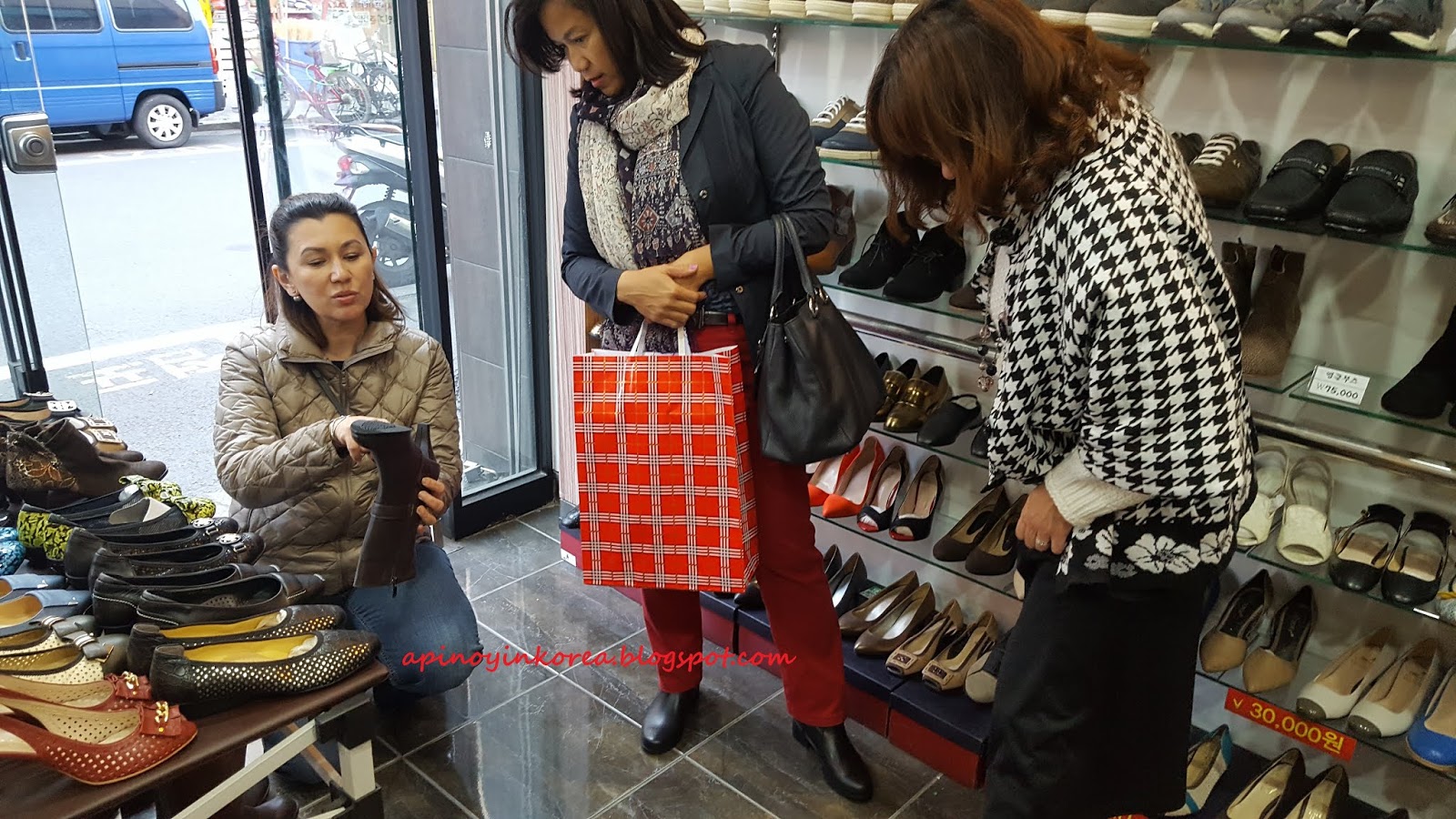
In order to walk off the calories from our lunch, we jumped from one store to another, admiring and trying on (at least Gail, Veronica, and Wendy did!) the shoes made by the shops.
(Veronica, Gail, and Wendy shopping for shoes)

The owners of the stores we visited told us that they could even tailor-make shoes for us. We could just choose a design, pick the leather, and get our foot measurements. And after a week, he could just text us if the shoes are ready for pick up! 

Since you're buying from the shoemaker himself, the prices are so reasonably low! So much lower than the ones sold at the department stores! 

(Happy shoppers!)

Common Ground shops and cafes
The other interesting corner near Seongsu-dong is Common Ground, an open area full of blue container vans that were turned into shops, restaurants, and cafés.
(A red shoe)
                            (A gold shoe)

Common Ground is already part of the neighboring district, Gwangjin-gu, and it's about 700 meters from Exit 3 of Seongsu Station. But it's worth visiting if you're in the area. From there, just walk eastward towards the direction of Konkuk University Station until you see piles of blue-colored container vans. That's Common Ground.

These multi-layered commercial spaces, made from container vans, even have a 'rooftop', where you'd find open-air restaurants, food stalls, and an ice cream counter. On the ground, a small entertainment corner and food trucks occupy the open area.
                (Everyone's favorite at Doré Doré)

If there's one thing that would bring me back to Common Ground, it's the cafe that serves rainbow cake. The multi-colored layers are separated by white cream and it's heavy to the tummy. Heavy because I had a slice all to myself!

If you want to visit Common Ground on another day, it's closer to Konkuk University Station. It's about 200 meters from Exit 6.
      (Inside the container vans are 
pop-up shops and cafés)
      (Common Ground's open space with 
a stage and food trucks)

I know the shoes sold at Seoul's department stores are a bit pricey. So, here at Seongsu-dong, just like the bags at Dongdemun's NPH bag market (read blog here), you have cheaper options. And you can have a pair tailor-made, too!

So, gather your shoe-loving friends and drag them to Seoul's shoe center. Who knows? You might bump into Carrie Bradshaw herself.😀
(Let him eat cake!)


#seoul #Korea #shoes #seongsudong #konkuk #konkukuniversity #tourist #kdrama #carriebradshaw #kpop #shopping