Thursday, 18 April 2019

Carrozzas de La Semana Santa: The Most Attended and The Most Popular is a Procession of Faith and Style


Catholicism is the most significant contribution by the Spanish colonizers to the Philippines, although I'd put jamón and Spanish pastries up there, alongside saints and angels. And the religious procession of Jesus, Mary, and the saints who were part of His Passion during Semana Santa or Holy Week is the most colorful display of style, art, and creativity in the whole Catholic calendar. This is also the most attended and the most popular of all religious parades. This Lenten procession has colorful floats that make your Christmas trees look like grade school art projects.

(The Agony in the Garden carro in 
2011 was decorated with white picket fences. 
What's missing is a rocking chair.)

 (The Good Friday crowd gathers for the procession)

That's why when I was a kid, I had fun memories of helping prepare the Agony in the Garden carro, short for 'carrozza' (the Spanish word for carriage), here in my hometown of Victorias City in the Philippines, (they're also called pasos in other parts of the Philippines) during the Holy Week when school was out and the summer heat was in. 

Back then, there were just a handful of carros participating in the procession that was held on Maundy Thursday and Good Friday. Currently, the procession in only held on Good Friday and involves more than a dozen carros.


(Agony in the Garden) 
(Jesus Cautivo)
(Scourging at the Pillar)


While most of the carros during the procession in our hometown in Victorias City was obviously made during the last decade or two, the Agony in the Garden, owned by the Montinola family of Victorias, dates back to the 1950s, after World War II. 

Commissioned by Don Felix Montinola and his wifeDoña Dorothea, from artisans and craftsmen in the Iloilo Province, the sculpted image is that of a kneeling Jesus looking up to a winged angel holding a chalice that seems to be bringing Him the prophecy of his impending suffering and death on the cross; it is made of heavy wood that was cured and had not shrunk or deteriorated all these years. (Wood from santol, I learned, is not a good material for statues because the wood shrinks over time, although the santol fruit itself is a delight to eat!😍).


 (Above: Inday Lydia Quiatchon with the Montinola Family's Agony in the Garden carro that she decorated for the annual Lenten procession)


The Agony in the Garden depicts Christ kneeling with His face expressing sadness and anguish as He prayed on the eve of His Crucifixion in a garden which was located at the foot of Mount Olives in Jerusalem, where water has always been a problem as it is in a desert region, next to the Judaean Desert. 

Olive trees naturally survive in arid conditions and the ones at Gethsemane have been tested to be the oldest olive trees in the world with some aging as 900 years old. Those trees have witnessed more biblical events than any living organism on Earth.

(Jesus de la Paciencia)

(St. Peter's carroza was the most creative. His 
golden robes paired with emerald green was 
a color combination that was attractive to the eyes. 
A 'palm tree' made the carro a standout as 
this added a tropical Philippine flavor) 
(Gold and emerald green with devotees 
in matching gold shirts. The faithful are tasteful.😉)

If you look closely at Christ's statue on the Agony in the Garden while ignoring His red cape and white vest with glittery sequins, you'd see a face in a state of surrender and sadness. 

For me, the expression on His face summarizes His suffering; the Five Sorrowful Mysteries are right there on the Lord's face. 😢


(The Carrying of the Cross)
 (The Crucified Christ)


The late Inday Lydia Ledesma-Quiatchon, who was tasked by the late Doña Luz Montinola with the annual responsibility to oversee the preparation and decoration of the Agony in the Garden when she was still alive and able, once exclaimed upon gazing at Christ's face, "Katahum guid sang nawong sang aton Gino-o. (The face of our Lord is so beautiful)."

The decorations of the carros decades ago were only plastic flowers as there were no vendors who could supply huge quantities of flowers required by the local owners of carros in Bacolod City then.

 (Red anthuriums on the Agony in the Garden carro)
(Putting the angel's wings)

During the parade when darkness falls and the lights are turned on, there's a spotlight that directly illuminates His face, and amidst the weariness of walking, any faithful could still draw strength and inspiration upon gazing at this apparition.

(A spotlight illuminates Christ's face)

If you're wondering why the saints' faces look very European with high noses and chiseled bone structure, it's because when the Spanish friars and religious men came to the Philippines, they brought with them icons and statues whose faces were patterned after Spanish and European features. And when the Philippine craftsmen and artisans learned how to carve intricate statues, that's what they have been told to copy ever since.

 (Father Rafa and Father Vince greet and 
bless the passing carros)
(La Pieta)
(San Juan Evangelista)

That's why it's no wonder that many of the faithful are in awe of these images and statues being paraded during Good Friday. 

And as these are blessed by the priests, they are considered sacred with some people even grabbing them from the carros after the procession to keep them as 'pangalap' or items they'd use for their livelihood like a piece of the saint's vest fishermen brought to the sea with the belief that these would bring in a bountiful catch. Yes, there were times people would bring scissors to cut off the statue's clothing, although the most common practice now is just to grab the flowers that adorned the carros.

(Santo Entierro or Holy Burial) 

(Saint Veronica whose statue for me was the most elegant and dramatic of all. Sadly, this statue was lost in a fire in 2018.)

(Virgen Dolorosa)

Aside from the 'pangalap' tradition, people bring white cloths or handkerchieves to wipe the saint's faces or raise their children up to the carros so that they could kiss the saints.
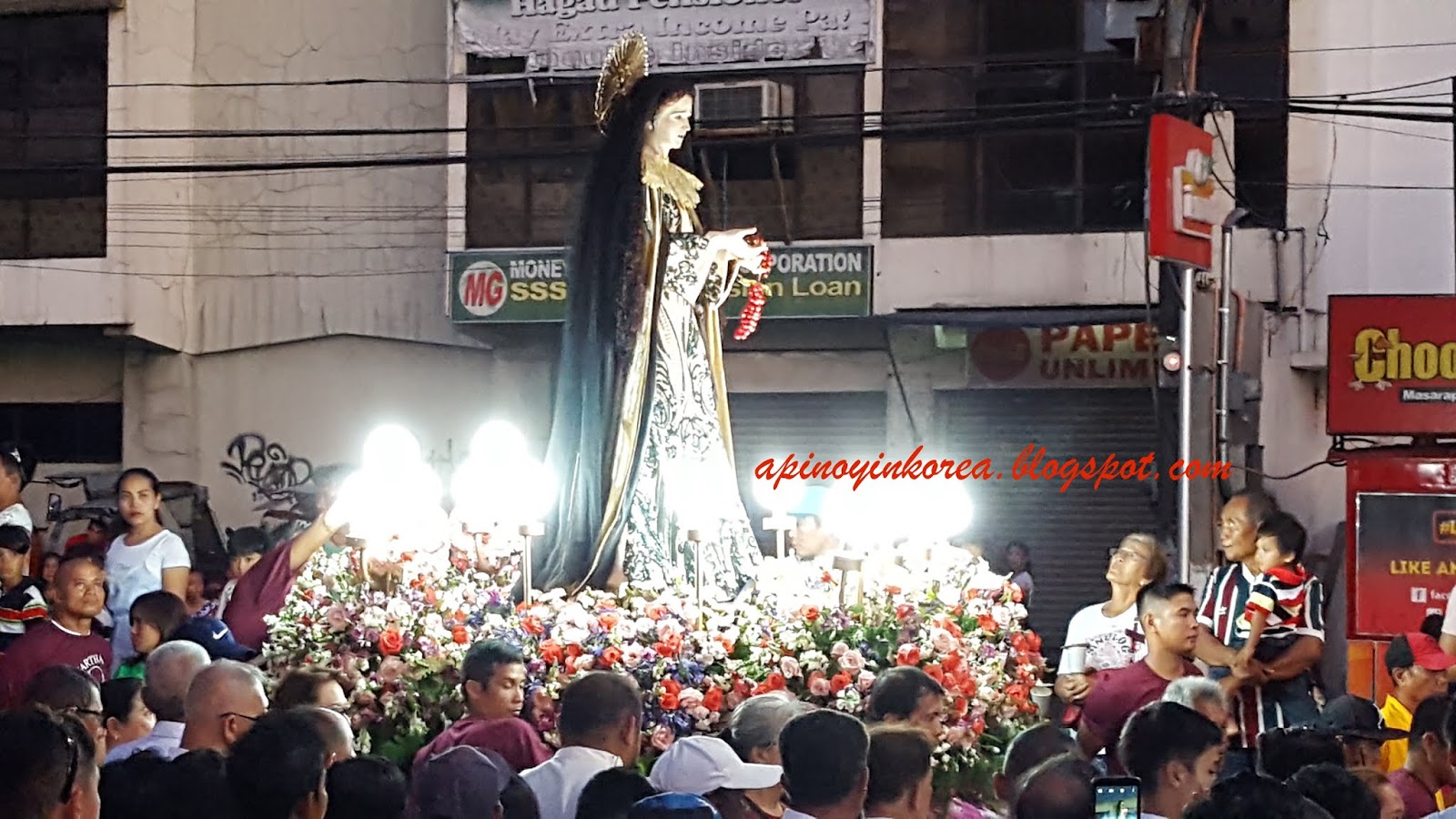
(Santa Marta)
(Saint Mary Magdalene) 
(Parish altar boys lead the procession)


Although this is not a competition but a profession of our faith, we subconsciously (or maybe not!) compare the floats as to their decorations, the saints' glittery vestments, the size of the carriage, and the flowers that adorn the carro as if the whole thing was a beauty pageant. 

I know this as kid with a direct hand in decorating a carro (well, it was just handing thumb tacks to whoever was putting on the silky purple skirt around the carriage or handing flowers to whoever was decorating), I used to compare, too, even boasting then that the Agony in the Garden was the only one with accompanying music. 

Weeks before the procession, my mom would go to a music shop in Bacolod City to have religious music copied into a cassette tape. That's why days before Good Friday, you'd already hear Mario Lanza singing at home The Lord's Prayer before he even belted the same songs for two hours all over town on Maundy Thursday and Good Friday.

(Mary Magdalene)
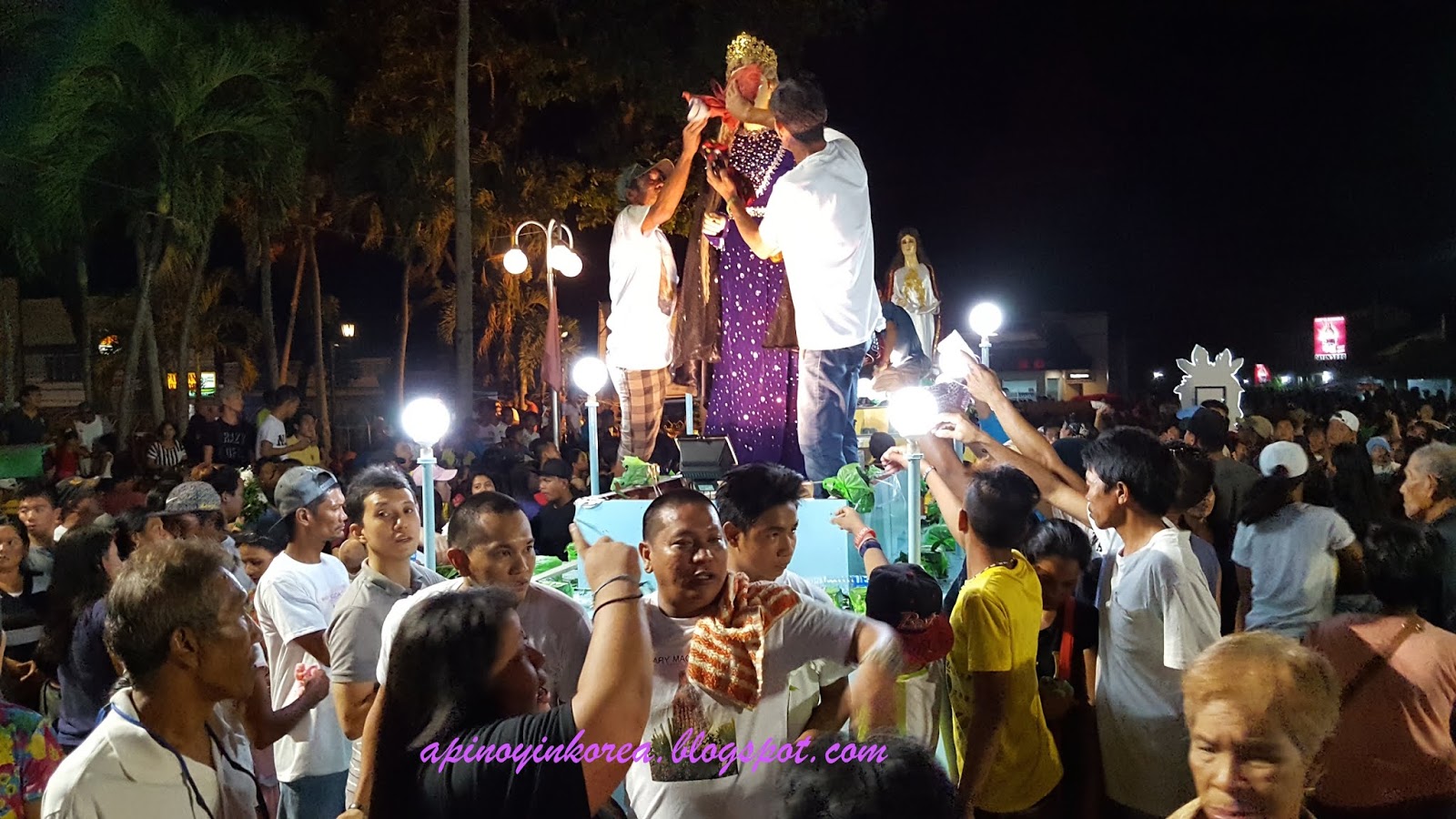
(People raise their white cloths to
 wipe the saint's face)
(A child is raised to kiss the saint)

And on this Holy Week, as we Catholics ponder on Christ's passion, most of us will probably be attending the procession to have more photos for Instagram and Facebook but I hope we'll all remember that the procession is a profession of our faith and not a parade of style and creativity.🙏

Sunday, 31 March 2019

On Fire Prevention Month: Let's All Save Lives & Property

According to the website of the Department of Interior and Local Government of the Philippines, March is the designated fire prevention month because the most number of fires happens during this month.🚒

And yet, on March 12, 2019, the second Tuesday of the Fire Prevention Month, all hell broke loose in the city center of Victorias just after lunch! Well, it was literally hell as a fire razed 14 houses and caused damage to three others in the city's Barangay 4 right next to a public elementary school, causing panic and grief to the students and the whole neighborhood.


The firemen and volunteers gathered 
at Quezon Street to help)

I experienced a fire in my neighborhood during my early years in Manila, Philippines. One was in Tambo in Parañaque City, where the third house from ours caught fire. It was a late Friday afternoon, just as I got back from work at Ayala Avenue in Makati City. There wasn't any fire truck in sight yet and Vina, our help, was crying when I got home; she didn't know what to do. I immediately got her upstairs, laid out a huge blanket, and put clothes on it: shirts, trousers, socks, underwear, towels and everything one would need in case you need to evacuate; and then tied them inside the blanket ready to be dragged out of the house if the fire came too close. I also told her to do the same with their own things. Fortunately, the fire didn't cross over to our fence but we ended up having a souvenir photo as the fire was razing the neighbor's two-story house along MIA Road. The next-door neighbor's (Tita Elsa Ardosa's) sofa was brought out into the street during the fire and we were already comfortably seated when I realized I had my film camera with me! Well, what do you do then? Take a photo, of course! Imagine this: it was early in the evening with no electricity on our four-lane road temporarily closed to vehicular traffic, the fire sirens were wailing, and the firemen were busy putting the fire under control. And there we were, sitting and posing on the sofa as the pedestrians walking past us were staring at the 'fire victims' who were having a photo shoot! In the middle of a fire! Ha-ha-ha!😆
(Students from a public school were 
nervously watching the fire from the school)


This time, however, at the Victorias City's fire, there were anguish and anger as the victims lamented the delay in the response of the local firemen. (Yes, I spoke to these crying victims as the fire was raging!). Witnesses even told me the city's fire truck didn't even have enough water in it, and it was the firemen and trucks from the neighboring cities and municipalities, including the Chamber Volunteer Fire Brigade and Amity Fire Brigade from Bacolod City, that successfully put the fire out. Thanks to all of them!🙇 Fortunately, no one was killed in the fire, only some livelihood of the victims who badly needed help after.


(Fire trucks from neighboring cities and 
municipalities came to help)


I would have enumerated the shortcomings of the local firemen's response but I was thinking they should know better how to tweak their system after the hullabaloo at the municipality of the neighboring Manapla when an early morning fire on February 15, 2019, broke out at their public market and the firemen had to be awakened from their sleep by a security guard of a neighboring convenience store and an empty fire truck had still to be filled with water. Sadly, all was razed that day. 😥

Compared to Manapla's, the fire in Victorias City was smaller. Here's the video of the fire:


It has been two weeks since the fire, and the victims have received a lot of help from their fellow Victoriahanons and are starting to get their lives back. Of course, local politicians were quick to grab the opportunity for a free ride on the publicity they could get using the fire victims for their political campaign as they posed for photos and uploaded these on social media. Well, this reminds of an American TV series titled 'Shameless'. Ha-ha-ha!😾 

I was thinking: these victims already lost their livelihood, but as local politicians were using them for publicity, the victims also lost their dignity.😡

(The yellow fire truck of Chamber Volunteer 
Fire Brigade from Bacolod City)

(The site of the fire has been cleared of some 
debris and burnt houses)


With help from private individuals as well as from the city and provincial governments using the taxpayers' money, the families are slowly rebuilding their lives and livelihood.


But you can still help them by visiting the area at Quezon Street (next to the public elementary school) where some of them have put up improvised shelters. You can just ask around where it is.😢

In the meantime, click this link on how to prevent fire:

https://news.abs-cbn.com/nation/metro-manila/03/17/14/15-tips-keep-your-house-safe-fire

Thursday, 21 March 2019

Dancing With The Cars: Meet Mr. Rene, Traffic Enforcer and Street Dancer

        (Street dancers at the Kadalag-an Festival)

The other day, I watched the 12 groups of barangay dancers that competed at the 2019 Kadalag-an Festival of Victorias City in the Philippines.

With their colorful costumes, make-up, and choreography set to upbeat music, they charmed and entertained the crowds lining up along the city's main streets. That night, the best costumed and choreographed street-dance performances went 
home with the top prizes.


(Graceful dancers in colorful costumes 
at the street dance competition.)

Strangely, a few days later and on the same street, a highway, actually, I chanced upon the most entertaining street-dance performance I have ever seen. This performance was unrehearsed and the performer was not even wearing any colorful costume unlike the dancers at the competition. 


As I was watching him dance, I told myself that if there's 'Dancing With The Stars' on television, in our highway, there's 'Dancing With The Cars'. I had to take his video!😛

The performer is Mr. Rene Abellano, an amiable traffic enforcer for 15 years. His traffic-enforcing-shift-slash-dance-routine was simultaneous with the dance number of a group of city employees performing at the plaza. The employees' music, blasting all over, provided something for Mr. Abellano to dance to.

And under the warm noontime sun, he gave the motorists, pedestrians, and me something to watch and enjoy! Carefully, the drivers of the passing vehicles, especially those big dump trucks and trucks carrying tons of sugarcane, kept their eyes on the road and not on his dance moves!😆


(Mr. Rene and his audience)

While he was giving out hand signals to the drivers of tricycles, transport buses, private cars, and trucks, his turns, side steps, and footwork were all synchronized with the beat of the music of Psy, Momoland, and other artists. Not only does he have traffic gestures, but he's also got rhythm!🙌

                (Traffic enforcer and street dancer)

After his performance, I had to run after him as he was making his way to another intersection. I showed him the video and told him that what he did was the real public service. He was not only effectively guiding the traffic but also providing light entertainment! Sorry to the winners of the street dance competition, but Mr. Rene is the best street dancer there is!

I'm not sure when I'd stumble again into's Mr. Rene's performance. But with traffic or no traffic, with music or no music, he is definitely the best street dancer this side of the globe. Or lane.😎

In the meantime, here's his performance:


Thursday, 7 March 2019

Iloilo City's La Paz Public Market: Netong's Batchoy & Madge Café

The Philippines has a lot of popular merienda dishes and one of them is 'batchoy', a hot broth with noodles and a lot of other flavorful ingredients which I will enumerate later while salivating.😋

While I was growing up, I was never a fan of this dish because nobody at home seemed interested in dragging me to a 'batchoyan', the common name of a restaurant that serves this dish.  That's why batchoy never became a comfort food.😆

But over the years, whenever I got caught in a food arcade in Bacolod City where I didn't have any option but 'batchoy', I ended up slurping a bowl.

(Netong's is full)


In the menus and names of restaurants serving this dish, the words 'La Paz' always precede 'batchoy' because that's where this dish originated and these restaurants always claimed that their recipe followed the original one invented at La Paz, a district in Iloilo City, an old charming city in the middle part of the Philippines.
(Instagrammable Netong carrying 
a bowl of hot batchoy)


So, when my sister and I were in Iloilo City during the Dinagyang Festival, we made sure we got to slurp the real batchoy at the place where it was invented: the La Paz public market!😀

Right in the middle of the La Paz public market is Netong's, a batchoyan whose owner's great grandfather was said to have invented it by putting innards, noodles and flavorings into a hot broth from beef stock. Actually, it's more complicated than that.


                        (My batchoy and soda)

The real batchoy we were served at Netong's (the nickname of Leonito, the founder) was made of beef broth with bones (just like bulalo🐂) that has been cooked over low fire for hours, extracting the beef flavor, and added with fermented shrimp paste (bago-ong), with strands of egg noodles (locally known as miki) and slices of liver, pork, innards and cholesterol-high bone marrow, and topped with fried garlic, scallions and, my favorite topping, crushed chicharon!☝You can sprinkle black pepper or soy sauce, depending on your taste, and you can also have raw egg cracked into it for added taste and nutrition. 🐓

The feel of bits of crushed chicharon (deep-fried pig skin) in my mouth dancing in a spoonful of hot, flavorful broth mixed with innards was a lot different from the ones I tasted outside Iloilo City. This one was the real - the authentic - Batchoy!
(Outside the restaurant, they were 
cooking these innards for another dish)

At Netong's, you can pair the batchoy with puto, the kind that tastes creamier because it is made with coconut milk, although, for me, I'd rather have my batchoy with my favorite soda.

After batchoy, we wanted to neutralize the beefy flavor left in our mouths with coffee and dessert, and since we were already at La Paz public market, we headed to Madge Café, the market's famous and unique coffee shop.


As I ordered my go-to coffee drink of iced cafe mocha, the Madge Café waitress recommended cake to pair with it, and what do you know, she offered chocolate cake from Calea! Calea is a popular cake shop in Bacolod City and its popularity (and obviously chocolate cake) has crossed the Iloilo Strait! So we got a slice! 

But when she served us the chocolate cake, I had to tell her that we were from Bacolod City and that the best chocolate cake wasn't Calea's nor Felicia's chocolate cakes. It was Bar 21's! Yes, if you're in Bacolod City, make sure you visit Bar 21 and have a taste of their moist, chocolate cake with custard filling. 
Calea's chocolate cake and 
Madge Café's iced cafe mocha)

Madge Café, named after Magdalena, the wife of the original owner, has been there since 1951, and decades of serving good coffee inside an unassuming place right in the middle of a public market have turned it into an institution, attracting locals as well as tourists.

Well, after tasting Netong's, reputedly the best batchoy, not only in Iloilo City but everywhere else, my palate can now measure other people's batchoy version. 😄

So, if you're visiting Iloilo City soon, I highly recommend you drop by the La Paz public market to discover a real batchoyan🍲 and hang out at the city's most famous coffee shop☕. 

Sunday, 24 February 2019

Touring Seoul: Haebangchon on a Weekend

                    (Artwork in Haebangchon's 
                      pedestrian underpass)

When I first arrived in Seoul more than ten years ago, Itaewon was my go-to place during the weekend. Why? It was right next to my Hannam-dong neighborhood in the Yongsan District in Seoul, Korea. And Hannam-dong was as boring as an insect museum.😴

                        (Talk Greek to me)

I could just lazily walk for ten minutes from the Hannam-dong 5-gori towards the Soonchunhyang Hospital street, and climb up the inclined path next to Cheil Building.  And I'd be in the busy Itaewon intersection!

                  (Greek food in Haebangchon)

And over the years, I realized a lot of Koreans and foreigners made Itaewon their hangout spot during the weekends. Before, I could easily get a spot by the window of Starbucks, the one next to McDonalds. Years on, it would always be crowded even if I got there right after Sunday lunch.


(This busy road leads up to Namsan and Hyatt Hotel)


    (When you can't sit and sip coffee, you stand)

Luckily, Haebangchon, the area next to Itaewon (Exit 2 of Noksapyeong Station), also hosts a lot of cafés and restaurants that attract locals and foreigners during the day, and a few bars that attract drunkards at night.😂

Especially during holidays and summer weekends, crowds would descend upon Haebangchon. From the main street where traffic from Itaewon flows, the restaurants, ice cream parlors, cafés, and burger stands located even inside the alleyways would always be full.

       (When churros was the craze around Seoul)

And that winding road that leads up to Hyatt Hotel would be crowded as well. It seemed that people, who have been used to the Gangnam, Daehangno, and Hongdae spots, ventured to check out the Haebangchon life as well.

And one summer weekend, when my Sunday was as uneventful as a scripted Korean wedding, I dragged my Korean friend Woongjae to join me in exploring Haebangchon in search of lunch.


            (Creativity transforms a set of steps)

Needless to say, we spent half an hour walking up and down the alleys in search of an empty table with seats until we found Greece.

El Grecos hidden inside an alleyway had space for two hungry tummies. Lucky us, we finally were able to sit down and enjoy a Haebangchon lunch. 


             (Shaved ice with flavors in a cup is 
              a perfect companion during summer)

After eating and speaking Greek, we strolled around the area and found ourselves back in Itaewon for coffee. Since the cafés at Haebangchon were small, we figured the ones in Itaewon probably had better seats for us.

                     (The Haebangchon crowd)

And since I knew all the cafés in Itaewon, we headed to Leonidas right across Hamilton. There, we got a table as this place is spacious and had more corners than any café in the neighborhood. Their staff is also friendly. This is the only coffee shop in Seoul that gave me a box of chocolates!👌

So, in case you run out of places to discover in Seoul, Haebangchon is a recommended spot! Have fun!😀

Friday, 15 February 2019

Travel Blog Korea: Seoul Plaza & Free K-Pop Concerts


(Crowds gather at Seoul Plaza to watch a K-pop concert)

The Seoul Plaza right at the center of South Korea's capital is one of the most overlooked tourist attractions because, as what most people think, it's just an open space.

But isn't it more interesting to know that an open space can provide unique events and gather people together for some fun and enjoyment?


             (A k-pop girl band takes the stage)


(I chanced upon a k-pop girl band entering
 the backstage before their number)

Over the years of living in Seoul, I'd stumble upon different kinds of events held at the Seoul Plaza: the annual Seoul Global Festival, Psy's Gangnam Style concert, the annual Kimchi-making festivals, philharmonic orchestra concerts, agricultural fairs, and the most popular event of all: free K-pop concerts!

It also hosts protest rallies as a venue for the citizenry's outcry. But on a few sad occasions, the Seoul Plaza hosted memorials for the late President Kim Dae-Jung and the memorial of the 46 sailors who died in the sinking of a frigate in March 2010.  Those were sad times in Korea.😪

(The crowds cheering for a K-pop girl band 
as they took the stage)

But one summer weekend, as I made my way to Gwanghwamun Square on foot, I stumbled upon a huge crowd at the Seoul Plaza. So I stopped by and looked around.


        (A pretty face, a white dress plus a guitar 
                       and you got a duo)
                 (Please help me name her.😓)

It turned out a free K-pop concert was happening and as expected, a lot of youngsters in the audience alongside families who were out on a weekend. K-pop concerts in Seoul are pricey and are held either at the Jamsil area or Olympic Park, which are both in the southwest area of Seoul and far from the city center.

                  (Is he a boy band member?)

                (Which k-pop boy band is this?)

These free k-pop concerts in an open-air venue at the city center with convenient access by bus and subway are not just a treat but a fun experience, especially for tourists!


Yes, if you're a K-pop fan who's just visiting Seoul for a few days and wasn't really expecting to watch a k-pop concert, wouldn't this be like a miracle of sorts? An unforgettable experience if you're a diehard k-pop fan!

So, when you're in Seoul, do ask the tourist information desks at the tourist centers, or the tourist guides wearing red jackets who walk around the crowded areas like Myeongdong, Insadong or Namdaemun. They can help you find out what's happening at the Seoul Plaza during your stay. Your itinerary may end up including a free k-pop concert at Seoul Plaza!😀


(A k-pop boy band providing a lot of fun to their fans at the Seoul Plaza)

Now, you know that Seoul Plaza should be in your list of places to visit when you're in Seoul.😄

Monday, 11 February 2019

Four Reasons Why Korean Dramas Are Better Than Pinoy Dramas

Working on TV dramas, according to one actor, isn't about acting. Good for him; he was honest to say the obvious.  Of course, TV dramas are all about making money, and not exactly about flaunting your Meryl Streep or Daniel Day-Lewis acting skills. 

I have lived in Seoul for more than a decade, exposed to Korean movies and dramas. But as I recently spent a lot of time in front of the television with my mom here in the Philippines, I got to compare the dramas from both countries. 

And now, I know the reasons why Korean dramas are way more interesting, more creative, and more popular than Filipino dramas. And I was able to come up with four, which I probably share with the millions of Korean drama fans.

1. Horrible Filipino actors and actresses (not all, only some!😀)
Though there are dependable performers, veterans and young alike, there a bunch who are obviously untalented. If you watch them, you'd think they're in a school play. While some don't know how to act, others overact, probably to grab attention, or to compensate for the absence of real talent. 

Unlike the Christopher de Leons, the Nora Aunors, the Cherie Gils, the Mylene Dizons, or Angel Aquinos  of Philippine TV dramas👍, most of these actors either don't know how to act or just want to grab more screen time from their co-stars. I noticed that some Filipino TV dramas exaggerate the simple in order to create hype but the people behind it don't seem to realize that they instead successfully turn the drama into comedy.

Some lead actors look like a miscast when their roles demand heavy acting and they seemed lost. Put them in a confrontation scene with very effective contrabidas like Eula Valdez and they disappear. At times,  I asked why a lead actor or actress was cast when it was obvious he or she couldn't act. Just because someone won a reality TV show doesn't mean there was talent. And just because one has telegenic looks doesn't also mean he or she can express emotions with a range from A to Z. Most of the time, the range just hovers between A and B. Ha-ha-ha!😆

And while not all Philippine TV dramas suck, some comedy shows are full of corny jokes and plots. The satire-comedy show 'Abangan Ang Susunod na Kabanata' which starred the talented Tessie Tomas, Anjo Yllana, Nova Villa, and Roderick Paulate was the best I could remember. The script was well-written and the delivery perfect. I wish they bring back that kind of satire; we badly need it.

Korean dramas, however, have this nature of not exactly pressing the characters into heavy wailing or screaming like a cat died or something. Although Koreans are not emotional by nature (only drunk Korean men and Korean CEOs are violent, and only Korean ajummas are noisy!), they are stingy when it comes to facial expressions and yet you get to like the scene. Song Hye-kyo and Kim Yoo-jung could deliver a sad scene with a couple of sentences paired with a look. In Philippine TV, the same scene would require five minutes of wailing without tears interrupted by ten minutes of commercials.😂 

2. Interesting and mostly original storyline
A famous name and good acting alone won't make a drama popular. Take Bae Yong-joon. He became a superstar after Winter Sonata became a super hit in Asia. He even became godlike among his Japanese fans. That drama single-handedly started hallyu, or the Korean Wave that swept Asia.

That drama's storyline was very original and well-written that its message wasn't just Korean. It was universal, understood not just by the Korean audience but by an international audience as well. Of course, it also helped that both Bae Yong-joon and Choi Ji-woo were good-looking and had impeccable make-up. Both deserved their superstar fame and the billions of Korean won and Japanese yen that went with it.

Philippine TV dramas, on the other hand, always have these common denominators: guns, a crooked politician, an angry ex-girlfriend, and an even angrier ex-wife. You bring all these together and you got a TV drama. Or you can also copy stories from Twilight the movie series. And not to mention, a lead actor who just couldn't die no matter how many battalions of enemies are sent to kill him. Right, Ang Probinsyano fans? 😆

Even though some Korean dramas are fantasy, the immortal or ghostly characters always manifest some human frailties and character that make them interesting to the viewers. Take Goblin and Black. My mom loved watching these.😍

3. Well-financed production
Korean productions don't scrimp on costs. From CGIs to location shoots in Europe or other continents, the Korean dramas never look cheap. Even the wardrobe of the lead actors and actresses get their own screentime. Since Korea has four seasons, you won't wonder why the characters are wearing boots and coats.

In Philippine dramas like Ang Probinsyano, I always wondered which province is the setting because he always wore a jacket on top of a shirt! His province must be cold, or perhaps, he has a fever every day?😜 Or do they just want to show that they have a lot of budget for his jackets?

I guess technology and the Korean passport also make the difference. In case of an overseas location shoot, Korean production staff has no problem traveling to Europe or the Americas as their passport would usually give them easy access to other countries without visas. For Philippine TV production staff, however, this may require them to apply for a visa first before getting over there. And that's a lot of hassle.

You need not be a film expert but you can easily tell if it's a good TV production or not. From the wardrobe to costumes, to the set and the location. These will tell you if the producers are scrimping or not.

4. Korean productions know when to end

Unlike this walang-kamatayang Ang Probinsiyano, Korean dramas, even before they started shooting, the plot, the script, and the schedules are already finalized.

Ang Probinsyano's plot has been stretched to maximize profit while they still can. Old enemies are resurrected and when they ran out of enemies, they turned friends into one.

Korean dramas, on the other hand, get respected because they know when it's time to end the series. That's why the storyline isn't muddled because the producers stay true to the story they originally planned to tell.

In Philippine dramas, they always stretch the story by inserting scenes that they think would hype up the drama's attraction again when the ratings drop. Most of the time, they introduce new characters to do just that. For example, in that Wildflower drama, they introduced Zsazsa Padilla as a new, sinister character. Her role, her acting, and her hairdo that resembled that of Gary Oldman's in Bram Stoker's Dracula turned her into a comedy character.😂


*  *  *  *

So, there. My thoughts on why Korean dramas lord it over, not just Philippine TV series, but probably most of the dramas from other Asian countries. I don't really wonder why the fans of Korean dramas are always excited if there's a new drama coming out. Lucky them! 😊

In the meantime, a shout-out to my dear Korean drama fans Fay, Cielo, Marlu, Itchay and Jenny!😄

Happy watching!😊